Author Interview: Brandon Crawford – Jonathan Edwards on the Atonement

EdwardsStudies is talking today with Brandon Crawford, the author of the new book Jonathan Edwards on the Atonement: Understanding the Legacy of America’s Greatest Theologian published by Wipf and Stock. Brandon, tell us a little bit about yourself. 

I am 33 years old, and I serve as a pastor in Marshall, Michigan. I hold an M.Div. and a Th.M. in Reformation and Post-Reformation Theology. My wife, Melanie, and I will celebrate our 11-year anniversary this June, and we have two children—Daniel and Sarah. I love reading, writing, stargazing, visiting sites of historical importance, and spending time with my family.Brandon Crawford

So, how did you get started studying Jonathan Edwards? 

I tell the full story in the preface of my book. In short, my interest in Jonathan Edwards was ignited during my freshmen year of college after reading John Piper’s book, Desiring God. While I wasn’t sure I liked the term “Christian Hedonism,” the overall message of Piper’s book really resonated with me. On the back cover there was an endorsement from J. I. Packer that said, “Jonathan Edwards, whose ghost walks through most of Piper’s pages, would be delighted with his disciple.” If Piper was getting his inspiration from Jonathan Edwards, I knew I needed to study Edwards too. I began with a couple biographies of Edwards, and then turned to his own writings. I began with his famous treatise, The End for which God Created the World, and went on from there. That was about 15 years ago. I have been a disciple of Edwards ever since.

Where are you doing ministry right now? 

I was ordained in August of 2010, and was installed as the pastor of Grace Baptist Church in Marshall, Michigan, immediately thereafter. I have been at Grace ever since.

So give us the overall picture of your book. 

Jonathan Edwards had no true intellectual successors, but he did leave behind a group of admirers now known as the “Edwardeans” or “New Divinity” men. Without exception, these New Divinity men rejected the penal substitutionary view of Christ’s atonement in favor of a view that sees Christ’s death merely as a penal example. So the perennial question is, “To what extent did Jonathan Edwards influence the New Divinity toward this view?”One reason for the continuing debate on this question is the paucity of secondary literature examining Edwards’s doctrine of atonement on its own terms. This is where my book comes in. My aim was to provide a thorough presentation of Edwards’s doctrine of atonement as revealed in his collected works, with the goal of (1) filling that lacuna in our understanding of Edwards’s doctrinal perspective; (2) generating interest in this subject from other authors; (3) settling the question of Edwards’s influence on the New Divinity; and (3) stirring greater interest in the doctrine of atonement in general.The first three chapters of the book offer a brief history of the doctrine of atonement from the Apostolic Fathers to the Age of Enlightenment. The remaining four chapters explore Edwards’s own doctrinal perspective. A concluding chapter offers a few summary thoughts.

Do you think you turned over any stones that haven’t already been turned over by other scholars? 

Thanks to the good work of the scholars at The Jonathan Edwards Center at Yale University, most of Jonathan Edwards’s extant writings have been digitized, posted online, and made accessible with a searchable database. This allowed me to scan the massive Edwards corpus for statements on the atonement in a way that has never been possible before. As a result, I was able to offer a more complete survey of Edwards’s doctrine of atonement than anyone before me. I trust that the greater level of information has also led to a greater level of insight.

What drew you to the theme of atonement? 

The gospel is the heart of the Christian faith, and the atonement is the heart of the gospel. No doctrine is more worthy of our reflection, affection, and careful application than this one.

Okay, so what, if anything, does Jonathan Edwards contribute that is unique to our understanding of the biblical doctrine of the Atonement among Reformed theologians? 

Unique to Jonathan Edwards is the way he brings together the concepts of penal substitution and penal example into a single, coherent system. Very briefly, he taught that Adam’s sin involved a twofold offense: he violated God’s law, and he dishonored God himself. As a result, Christ’s atonement necessarily involved a twofold work: he bore sin’s penalty in the sinner’s place, and he publicly vindicated God’s honor through his life and death. The symmetry of his doctrine of atonement is quite stunning. Most Reformed writers tend to emphasize the former at the expense of the latter.

What biblical texts or primary sources does Edwards draw upon in his construct of the Atonement? 

Edwards relies on two sources in constructing his doctrine of atonement: Reason and Revelation. His sermons on Psalm 40:6-8, Isaiah 53, Luke 22:44, Galatians 2:20, Ephesians 5:25-27, Hebrews 9:12-14, and Revelation 5:12, along with his works History of the Work of Redemption and Justification by Faith Alone, all contain rich material on Christ’s atonement.

What original sources of his (sermons, treatises etc.) did you primarily consult in his massive corpus? 

The sermons and treatises mentioned previously were very helpful. Additionally, I found quite a bit of information on the atonement in his Miscellanies, Controversies Notebook, Notes on Scripture, and other sermons.

Finally, do you have any books on JE to recommend to our readers? 

I would recommend my book, of course! But beyond that, readers looking for a good devotional biography on Edwards should consult Iain Murray’s classic work Jonathan Edwards: A New Biography. Those interested in a substantive critical biography should read George Marsden’s Jonathan Edwards: A Life. Those who want to start reading the works of Edwards himself should begin with his sermons. They are generally easy to understand, and they are very helpful. Many of them are available online through The Jonathan Edwards Center. After spending some time in his sermons, interested readers could move on to his more taxing works like The End for Which God Created the World and Religious Affections.
 

Free Book Giveaway! Volume One “Freedom of the Will” ($125 value).

This month EdwardsStudies.com is giving away Volume One of the Works of Jonathan Edwards, a $125 value. All you have to do is tweet a link to any article on this webpage (EdwardsStudies.com) to your followers on Twitter to enter. Be sure to tag us here at @EdwardsStudies so we know you are interested! Winners will be chose on March 1st, 2017. Watch this video for more info…

Spring 2017: Updates from Ken Minkema

EdwardsStudies.com has a few updates for our readers in the ever-advancing world of Jonathan Edwards-related research and study. Here you go!

1. Study Edwards this Summer at Yale. 

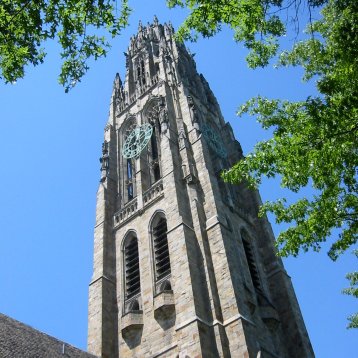
First, the Edwards summer course at Yale has now been announced. It will be entitled, “Jonathan Edwards and the Enlightenment: Free Will and Conversion.” The dates will be June 12-16; from 9:00 – 11:30am. The speakers will be Paul Helm, Ken Minkema, and Adrian Neele. Paul Helm is the special guest instructor; King’s College, London, Emeritus, a renowned expert on Reformed theology and Jonathan Edwards.

To get you excited about Paul Helm as the featured speaker, here is a list of his publications.

yale_harkness_tower

Per Ken Minkema, what follows is the course description:

Jonathan Edwards’ relationship with the Enlightenment of the eighteenth century is traditionally viewed as conflicted, condemning many of its aspects and viewing them as antithetical to Christianity. Yet, he embraced many Enlightenment figures and ideas. As part of the ongoing general reassessment of the Enlightenment that stresses the religious nature of the movement, this course, through primary readings by Edwards and contemporary writers and through interpretive literature, will look at Edwards’ thought on a key Enlightenment topic: the nature of the human self, particularly the nature of the will. We will look at how Edwards’ context, the specific challenges he faced, shaped the solutions at which he arrived. Along the way we will consider the debate over whether Edwards, in his formulation of the will, departed from or stayed within Reformed orthodox strictures.

Check out summerstudy.yale.edu for more info.
2. The JE Encyclopedia is Headed to Print! 

Secondly, per Ken Minkema, “The final draft of the Jonathan Edwards Encyclopedia was submitted to Eerdmans at the end of last year and is currently in production. Preliminary estimates say our newborn will weigh in at 700 pages.” This is excellent news, as well as a very healthy birth-girth! Our opinion is that this will instantly become a classic in the field of Jonathan Edwards studies, and will likely be THE must have work about Edwards for the year 2017. As soon as it becomes available, EdwardsStudies.com will get our hands on a copy to do a full video and written review.

For more information on the Edwards encyclopedia, see our archived interview with Ken Minkema last April. In that interview, Minkema described the JE Encyclopedia as the definitive “go-to source for quick information on a given idea, writing, person, place, or event in Edwards’s life, along with a few sources with which a reader can follow up to further explore.”

3. New V&R Books.

Reminding our readers that the JEC (Jonathan Edwards Study Center at Yale University) has a special deal with Vanderhoeck & Ruprecht in Germany to bring to press a series of new directions in Edwards’ studies. Here is a quick glance at what has already come to print. According to Minkema, the following describes what’s next on the printing press with the JEC/V&R partnership…

The next installment in the “New Directions in Jonathan Edwards Studies” from Vanderhoeck & Ruprecht is Charles Phillips’ Edwards Amasa Park: The Last Edwardsean. Charlie is the National Program Officer with the Maclellan Foundation of Chattanooga, Tenn. An excerpt from his description of the book reads: “Park drew creatively on the intellectual resources at hand to re-cast his inherited orthodox Calvinism in the new conditions of the nineteenth century. The New Rhetoric and common-sense epistemology from the Scottish Enlightenment, methodological principles from the German mediating theologians, the fresh affective sensibilities of his audience as dictated by the bracing stream of Romanticism from England —all were used by Park to create a broadly relevant orthodox synthesis in the innovative spirit of Jonathan Edwards and his theological successors.”

4. Northampton Church Records

Next, our readers might be interested to know that the Northampton Church Records have been scanned and are on line via the “New England’s Hidden Histories” project at the Congregational Library, Boston. Readers can go to congregationallibrary.org and follow the links. Minkema told me that this is the church’s first book, started by Eleazar Mather in 1654, and contains entries by Solomon Stoddard, Jonathan Edwards, and John Hooker.

5. Forthcoming Works

Finally, Ken Minkema along with Kyle Strobel, and Adriaan Neele are together working on an Edwards volume for the Classics of Western Spirituality series (published by Paulist Press). This series already contains other works by timeless writers such as Julian of Norwich,  Saint John of the Cross, John and Charles Wesley and many others. The series generally focuses on the great writers in the genres of prayer, piety, and mysticism. This new volume on Edwards will contain some classic texts illustrating Edwards’ piety as well as some “previously unpublished documents.” Can’t wait to see what those might be!

The History of the Work of Redemption: Synopsis

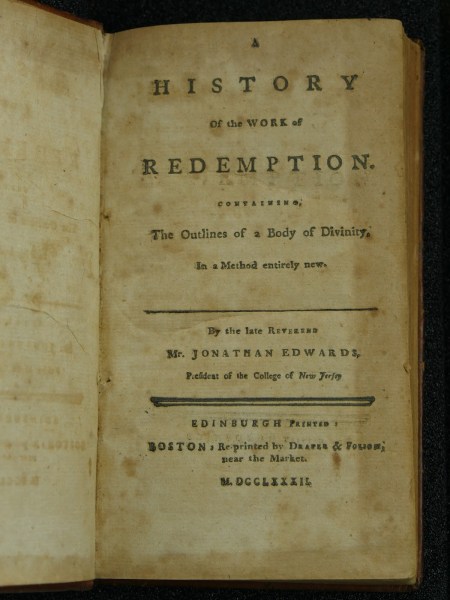
The History of the Work of Redemption (published posthumously in 1773; now Volume IX of the Yale Works), is Jonathan Edwards’ attempt to retell the entire story of human history from the divine perspective of God’s sovereign plan. It is a meta-narrative that intends to cast the unfolding drama of redemptive history as a coherent, divinely driven unity, expressly controlled and compelled by God’s glorious determination. As such, it is unabashedly a theocentric retelling of human history, and a direct counterattack to the prevailing, contemporary Enlightenment view that mankind is driving its own history, propelled by the twin oars of human virtue and innovation.

p1030309

Originally a sermon series preached in 1739, Edwards had great plans for his History. Before his untimely death, Edwards had planned to convert this sermon series, existing now only as a compilation of sermon manuscripts, into a comprehensive theology that would be classified in today’s rubric as “biblical theology.” His desire was so great to complete this work, that it almost prevented him from accepting the position of President of Princeton College (then, the College of New Jersey). Complimentary to other printed theologies available in his day that approached doctrine more systematically, such as Calvin’s Institutes, and Watson’s Body of Divinity, Edwards was hoping to create an authoritative, chronological work. Here, he would progress from creation through the fall, developing the themes of the major covenants, culminating in the coming of Messiah, and then driving victoriously towards the consummation of all things in the eternal age.

Jonathan Edwards Jr, his son, described the blueprint of the Puritan divine’s would-be magnum opus as follows:

“A body of divinity, in a new method, and in the form of a history; in which he was first to show, how the most remarkable events, in all ages from the fall to the present times, recorded in sacred and profane history, were adapted to promote the work of redemption; and then to trace, by the light of scripture prophecy, how the same work should be yet further carried on even to the end of the world.”

As a sermon series, Edwards preached some thirty messages on the text “For the moth will eat them up like a garment, and the worm will eat them like wool, but my righteousness will be forever, and my salvation to all generations” (Isaiah 51:8). His thesis which he carries on throughout the entire 1739 preaching series was “The work of redemption is a work that God carries on from the fall of man to the end of the world.” Typically, he describes this work as a “grand design,” always emphasizing that God is the driving and determining cause of all things. Interestingly, Edwards does not begin in earnest with creation (but might have if he had completed his full project) but rather starts the second sermon in earnest with the Fall, after a brief overview of his goals in the first message.

Edwards then divides biblical history into three primary epochs: [1] the Fall of man to the incarnation of Christ, [2] from Christ’s incarnation until his resurrection (His humiliation), [3] from thence to the end of the world.

Period One Edwards subdivides, primarily along the lines of the historical covenants; Noah, Abraham, Moses, and David. He includes the captivity in Babylon. “Types of Christ,” or ways that Christ is forefigured in the Old Testament are replete throughout. He labors to show the revealing and fulfilling of Biblical prophecy, especially as it portends to Christ as the Messiah. Towards the close of the first triad, Edwards includes a section on “improvement” (or application) as all Puritan sermons would. It is notable, however, that the application sections are lighter than most Edwardsean sermons.

In Period Two, Edwards primarily focuses on themes related to the atonement, or the “purchase” (his term) of redemption fulfilled in Jesus’ crucifixion and death. Edwards believed the life, death, and resurrection of Jesus Christ to be central to the Biblical drama of history. The Old Testament had anticipated His coming; the New Testament sought to apply His life, death, and resurrection to believers’ souls and lives. Without any doubt, Edwards viewed the Christ Event (as one of my professors winsomely used to call it) as the pin that holds all of history together as a cohesive unity. No event, no matter how small, fails to point in some way to the centrality of Christ and His cross.

In the third Triad, Period Three, Edwards not only fills out the other major portions of the New Testament drama, i.e. the Ascension of Christ and the work of the Apostles, but he also takes the work beyond the Apostolic Age, and into post-biblical history, incorporating other major events into one sweeping narrative. Thus, he appends the destruction of the Empire of Rome, the rise and corruption of the Roman Catholic Church, and exalts the work of the Protestant Reformers. He views these events as the continuing story of redemption, not at all separated from the events recounted authoritatively in Scripture. As a post-millennialist, Edwards anticipated great success in the Gospel mission of the church. As a revivalist, Edwards continually shows his fascination – even absorption – with those times in which true religion is greatly fanned into flame. Of course, Edwards believed himself to be living in such a time, and from our contemporay position of retrospective, we must agree.

Throughout, there are strong motifs of spiritual warfare. However this “warfare” is not the trite, egocentric prayers for daily victory over petty sins that many believers engage in today; but rather the large-scale, cosmic conflict between God’s gloriously advancing army versus Satan’s feeble, but indefatigable resistance. The inevitable smashing of the Devil’s terrorist troops – more like guerrilla warfare than a fairly contested battlefield conflict – is a foregone conclusion, but must be played out in real-time.

As Edwards concludes the sermon series – remember: the final work was never completed as he envisioned it to be – he closes with improvements on the authority of Scripture, and warnings against apostasy and false religion (read: Roman Catholicism and “Mahomatism,” the latter already being perceived as an existential threat to Christendom). He ends with a glorious section on the joys of Heaven for those who repent and believe in the beautiful work of redemption purchased through Christ’s blood.

We are left to wonder what might have happened had Edwards finished his work and lived longer into his presidency at Princeton. Students of Reformed theology in particular and evangelicalism in general might have well become the heirs to one of the most significant works yet written in the young American Colonies. However it was not to be. If Edwards would be consistent with the premise of his own extant drafts in sermonic form, he would be compelled to admit that it was not part of God’s “grand design” for the book to ever be completed as he hoped.

Interview with Daniel Gullotta and John T. Lowe; Editors of the Forthcoming “Edwards and the Dark Side of the Enlightenment”

EdwardsStudies is talking today with Daniel Gullotta and John T. Lowe, editors of the new collaborative project, Edwards and the Dark Side of the Enlightenment, which is now collecting chapter proposals for a future book with V&R. 

This is a pretty cool gig. How did you guys land this job as the editors for this project?

JTL: The credit goes to Daniel. While we had both tossed around the idea of putting a writing project together, it was him who proposed the idea to the directors at the Edwards Center at Yale, Ken Minkema and Harry Stout, for this to be part of the “New Directions in Jonathan Edwards” series. Daniel and I wrote a proposal together, gained the support from the series editors, and from Vandenhoeck & Ruprecht, and have hit the ground running since then.

1978581_10154808184010512_2172072111721151838_o

The title kind of sounds like a Star Wars thing. Is this a Jedi vs. Sith concept, and if so, were you inspired by the new movie Rogue One? 

JTL: Somewhat. Daniel and I are both Star Wars fans. While this volume is to focus on broad aspects of Edwards and the Enlightenment, we want it to touch areas where scholarship has either been previously assumed or unexplored entirely. Most of the time we only hear about one side of Edwards. Sometimes readers forget there were “dark” aspects of his life and context. For example, he was pro-slavery, he had to deal with ideas of witchcraft, and his world was full of violence.

15232216_10102259139603304_2830052018383301875_n

Alright, so remind us what the Enlightenment was, how long it lasted, and why it is significant to Jonathan Edwards. 

JTL: In short, and by broad definition, the Enlightenment took place during the seventeenth and eighteenth centuries. It was period where areas of science, medicine, philosophy, politics, and others underwent drastic changes. Some say it marked the beginning of modernity in the Western world. The Enlightenment needs to be understood with Edwards because it was part of his context. While Edwards was trained in a medieval tradition, his thought is the expression of both his Puritan heritage and Enlightenment influence. He is the synthesis of both the old and new worlds, and influential to the development of evangelical and American identity.

What is it like studying with Ken Minkema?

DG: Studying with Dr. Minkema (or Ken as he insists being called) has been a great experience. So far I have had the opportunity to study Jonathan Edwards, American Puritans, early modern witchcraft, and the Christian colonization of the Americans under him. He is a great teacher and a fantastic scholar. He is also very personable. When we aren’t talking about Edwards, the conversation usually turns to Bob Dylan. He and the Jonathan Edwards Center at Yale are both treasures. As a student, he is the type of scholar-teacher I want to emulate in my own career.

Where did you originally get the idea for this work, that is, to focus on Edwards and the Enlightenment?

DG: I got the idea for this volume from a seminar I took at Yale on the Enlightenment with Dr. Sophia Rosenfield. One of the challenges we kept facing and one of the questions were kept asking was: what is the legacy of the Enlightenment? Typically scholarship has viewed the Enlightenment as a part of the triumphal progress of humanism, reason, democracy, science, etc. But after engaging texts by Foucault (Discipline and Punish) and Sala-Molins (Dark Side of the Light), just to name two, this narrative was not so easily upheld. We have Enlightenment thinkers being complicit in the Atlantic slave trade, we have others thinking of new ways to control the populous, and others appealing to authoritarianism as the better means to govern. What got me thinking about Edwards and the “dark side” of the Enlightenment was his role in Indian missions and his ownership of slaves. It is clear that Edwards believes converting and ‘civilizing’ the Native Americans are one in the same. It was uncomfortable truths like this that got me thinking about the most uncomfortable elements of Edwards’s life, theology, and legacy. Sometimes, Edwards scholars are too romantic in their approach to Edwards and push things they don’t like to the side. We didn’t want to do that with this volume. Not that this book is an indictment of Edwards, rather, it will be designed to help scholars and students further contextual Edwards and situate Edwards within the Enlightenment. This includes the Enlightenment’s dark side.

John, tell us a little bit about your interest in JE. How did you get started? 

JTL: I was first exposed to Edwards during college—it was more of a hobby. It wasn’t until graduate school when I became a serious reader of Edwards. After reading Andrew Fuller (a later Edwardsean), I noticed he relied heavily on Edwards’ writings. Chris Chun’s The Legacy of Jonathan Edwards in the Theology of Andrew Fuller connected my two interests and I was hooked.

And Daniel, how did you originally get interested in studying JE?

DG: Being an Australian and a former Anglican, I had never heard of Jonathan Edwards. If I recall correctly, I first encountered Edwards in Joseph Campbell’s Hero with a Thousand Faces of all places. But when I began to study American religious history, I learned about Edwards and his role in the First Great Awakening. Coming to Yale, it was in Dr. Stout and Dr. Kinkema’s “Jonathan Edwards and the American Puritans” class that I really got bitten by the Edwards bug. I could not believe how much had been written on him! Over the summer break, I took a summer course on “Edwards and the Bible,” where I met John, and it was amazing to see how many people Edwards still brings together. Studying with Skip (Dr. Stout) and Ken (Dr. Minkema) makes it easy to see why people become Edwards junkies. He unavoidable in American religious history and once you start really engaging with his life and thought, he is hard to escape!

If we were interviewing Edwards today, do you think he would have described the Enlightenment as a positive development? 

JTL: I’m always hesitant to suggest Edwards would have done “this” or “that.” But I think he would have seen the Enlightenment as a positive movement. Although he would have undoubtedly seen something like Unitarianism as appalling, Edwards wouldn’t have viewed reason in of itself as something “bad.” Modern views of the Enlightenment see faith and reason pitted against one another, but for Edwards, everything existed in one realm and he probably would have seen the oncoming areas of knowledge as revelation and as aids to explain experience.

Same question Daniel, do you think Edwards would have thought of the Enlightenment as a good thing, or a great challenge to the Puritan/Colonial status quo?

DG: The Enlightenment was not a monolithic movement (if you can even call it a movement), but there were certain things about it Edwards championed. More knowledge about the world meant more knowledge about God and his providence, better education meant more people could read and understand the Bible, and more rationalism could further damage the ‘superstitious’ beliefs associated with popery. Yet there were things Edwards would have been horrified about, particularly how key Enlightenment thinkers began to embrace deism and atheism. Something like Thomas Jefferson’s Bible would have enraged him. And because the Enlightenment is often credited for being integral to the ‘age of revolutions,’ a question John and I love discussing is whether or not Edwards would have supported the American Revolution. Because the Enlightenment was not a single thing, we should not expect Edwards to have a single response.

What kinds of chapters are you hoping to receive for publication in this new book? Tell us about the range of suggested topics you released.

JTL: A few of the suggested topics are: political economy and the expansion of trade and/or capitalism; language, epistemology and the organization of knowledge; human rights, and thinking about war and peace; slavery and the question of racism; the place of women in the home and in the church; international relations; the social hierarchy; hysteria, superstition, and pseudo-science; poverty and the marginal of society; anthropocentrism and ecological dominance; Native Americans and colonialism; British imperialism; etc. Topics unnamed here are welcomed as well. These areas are not new to historians, or theologians, but we hope to this project brings new ideas once Edwards is in the mix.

How many contributors are you expecting in this collaboration, and what kind of backgrounds (education, experience) do you expect possible writers to bring to the table? 

JTL: We are expecting a dozen or so contributors with a wide range of backgrounds. We’re hoping to see more new names and fresh ideas brought to this effort. This isn’t geared to a specific audience, but to all readers of Jonathan Edwards. We’d like a variety of scholars to participate—fresh academics to seasoned researchers. To that end, graduate students as well as experienced Edwards scholars are encouraged to make submissions.

You are working on some stuff related to Edwards and witchcraft. Give us a teaser of what you are developing.

DG: The main element of my research is similar to that of Owen Davies and Paul Kléber Monod in which I argue that the Enlightenment and the dawning of the eighteenth century did not end belief in witches and witchcraft. For a long time, scholarship has been dominated by the model championed by Keith Thomas’s Magic and the Decline of Religion, in which it was believed magical thinking and witchcraft belief died out because of modern rationalism. But there is plenty of evidence to challenge this. People (mostly women) throughout the American colonies in the eighteenth century were still being accused of witchcraft and sometimes, they were even still executed. Yale College own both Glanvill’s Saducismus triumphatus and Hutchinson’s A Historical Essay concerning Witchcraft. To be sure, belief in witchcraft and understandings in how witches operated had changed, but they had not vanished. Edwards was, I argue, a part of this changing landscape and is a good model to see how some of these changing beliefs took place. While Edwards was not a philosopher on witchcraft or a witch hunter in any sense, he did believe in witches and witchcraft, as evidenced by his writings.

Any shout-outs or book recommendations for our readers? 

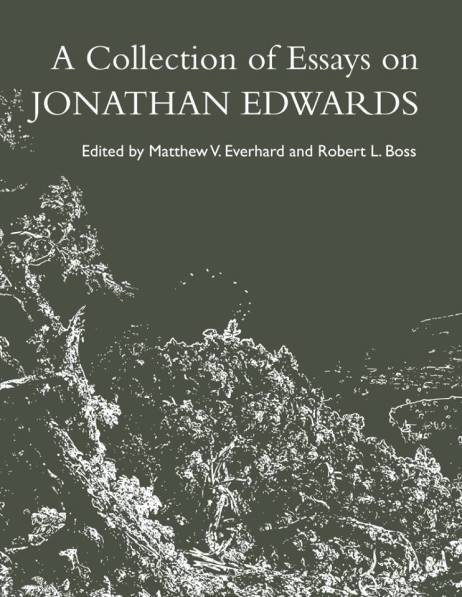
JTL: Book recommendations?! I might have too many. But if I had to narrow it down, I’m really looking forward to reading A Collection of Essays on Jonathan Edwards. I had a few friends contribute to that project and excited to dig in. Thomas Kidd’s American Colonial History: Clashing Cultures and Faiths. While this isn’t a book on Edwards—but has a chapter of his dealings with the Great Awakening—it’s about Edwards’ world. The world in which he lived and thought. Also, Douglas Winiarski’s book coming out this year Darkness Falls on the Land of the Light: Experiencing Religious Awakenings in Eighteenth-Century New England. I got to see the proofs last week. It looks fantastic.

Thanks so much for chiming in! Will you keep us updated on the project? 

JTL: Absolutely. Daniel and I will be sure to give updates as it moves along. Thanks for having me.

New Project Announced: Edwards and the Dark Side of the Enlightenment

EdwardsStudies.com is happy to report that there is a new call for papers for an exciting collaborative research and writing project coming up this year. This announcement was made just the other day on the edwards.yale.edu site, and we are pleased to reissue the call here.

The title of the new work is tentatively slated as Edwards and the Dark Side of the Enlightenment, and the volume is scheduled to be edited by Daniel N. Gullotta and John T. Lowe. The plan is to publish this work in the “New Directions in Jonathan Edwards Studies” series, in cooperation with the Edwards Center at Yale University, a development which we reported first here back in April of 2016 in our interview with Ken Minkema.

As mentioned in that conversation with Minkema, the New Directions series will be brought forward by German publisher Vandenhoeck & Ruprecht (V&R)  in cooperation with the Jonathan Edwards Center at Yale University. Another excellent volume in this series that has been already released was also covered here at EdwardsStudies.com when we discussed Michal Choinski’s excellent work, The Rhetoric of the Revival including an author interview related to the same title.

how-to-write-my-essay-2

As for the new work regarding Edwards and the Enlightenment, what follows is the description of the proposed volume provided by the editors, along with some suggested foci for possible chapter contributions:

The editors of the proposed volume, Jonathan Edwards and the Dark Side of the Enlightenment, are seeking chapter contributions of 5000-7000 words. Chapters should focus on Jonathan Edwards’ in relation to some subject of the eighteenth-century Enlightenment. Suggested topics include: political economy and the expansion of trade and/or capitalism; language, epistemology and the organization of knowledge; human rights, and thinking about war and peace; slavery and the question of racism; the place of women in the home and in the church; international relations; the social hierarchy; hysteria, superstition, and pseudo-science; poverty and the marginal of society; anthropocentrism and ecological dominance; Native Americans and colonialism; British imperialism; etc. Other related but not listed topics would be welcomed as well. The chapters shall be arranged into thematic sections. Contributors must use The Chicago Manual of Style and conform to the norms of the Jonathan Edwards Center (see the Jonathan Edwards Studies Journal).

Edwardsstudies.com plans to have a full interview with John T. Lowe in the coming days. At that time, we hope to detail this project in fuller measure for the benefit of our readers and possible contributors.

Deadlines: For qualified contributors, the timeline for participating in this project is as follows:

  • Deadline for Abstracts: Apr. 30th, 2017. (300 Words and CV sent to daniel.gullotta@gmail.com and lowejohnthomas@gmail.com.
  • Answer to Authors: May 31th, 2017.
  • Full Chapters to Submitted: Dec. 31st, 2017.

For More Exciting Edwards Information: 

Sarah Boss: Second Generation Jonathan Edwards Scholar

Today, EdwardsStudies.com chats with Sarah Boss, a second generation Edwards Scholar whose essay “Edwards and Thoreau: Typologies of Lakes” appears in the new JESociety publication A Collection of Essays on Jonathan Edwards (2016).

Sarah, thank you so much for joining us today. Tell us a little bit about yourself.

Thanks for having me! I’m always happy to talk with other Edwards enthusiasts. In a nutshell, I’m a native Texan, a recent graduate of Wheaton College, where I studied English and history, and a current teacher in Fort Worth.

You teach ancient history at Covenant Classical School. What are some of your main foci in your curriculum and how is that going?sarah-boss

It’s going well, thanks! I attended Covenant myself, and it played a vital role in my development both spiritually and intellectually, so it has been a joy to be a part of giving what I received there. This year I’ve had the opportunity to teach a very bright, inquisitive class of seventh graders about Pre- and Early Dynasty Egypt and Sumer. A couple threads we’ve been following through these periods are rulers’ claims to divinity as a means of expressing or expanding their authority and how these claims and other technological or cultural developments enable empires to be born. (We also talk a lot about pyramids, of course!) A key emphasis of classical Christian education is training young minds to think critically and express themselves clearly, so our discussions are informed by the lens of biblical truth, beauty, and wisdom, especially as we think through age-old questions of humanity, divinity, and how they play out in society. So far I haven’t made any tangential references to Edwards in class, but the year isn’t over yet…

So, how did you become interested in a dead, wig-wearing Puritan (referring to Edwards of course!)?

Full credit goes to my dad, who introduced me to Edwards at a young age; this dead, wig-wearing Puritan was a household name for me growing up. I first read Edwards for myself as a ninth grader, beginning with “A Divine and Supernatural Light,” then dove in to his typological writings. I’ve read more broadly since then, but I still haven’t lost the fascination that I felt for Edwards’s “Images” as a fourteen year old. A year after discovering my interest in Edwards, I accompanied my dad to the Jonathan Edwards Society conference in Northampton, MA, where I got my first taste of the Edwards community in action. The summer before my senior year of high school I wrote a paper on Edwards that I was able to present at that year’s conference. I continued research afterwards and rewrote it as my high school senior thesis. The paper dealt with the connections between Edwards’s typological writings and the myth genre and sought to find an outlet for Edwards’s epic worldview in our contemporary society. I was out of my depth with such a colossal undertaking, and, as often happens, the more I read the less I felt I knew. But that first paper brought up questions I’m still wrestling with now and gave me a sense of how intricate and relevant Edwards’s thought remains today.

Tell us a little bit about your essay in the recent publication by JESociety and how it developed. It’s had a wider audience already, hasn’t it?

I originally wrote the essay for my college’s independent literary journal, The Wheaton Pub. The issue’s theme was “encounter,” and I knew I wanted to write about Edwards and his encounters with nature, but wasn’t sure what specifically. While reading Walden Pond for an American literature class, I was struck by how similar a certain passage was to an entry in Edwards’s “Images.” I decided to wrestle with these two passages in my essay, and teased out subtle differences that reveal opposing frameworks of thought. After being in The Pub, the essay appeared a few places online – including here on Edwards Studies – and I also had the opportunity to present a version of it at the Midwestern Conference on Literature, Language, and Media at Northern Illinois University this past spring. Now I am happy to have it included in JESociety’s latest publication.

You have the unique opportunity to work alongside your father in this publication. What’s that like?

My parents have always encouraged my interest in Edwards, and it has been special to present papers alongside my dad and now to be published with him. I feel very blessed to be part of a family that values education so much and to have a father who is intellectually creative and encourages me to be the same. With this publication in particular, as we wrote essays on related topics, I can see how much I have gained from his research and example and how that has influenced me as a thinker and writer. (Also, it’s pretty nice to have access to his library.)

What are your other research interests?

Most simply, I’m interested in nature. Nature as a universal symbol – how it manifests in literature, religion, and art and often serves as a muse or conduit for dialogues on life’s big questions. But also nature as a concrete, basic element of human life. Over the past couple years I’ve become more interested in the sciences, ecocriticism, and exploring how Christians do and should encounter nature and mediate a spiritual and scientific understanding of their environment. These questions have fed my interest in typology but also expanded it to engage issues of how to practically live out a biblical understanding of nature.

Any shout-outs or book recommendations for our readers?

A couple books that gave me a solid foundation when I first started researching Edwards are George Marsden’s Jonathan Edwards: A Life and Michael McClymond and Gerald McDermott’s The Theology of Jonathan Edwards (which I loved in part for the really cool cover art). A couple that helped contextualize my thoughts when writing my essay on Edwards and Thoreau are Mason Lowance’s The Language of Canaan: Metaphor and Symbol in New England from the Puritans to the Transcendentalists and Perry Miller’s classic Errand into the Wilderness. A couple books on typology I am currently reading (or am excited to read over Christmas break) are Jennifer Leader’s Knowing, Seeing, Being: Jonathan Edwards, Emily Dickinson, Marianne Moore, and the American Typological Tradition and Tibor Fabiny’s Figura and Fulfillment: Typology in the Bible, Art and Literature. Lastly, for an in-depth study of Edwards’s typology and the tradition he drew from, I recommend Rob Boss’s God-Haunted World: The Elemental Theology of Jonathan Edwards.

This is What Happens When Ten Edwards Geeks Get Together and Collaborate: Introducing “A Collection of Essays”

EdwardsStudies.com and the JESociety have recently joined forces and put together a group of ten young, fresh Jonathan Edwards Scholars with an agreement to work together on one project. Each writer was asked to contribute an original piece on the Northhampton Puritan. The result is the new book, A Collection of Essays. Contributors include pastors, theologians, students, and scholars.

Here’s the video introduction:

Author Interview: J.T. Holderman

In celebration of our new publication,  “A Collection of Essays on Jonathan Edwards” (JESociety Press, 2017) EdwardsStudies.com will be doing some short profile interviews with our article contributors.  Today, we chat with J.T. Holderman. 

Tell us a little bit about what you are doing right now? (career, ministry etc.)

Since you asked, life is all manner of exciting these days. For starters my wife Kim and I just welcomed our second baby girl to the family, Corinne Hope. I forgot how much I love sleep. This past July my Senior Pastor retired and I have been called into that position and am striving daily to be faithful in loving the people of Bellevue Presbyterian Church here in Gap, PA. The transition from Associate Pastor to Senior Pastor has been eye-opening and I’m realizing daily the weight of the calling to the pastorate. Life is all manner of exciting.

edwards-essaysHow did you get interested in JE?

I first became interested in Jonathan Edwards while studying at Princeton Theological Seminary. It was there that I picked up a book by John Piper titled God’s Passion for His Glory. Within this 250 page book is a biographical narrative of Edwards and a copy of his The End For Which God Created the World. As I read Piper’s detailed account of Edward’s and his indebtedness to the man, I found similar chords of interest in my own heart towards Edwards. After reading Edward’s The End For Which God Created the World I found myself shocked and stunned at first the intellect and brilliance of Edwards to pinpoint the reason for God’s creation, that He might be glorified, and second at the weight of the man’s logic to turn the human heart toward the Lord.

As I read the biography Piper supplied, I realized quickly that Edwards ended his earthly life in the same town in which I was studying, Princeton, NJ. More than that he was buried in a nearby cemetery. One afternoon, with coffee in hand from the local Small World Coffee, I made a pilgrimage to the grave, where there I worshiped the Lord in thankfulness for the man Jonathan Edwards.

What are some of your favorite works of JE?

Perhaps my favorite work of Edwards are his sermons. At least through the written medium his soul thirsty work for preaching the glory of God is a balm to me in every season of life. I would recommend as a starting place The Sermons of Jonathan Edwards: A Reader edited by Wilson H. Kimnach and co. Second to his sermons, I would be remiss if I did not highlight The Religious Affections, a marvel of human intellect and logic.

Give us a tidbit from your essay! What is your article about?

In my chapter in the collection of essays, I highlight in brief a biography of Edwards and certain implications we should glean from his life. Here’s an excerpt:

To many, the Christian faith looks like a joyless prison. It is a religion of prohibition: you can’t get drunk, you can’t sleep around, you can’t lie on your taxes. Many in the world see Christianity as a set of rules that restrict the individual and take all “fun” out of life. Edwards, however, would encourage us that it’s exactly the opposite for the Christian. He roots the fundamental core of Christianity in relation to an individual’s happiness, freedom, and joy, not in a prison of constraint and obedience. Christianity does not kill delight; it, instead, magnifies it and puts it in its proper place. Edwards says it this way:

“God is glorified not only by His glory’s being seen, but by its being rejoiced in. When those that see it delight in it, God is more glorified than if they only see it.”[1]

[1] Quoted in John Piper, God’s Passion for His Glory (Wheaton, Ill: Crossway, 1998), 79.

Author Interview: Obbie Tyler Todd

In celebration of our new publication,  “A Collection of Essays on Jonathan Edwards” (JESociety Press, 2017) EdwardsStudies.com will be doing some short profile interviews with our article contributors.  Today, we chat with Obbie Tyler Todd. 

Greetings Obbie, tell us about yourself! 

I serve as Associate Pastor of Students at Zoar Baptist Church in Baton Rouge, Louisiana. Previously I pastored a small rural church outside of Bardstown, Kentucky for over a year. As I was finishing up my Th.M. at Southern Seminary, Kelly and I felt the Lord calling us to Cajun country. Not long ago I also began my PhD work at New Orleans Baptist Theological Seminary. Currently I’m studying 18th century South Carolina Baptist Richard Furman and his influences (e.g. Jonathan Edwards). Tom Nettles at Southern greatly aided me in exploring the Edwardsean influence on Furman and other 18thedwards-essays-19th century Baptists. I had Dr. Nettles for both Th.M. and PhD-level courses in Edwards studies, and I owe much of my initial research of Edwards to him. It was after one of these courses that I was inspired to compose my blog “The Edwardsian” (https://edwardsianblog.wordpress.com). Just about every month I’m writing on Edwards, and I don’t see that habit ceasing any time soon.

How did you become interested in Edwards? 

I suppose my first step into the world of Jonathan Edwards was reading Iain Murray’s Banner of Truth biography the Summer between my M.Div. and Th.M. at Southern Seminary. It was a bit hagiographic, but its devotional and pastoral elements grabbed me instantly. From there I started reading primary sources and then Marsden and so on. Dr. Tom Nettles was of course very influential in my introduction to Edwards. For my Th.M. paper I wrote on Edwards’ psychology of conversion and it’s during this time that I discovered the Religious Affections. Dr. Michael Harkin was also influential for me. His Andrew Fuller course also spawned the essay that I submitted for this book. As years have gone by, my Edwards collection has grown exponentially and I find myself going back to him time after time. He’s an ocean.
Do you have any Edwards-related book recommendations? 
I have a few. My favorite treatise by Edwards is The Religious Affections. I believe many people mistake this book for an exclusively devotional work, but it’s so much more than that. “True religion,” as Edwards calls it, encompasses anthropology, theology, psychology, soteriology, etc. It’s the telos of Edwards’ entire ministry, and we see this theme manifest itself in his covenantalism, his ecclesiology, his sacramentalism, his revivalism, and his view of conversion itself. For me, The End for Which God Created the World is absolute brilliance. It’s like reading Piper before Piper, and I honestly don’t think John Piper would mind me saying that. When you read this in tandem with The Nature of True Virtue, it’s amazing to witness the dynamics between metaphysics, aesthetics, and ethics. Perhaps my favorite two sermons are God Glorified in Man’s Dependence, both for its ultimacy and for what it meant in the timeline of Edwards’ own ministerial career – his “coming out” party so to speak. The other is The Excellency of Christ. I’m not aware of a more Christocentric sermon that exists today. The paradoxes and the beauty of Christ that Edwards so masterfully brings out…it’s homiletic brilliance and one I seek to mimic when appealing to the Person of Christ from the pulpit.
Tell us a little bit about your essay in A Collection…
My Essay features the theological link between Jonathan Edwards and Andrew Fuller, specifically between David Brainerd and Samuel Pearce as presented by the two theologians. This work was spawned from research I did under Michael Haykin at Southern as I was finishing up my Th.M. He really encouraged me to look to Fuller’s missiology and the Edwardsean influence therein. Today, I believe many people think of Edwards strictly as a theologian or even as a philosopher. However, his revivalism and conversionism were equally acute. Fuller’s missiology was, in many ways, the fresh embodiment of Edwards’ revivalism and piety. What Brainerd did for Edwards in serving as a true exemplar of Christian practice, Pearce was for Fuller. I labor to show that and how Fuller intentionally adopted Edwards’ approach to biography. So many studies are being done right now involving Edwards’ influence upon 18th and 19th century Baptists, especially Fuller. I think it’s important to remember Edwards’ missiological legacy as well.