The following article is used with permission by the author from his own website, tobyeasley.org. Dr. Toby Easley (D.Min., Southwestern Baptist Theological Seminary), is a theologian, author, and independent speaker who has twenty-nine years of public speaking and instructional experience.
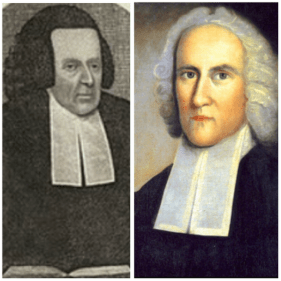
John Erskine was Scottish born seven years after the Colonial American Jonathan Edwards but their life spans would end up differing by more than twenty-seven and half years. However, the years of their lives that juxtapose from 1721 to 1758, eventually kindled a true kindred spirit through Edwards’s writings on the American spiritual awakening and Erskine’s generosity to send European books.
Erskine was born into a family that had financial means and many expected him to follow his father in a life’s vocation of jurisprudence. Nevertheless, he sensed the calling of God upon his life to enter the ministry and focus on the eternal realm. According to Jonathan Yeager, Erskine’s preaching differed from Edwards by simplifying “his sermons in the manner that the leading rhetorician George Campbell taught: to use only a few subordinate points to support one main argument…As opposed to many former Calvinist divines, Erskine did not ramble on in his discourses, using intricate and hard-to-follow metaphysical assumptions.”
As the 1740’s passed and the early 1750’s brought many trials into Edwards’s life, Erskine served as a means of encouragement through the letters they exchanged. Edwards shared many of the details of his ejection from his Northampton pulpit and his concerns for the future of his entire family. All throughout these difficult years, Erskine remained a faithful friend, correspondent, and crucial supplier of books that would have otherwise been unavailable to Edwards. Yeager also accurately claimed, “Since the number of bookshops in America paled by comparison to Britain, Edwards benefited from a patron who resided near a publishing epicenter like Edinburgh.”
Although Erskine and Edwards realized many of the intellectual ideas coming out of Europe were contrary to theirs, both men desired to read the conflicting doctrines. Erskine certainly had the intellectual capacity to think and speak against doctrinal error but Edwards could also wield the pen as an apologist and polemicist! Edwards was not only concerned about the doctrinal tremors at Harvard and Yale, he was becoming more aware of the doctrinal shift throughout Europe. After pastoring for almost two and a half decades in Northampton, he had reason for concern regarding the younger generation and the doctrinal movement within the Congregational Churches. On July 5, 1750, Edwards wrote a letter to Erskine and in sadness expressed, “I desire your fervent prayers for me and those who have heretofore been my people. I know not what will become of them. There seems to be the utmost danger that the younger generations will be carried away with Arminianism, as with a flood.” Bit-by-Bit, his prophetic words came true regarding the abandonment of Reformation Theology, and acceleration toward an Arminian majority in the two centuries following his death.
Erskine on the other side of the Atlantic lived into the early nineteenth-century and continued to impact theological discussions. During his ministry as a younger man he had stood against the Arminian principles of Wesley, and warned the Scottish people against his Methodist soteriology. Erskine’s influence within Scotland during the Eighteenth-century helped preserve the Calvinistic soteriology among Presbyterians and stifled the growth of Wesley’s Methodist groups inside Scotland. Although Erskine and Edwards lived on separate continents and ministered across the Atlantic Ocean from one another, they both had the foresight to discern the doctrinal changes of the Enlightenment and its far-reaching effects.
This article originally appeared at the official website of Credo Magazine on April 12, 2016. It is reprinted here at EdwardsStudies.com with permission.
The full article can be found in the new print edition of Credo Magazine entitled, “Preach the Word: Preachers Who Changed the World.” David Barshinger (Ph.D., Trinity Evangelical Divinity School) is an editor in the book division at Crossway, and has taught as an adjunct professor at Trinity International University and Trinity Christian College. He is the author ofJonathan Edwards and the Psalms: A Redemptive-Historical Vision of Scripture.
***
Dangling like a spider over tongues of fire. Standing before floodgates holding back furious waters. Targeted with an arrow waiting to be drunk with your blood. These images of the sinner’s condition have both captivated and horrified listeners and readers ever since Jonathan Edwards (1703–1758) preached his sermon “Sinners in the Hands of an Angry God” in the hot summer of 1741. Those who heard him give this sermon in Enfield, Connecticut, on July 8 of that year became so terrified that they screamed out in the middle of it, “Oh, I am going to Hell,” and “What shall I do to be Sav[e]d?” Their shrieking forced Edwards to stop preaching so he and the other pastors present could minister to the congregation.
While perhaps the most dramatic response to one of his sermons that Edwards ever encountered, this event was just one in a long preaching ministry stretching from 1720 to 1758. Edwards would eventually be remembered more for his contributions to theology, yet his preaching played an important role in promoting revival in his congregation and throughout New England.
Aiming at hearts
The common depiction of Edwards is that of a stilted, rigid, wig-wearing figure reading his sermons in a monotone voice that lulled his listeners to sleep. Edwards was certainly no George Whitefield (1714–1770)—Edwards’s younger contemporary and the far better known preacher of the day—but the evidence suggests a more complicated picture than this caricature portrays.
During his first years in Northampton, Massachusetts, Edwards served as an assistant to his grandfather, Solomon Stoddard (1643–1729), a well-respected pastor who called preachers to deliver their sermons without notes. For years Edwards felt slightly embarrassed that he could not manage to preach without writing his sermons out in full. Over time, though, Edwards loosened up, inspired in large part by a local visit from none other than Whitefield. After seeing Whitefield’s effect on his congregation—and feeling it himself (Edwards was brought to tears at his preaching)—Edwards worked harder at preaching extemporaneously, to the point that by the end of his career, he was often speaking from bare outlines.
Ultimately, Edwards preached to the hearts of his listeners, and he understood that how he delivered his sermon played a role in reaching them. As he explained in Religious Affections, Edwards believed that one of the main reasons God ordained the preaching of his Word was “the impressing divine things on the hearts and affections of men.” And he defended “an appearance of affection and earnestness in the manner of delivery” so long as it was “agreeable to the nature of the subject” and affected the listeners “with nothing but truth.” Edwards thus devoted himself to the earnest preaching of truth that penetrated the heart. …
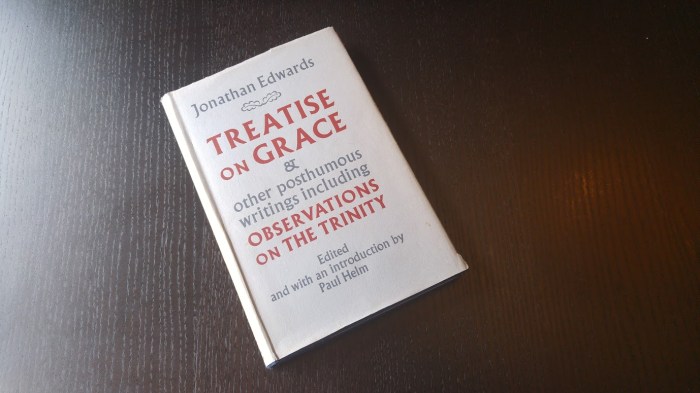
Observations on the Trinity is not to be confused with Jonathan Edwards’s other short piece on the godhead, entitled An Essay on the Trinity, although readers are likely to confuse them easily for two good reasons.
For one, they are both housed under the same roof – both short works come in the 1971 edition of Treatise on Grace & Other Posthumous Writings, edited by Paul Helm. For two, both essays are about the same size in length (the former is only 17 pages, the latter a little more at about 30). For this reason, when people mention “that little essay Edwards wrote about the Trinity,” even some of the most advanced Edwards scholars need to take a step back and say to themselves “Wait, which one is that again?”
I’ve already written on An Essay on the Trinity here. So I won’t recover that ground again, other than to simply say that this slightly longer work focuses on the persons of the Trinity in relation to one another. Edwards uses the so-called psychological model to describe how the persons can be one, and yet distinct. Edwards says that the Father is “God in the prime,” the Son is God’s perfect knowledge of Himself, and the Holy Spirit is God’s joy between the Father and Son. Each person is fully divine and yet retains distinct person-hood in relationship to the other.
In Observations, Edwards is more concerned with the economical (note: he spells it “oeconomical”) relationship between the Three Persons. Thus, it is fair to summarize both by saying that An Essay is about the doctrine of the ontological Trinity (God’s nature in being) and Observations is about the doctrine of the economical Trinity (the relationship between the Three Persons in terms of role and service to one another).
Observations begins with a fairly straightforward statement:
“There is a subordination of the persons of the Trinity, in their actions with respect to the creature; that one acts from another, and under another, and with a dependence on another in their actings, and particularly in what they act in the affairs of man’s redemption.” (p. 77).
This key statement sets the stage for all that follows. Like most Reformed theologians, Edwards will then argue for most of the rest of the essay that the Son is subject to the Father’s authority with respect to His role as the Redeemer of humanity. In a complementarian way, the Son is no less glorious or divine than the Father, but is subject to the Father with respect to His service as the God-Man by going on the mission to save humanity at His incarnation. Here, we must distinguish between the Three Persons’ worth (all are equal in divine splendor) and role (one submits to the other).
He says, “It is very manifest that the persons of the Trinity are not inferior one to another in glory and excellence of nature.” (p. 77). True enough. But this shared glory will be manifested in service one to the other in the saving of mankind. The Father appoints the Son (p. 81); the Son confers His Spirit upon the Church (p. 90).
With respect to the Father and Son, Edwards avers that they were already in an economical relationship of subordination before the Covenant of Redemption was made. He thinks this is quite important. Not only that, but the Holy Spirit too was economically subordinate to Father and Son before – and apart from – the Covenant of Redemption. Thus, Edwards seems reticent to consign subordination between persons merely to redemptive history. Rather, this is something “natural” to their eternal relationship with one another, and would have been so even without a plan to redeem the world.
To be clear, let’s define the term “Covenant of Redemption.” In some forms of covenant theology, God is understood to have undertaken a covenant – before the creation of the world and within the persons of the Trinity – to redeem humanity. This covenant is seen to undergird the Covenant of Grace (or: the New Covenant) mentioned in the Scriptures. In this way, Reformed thinkers (including Edwards) speak of the Father and Son making a covenant together to agree to redeem the elect. The Father sends the Son and assigns to Him the great task of being the God-Man and the atoning sacrifice; the Son willingly accepts the task and consents to it freely.
He says, “It is evident by the Scripture” (here we should presume he means John 17, although he does not say so explicitly), “that there is an eternal covenant between some of the persons of the Trinity, about the particular affairs of men’s redemption” (p. 80).
Edwards sees this as an agreement, however, only between two persons, the Father and the Son. Curiously, he does not believe that the Holy Spirit was a party of the covenant (p. 92) although Edwards believes the Holy Spirit “agrees” with, it and is “concerned” with it as it relates to the glory of the Holy Trinity (p. 93).
Edwards stresses that this economical subordination existed prior to the making of the covenant, as he is zealous to preserve this fact: only the subordination of the Son of God as it pertains to His humiliation is meritorious for purchasing human redemption. Thus, Christ’s subordination to the Father does not merit our salvation in regard to the pre-covenant, natural subordination of Son to Father. If this were so, Edwards argues, then the Spirit’s subordination to Father and Son would likewise be meritorious as well, which is clearly not the case. Thus the subordination that does merit our salvation is only that which is subsequent to the Covenant of Redemption; i.e. that humiliation in the incarnation that Christ willingly and freely undertook in the covenant.
So why does all this concern Edwards? Probably three reasons stand out as to why Edwards wrote Observations on the Trinity. First, Edwards is determined to understand the interrelationships between the Three Persons of the Trinity. He is not content to merely accept mystery for mystery’s sake. Edwards tends to attempt to push the envelope of human understanding as far as he can take it. We should respect him the more for this.
Second, Edwards is also concerned to defend both the equality of the Father, Son, and Spirit in terms of worth and honor, as well as to explain how it is possible for one to serve the other in humility. Scripture, he is convinced, teaches both. Again we should agree with this notion, even if we disagree with him on some of his particulars. Why the Holy Spirit cannot be a party of the covenant is not entirely clear to this writer. Nevertheless, we are right to emulate Edwards in preserving the shared divine worth of the Three Persons while seeing biblical subordination between them.
Thirdly, and perhaps most importantly, Edwards is always anxious to defend the great glories of the godhead in the marvelous actions of redemption to save the elect. In many ways, this is part and parcel of his entire theological project. Jonathan Edwards is transfixed on understanding, savoring,and glorying in God’s great works of redemption -even those that took place long before God created the world.
— Rev. Matthew Everhard is the general editor of Edwardsstudies.com and the pastor of Faith Evangelical Presbyterian Church in Brooksville, Florida.
In this short video, Owen Strachan talks about the series of five short introductions to the life and influence of Jonathan Edwards that he and his adviser Douglas Sweeney wrote together in 2010. These introductory booklets (about 160 pages each, compact layout) can be purchased together or separately.
At EdwardsStudies.com, we are constantly pressing the envelope for Jonathan Edwards geekiness. Not only do we review scholarly books by and about the eighteenth century puritan, but we also engage in a level of nerdy conversation rivaled only by Star Trek fans and Comic Con attendees.
In this short video, I debut my own hand-bound edition of my dissertation which I have written and intend to defend at Reformed Theological Seminary on Friday, April 15th. The dissertation is entitled “A Theology of Joy: Jonathan Edwards and Eternal Happiness in the Holy Trinity.” In this work, I have attempted to survey Edwards’s understanding of happiness, especially that holy happiness that centers on the glory of God as revealed in the Gospel.
In the dissertation, I survey some of Edwards’s most well known works (Religious Affection, The End for which God Created the World, the Resolutions) as well as some of his lesser known works (Essay on the Trinity, True and False Christians etc.)
In making this hand-bound edition of my dissertation, I attempted to create something that might have looked like a book that Edwards could have pulled off his own shelf. It is bound in cowhide leather with a suede liner, and all of the signatures (sewn groups of 32 pages) are hand-stitched by yours truly. Edwards would be proud – especially since he sewed many of the notebooks he used in his Miscellanies and other personal books.
Dr. Rob Boss has been treating readers of EdwardsStudies.com and the rest of the internet to some of the most visually stunning info-graphic-style videos on Jonathan Edwards’s typology. Having done much of his work on Edwards’s views of typology by studying Images of Divine Things, Boss attempts to help Edwards scholars make the connections between what the Northampton Puritan saw in the natural world with what he believed to be reality in the spiritual world.
Each of the videos is short: just 30 seconds long or so, and follows the route that Edwards takes mentally in connecting natural types with their spiritual fulfillment:
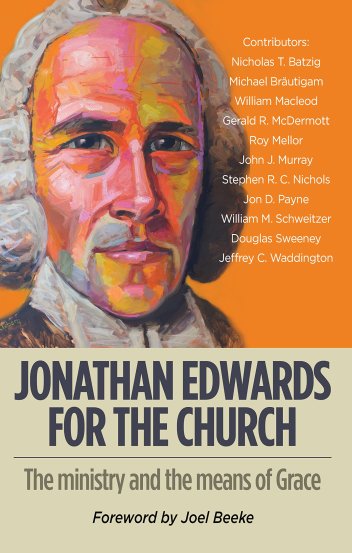
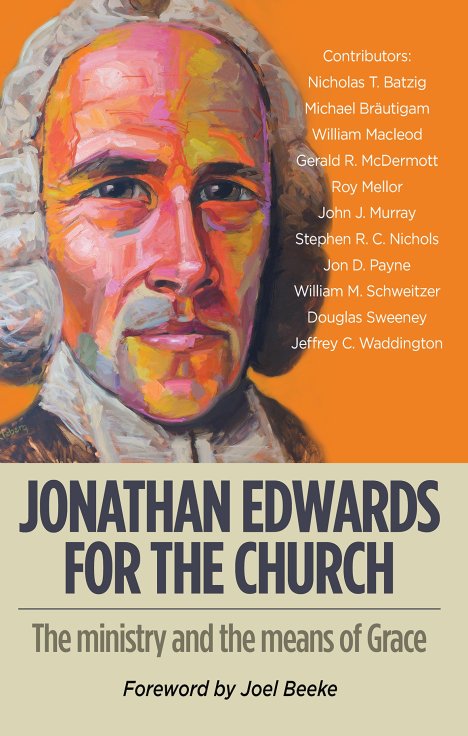
Conference speakers will be focusing on the theme: “Jonathan Edwards, For the Church: The Ministry and Means of Grace” corresponding the the 2015 book of the same title with chapters contributed by the conference speakers. [But the book here].
Jonathan Edwards For the Church is a conference to encourage the church in the UK. In a day of confusion, we pray it would be in the hands of Almighty God an instrument for reformation and revival. The topic for 2016 is one that delighted and animated Jonathan Edwards throughout his fruitful life: the Glory of God. Come join us; the speakers will have ministers or men training for ministry particularly in mind as they prepare, but all of God’s people are welcome.
A notable feature of the recovery of the Reformed faith in the United Kingdom was God’s use of American theologian Jonathan Edwards in the ministries and lives of the leaders. Thomas Chalmers, Charles Spurgeon, A. W. Pink, John Murray, and D. Martyn Lloyd-Jones all considered the discovery of Edwards’ writings as turning points in their ministries. Indeed, it is at least possible that the qualitative influence of Edwards has been greater here than it has been among the American church. Jonathan Edwards for the Church seeks to promote such usefulness in a new generation.
Permission to re-blog this post, which originally appeared here, was kindly granted by the author, Obbie Tyler Todd. Rev. Todd (M.Div & Th.M from SBTS) is Associate Pastor of Students at Zoar Baptist Church in Baton Rouge, Louisiana.
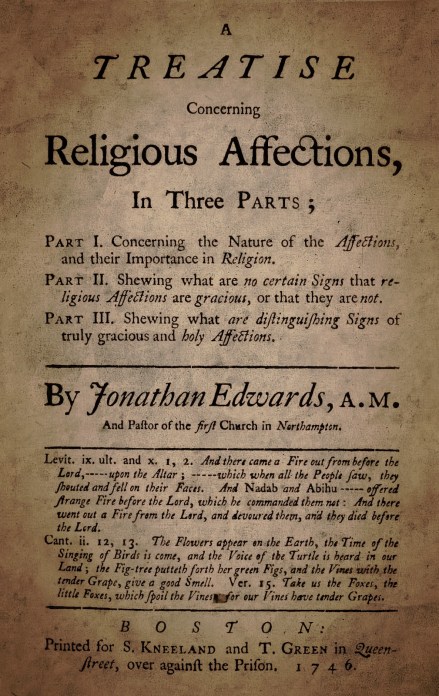
Yale Philosopher John E. Smith once suggested that the sum of Jonathan Edwards’ thought could be considered “one magnificent answer” to the question “What is true religion?”. Without question, Edwards’ most comprehensive attempt to formulate that answer is found in The Religious Affections. These so-called “affections” serve as the “springs of motion” that propel all of human activity: “In everything we do, wherein we act voluntarily, there is an exercise of the will and inclination; it is our inclination that governs us in our actions.” (25) Godly affections are those found specifically inside the church. These religious affections are the “fervent exercises of the heart” the Lord bestows upon His church for the promotion of “true religion.” Still, due to its timeless instruction on human nature and the heart of true worship, Religious Affections continues to transcend age and creed in its ability to speak to the Christian life. The following are three truths that Edwards’ magisterial work delivers to the modern church for meditation and practice.
Obbie Tyler Todd, Associate Pastor of Students, Zoar Baptist Church, Baton Rouge, LA
1. KNOWLEDGE OF GOD’S WORD AND TRUST IN ITS AUTHORITY
In his book Jonathan Edwards and the Church (2013), Rhys Bezzant eliminates the notion that Edwards’ ecclesiology was peripheral to his soteriology: “The church is not an afterthought in the otherwise individualist plans of God, but is the focused domain where God’s promises, presence, and purpose are to be discovered.” (ix) These three forces came together in the preached Word. The puritan religion was the religion of the Word and the one to which Jonathan Edwards wholly subscribed. As Edwards makes clear in The Religious Affections, any kind of accurate self-portrayal must begin in the Scriptures. Knowledge of self begins with true knowledge of God: “One who knew the heart of man better than we know our own hearts, and perfectly knew the nature of virtue and holiness, was the author of the Scriptures.” (229) God is the protagonist to the divine metanarrative and the one to whom we must continually be directed through His Word.
Throughout The Religious Affections, Edwards is insistent upon the fact that the Scriptures are God’s merciful self-revelation. Likewise, inspiration and illumination are both accomplished through the Spirit. Upon this divine authority, Edwards assures his readers that the Bible is our only trustworthy source in the things pertaining to salvation. Sinners must be “willing to have the Word of God rather than their own philosophy, and experiences, and conjectures, as their sufficient and sure guide.” (88) The authority of the Word is an issue that Edwards knew to be paramount in his own time and in the years to come: “The things revealed in the Word of God are so great, and so infinitely more important than all other things, that it is inconsistent with human nature, that a man should fully believe the truth of them, and not be influenced by them above all things in his practice.” (308) This is the confidence that Edwards had in the Word of God preached and believed: “Truly to see the truth of the Word of God, is to see the truth of the gospel.” (220) Edwards made a distinction between simple “notional” knowledge of the Gospel and a knowledge that “relishes and feels.” Biblical knowledge unaccompanied by a sense of holy beauty is worthless, according to Edwards. Conversely, Edwards exhorts his readers to seek “living upon Christ, and not upon experiences.” (103) Hence the Word of Christ is axiomatic to any ministry seeking to stave off rational and fanatical extremes.
2. WE DO THAT WHICH WE DESIRE MOST.
Long before John Piper invented the phrase “Christian Hedonism,” Jonathan Edwards introduced us to the “Religious Affections.” One of the truths contained in his magisterial work is that anywhere sinners have interests and exercise their wills, there is necessarily an inclination that dictates their behavior. According to Edwards, “Those acts which men delight in, they necessarily incline to do.” (317) These inclinations are what distinguish our pleasures from our displeasures. For example, if a young woman is bitter toward her parents when they forbid her from some unsavory activity, her displeasure must necessarily arise from an inclination to engage in that activity. Edwards knew that our loves define our hates, and our pleasures our displeasures.
Affections must have an object. Even a hardened sinner understands that to be “affectionate” implies someone receiving affection. The church’s primary task is therefore to designate Christ as the object of our affection. For unregenerate sinners in love with the world, Jesus cannot compete for the seat of their affections unless the seat-holder is dethroned. Therefore the “more vigorous and sensible exercises of the inclination and will of the soul” must find their telos and their satisfaction in Christ Jesus. Only then will human appetites be satiated.
According to the pastor from Northampton, “If men’s affection to God is founded first on His profitableness to them, their affection begins at the wrong end; they regard only for the utmost limit of the stream of divine good, where it touches them and reaches their interest, and have no respect to that infinite glory of God’s nature which is the original good, and the true fountain of all good.” (169) Our affections must never rest supremely in those benefits of Christ, but rather in Christ alone.
In order for the affections to rest in Christ, one must know Christ and His resurrection. In short, the Gospel must be fully understood and embraced. Edwards opines, “A man must first love God, or have his heart united to Him, before he will esteem God’s good his own, and before he will desire the glorifying and enjoying of God as his happiness.” (166) Gospel-less, ethical teaching will not suffice for transformative ministry. The concept of Christ-centered sanctification, for Edwards, was wrapped up in the idea of holiness. In The Religious Affections, Edwards’ eschatology informs his view of holiness, which in turn informs his view of humility. “It was never God’s design to give us any rules by which we may certainly know who of our fellow professors are His, and to make a full and clear separation between sheep and goats. On the contrary, it was God’s design to reserve this to Himself as His prerogative.” (120) The sheep and goats are indistinguishable today just as they were in Edwards’ post-Awakening era. Consequently, the identification of tares and wheat should be reserved for God in the eschaton. True religion, according to Edwards, was the power of godliness (Deut. 30:6). The pursuit of that godliness becomes the Christian mission in light of the mystery of election. This should prompt ministers of the Gospel to exhort their students to pursue holiness and to eschew licentious Christian living. According to Edwards, “Holiness, which is as it were the beauty and sweetness of the divine nature, is as much the proper nature of the Holy Spirit as heat is the nature of fire.” (129) A true love of God must begin with a delight in His holiness, not one’s own. In this sense, Religious Affections offers its readers a proto-“Christian hedonism,” recognizing that our desires and God’s glory are not mutually exclusive but rather consonant with the Gospel itself.
3. GOD’S GLORY MANIFESTED IN GOD’S LOVE.
Edwards has been called “the theologian of the first commandment” and with good reason. For him, love was central to theology: “For love is not only one of the affections, but it is the first and chief of the affections, and the fountain of all the affections. From live arises hatred of those things which are contrary to what we love, or which oppose and thwart us in those things that we delight in.” (36) In Edwards’ mind, love was the source of all affections, the well from which all inclinations were drawn. Love for God is the greatest commandment, and love for others the second greatest commandment. “Christians are Christlike,” Edwards remarked. (274) At the core of the Gospel message is love, and without love, one does not truly comprehend the truth of the Gospel. Edwards himself said in Religious Affections that he had no greater joy than to hear that his children walked in the truth. (329) Walking in that divine truth is epitomized by a life of love.
The love of God in His people is the means by which they are able to love others. And this is to His glory. A glimpse of God’s divine grace is the fire that ignites humble love for mankind. In Edwards’ mind, grace enables believers to see the beauty of God, to place him as the object of their affections. Therefore, in order to kindle a fire to serve, a pastor must place the glory of God as the supreme end of all ministry and life itself: “I know of no reason why a being affected with a view of God’s glory should not cause the body to faint, as well as being affected with a view of Solomon’s glory.” (60)
The glory of God was integral to Edwards’ very existence. It was all-encompassing. In fact, his extremely high view of Scripture was subservient to his extremely high view of God and His glory. He understood that nothing and no one else in the universe is worthy of worship other than God alone. For this reason, defining love in relation to God’s glory is ever so important. If sinners are taught that John 3:16 somehow means that they are deserving of God’s love, they will then carry a diminished view of grace. This naturally leads to a hidden belief in one’s inherent righteousness. On the other hand, when sinners are confronted with God’s glory as the determining influence behind salvation history, their worship is a humble worship. Loving a worthy God begins with an understanding of intrinsic human unworthiness. He is sovereign over all and set apart from all: “They that do not see the glory of God’s holiness cannot see anything of the true glory of His mercy and grace.” (183) At the bottom of grace and mercy is God’s glory.
Thirty years ago John Piper wrote a book calledDesiring God (1986). In it he famously stated that “God is most glorified in us when we are most satisfied in Him.” The concept was something Piper called “Christian Hedonism.” Aside from Scripture, he has consistently credited the crux of the idea to his theological hero Jonathan Edwards. And perhaps, through the help of John Piper’s prolific pen, millions of Christians will be drawn back to the genius of Religious Affections – a masterful work that continues to deliver spiritual gems to the modern church.
The following essay was written by Sarah Boss. It was originally published by the Wheaton Pub and also posted here at The Augustine Collective. This essay was also presented on 4/1/2016 at MCLLM (Midwestern Conference on Literature, Language, and Media) hosted by the English graduate department at NIU. Panel: “Fire, Nature, and Solitude: Transatlantic Romantic Trends.” EdwardsStudies.com thanks Sarah Boss for contributing this piece, and is grateful that she is following in her father’s footsteps in Edwards scholarship!
Herman Melville remarks in Moby-Dick, “Yes, as everyone knows, meditation and water are wedded for ever.” Whether “everyone” knows this is not certain, but two other stalwarts of American thought surely did. Jonathan Edwards and Henry David Thoreau both give water serious meditation—Thoreau perhaps more famously in Walden, while Edwards’s meditations on water appear throughout his work, but especially in his journal Images of Divine Things. Although these two men operate within contrasting schemata—Edwards extending the Puritan tradition of emblems and typology into the realm of nature, and Thoreau adhering to the transcendentalist veneration of nature—they meditate on the exact same image of water. In the chapter of Walden, “The Ponds,” and in Image no. 117 of Images of Divine Things, Thoreau and Edwards both reflect on the image of a pond which is so clear and still that it reflects the sky in its surface. A close reading of Edwards and Thoreau’s accounts of still water reveals a striking similarity in these two writers’ techne. They create parallel discourses on water, as they assert the water’s significance, describe the water vividly, then finally imagine a descent into the water. However, despite these similarities, they arrive at contrasting conclusions. For Edwards, such a lake is “death” and “darkness itself,” but for Thoreau, Walden is “remarkable” for its “purity.” Ultimately, their contrasting conclusions reveal irreconcilable differences in methodology, resulting in two distinct modes of typology.
Sarah Boss
Edwards begins Image no. 117 with an explicit statement of his typology. Traditionally, typology is the reading and understanding of Old Testament “types” in light of their New Testament “antitypes” or fulfillment, but Edwards extends his reading beyond Scripture to include nature. In this image, he frames his typological reading as a poignant thesis. He writes, “The water, as I have observed elsewhere, is a type of sin or the corruption of man, and of the state of misery that is the consequence of it.” By asserting that water “is a type of” sin and corruption, Edwards accomplishes two things: First, he announces that he will interpret a universal image of a body of water, rather than one specific lake or pond, thus universalizing his forthcoming interpretation. Second, he establishes a strong sense of typology by using a being verb rather than simile or metaphorical language, thus clearly equating the “type” with his reading of it. Edwards’s strong, direct language and the placement of a clear thesis at the beginning of his entry strengthen his typological interpretation. Edwards moves to demonstrate his thesis through a description of the water’s “flattering appearance.” He writes, “How smooth and harmless does the water oftentimes appear, and as if it had paradise and heaven in its bosom. Thus when we stand on the banks of a lake or river, how flattering and pleasing does it oftentimes appear, as though under were pleasant and delightful groves and bowers, or even heaven itself in its clearness …” Here Edwards uses vivid imagery of heaven reflected on a lake’s surface to illustrate the comparison between such water and deceptive sin. His use of “we” invites the reader to join him in a communal memory and empathize with his rendering of the image, drawing her to the water’s beatific appearance. The clarity of Edwards’s thesis, combined with his succinct but vivid imagery, creates a firm foundation for his interpretation.
Thoreau’s thesis is more nuanced. He begins his first account of Walden Pond, “The scenery of Walden is on a humble scale, and, though very beautiful, does not approach to grandeur, nor can it much concern one who has not long frequented it or lived by its shore; yet this pond is so remarkable for its depth and purity as to merit a particular description.” Here Thoreau may seem almost self-deprecating, but buried in this unassuming start is a quiet thesis, which he will aim to demonstrate through his description of the pond. By stating that Walden is humble and without grandeur, then claiming that it is nevertheless “remarkable,” Thoreau elevates Walden above other landscapes or bodies of water that may seem more grand. He differs from Edwards in that he does not propose to address a universal image of water, but rather one specific body and its special attributes. The characteristic that merits such elevation is Walden’s “purity.” Thoreau will spend the body of this description of Walden discussing its color. He describes Walden’s color as being “blue at one time and green at another,” and recalls, “I have discerned a matchless and indescribable blue light, such as watered or changeable silks and sword blades suggest, more cerulean than the sky itself.” Such is the purity and beauty of Walden that all other ponds are merely “yellowish” and “but muddy by comparison.” The contrast between Walden’s purity and other ponds’ muddiness lends Walden a special quality, as if it possessed some inherent goodness. Furthermore, like Edwards, Thoreau notes the reflection of the sky on the water’s surface. He writes of Walden: “Lying between the earth and the heavens, it partakes of the color of both,” and he notes again times when “the surface of the waves may reflect the sky.” Noting Walden’s purity enables Thoreau to argue that it “partakes” of both heaven and earth, essentially acting as a mediator between the two—physically, but also symbolically. Moreover, by claiming that Walden’s color is “more cerulean than the sky itself,” Thoreau elevates the water above heaven. Giving Walden this heavenly quality suggests a symbolic essence of the water and prompts the reader to consider the double meaning of “purity”—physically, in terms of color, but also metaphysically, through ontological value.
Although Edwards and Thoreau have thus differed slightly in form, with Thoreau creating a more nuanced thesis, the real deviation comes after their parallel descent into the water. Edwards, after describing the “paradise and heaven” depicted on the water’s surface, sharply reasserts his thesis: “But indeed, it is all a cheat.” He subsequently envisions a scenario in which he and the reader are successfully tempted to enter into the water: “If we should descend into it, instead of finding pleasant, delightful groves and a garden of pleasure, and heaven in its clearness, we should meet with nothing but death, a land of darkness, or darkness itself.” In Edwards’s account of a descent into the water, he emphasizes the “cheat” of the image and the stark contrast between appearance and reality. The “garden of pleasure,” with its Edenic connotations, is exposed as “a land of darkness.” Edwards’s tone and use of the hypothetical “if” demarcate this passage as an urgent warning, rather than mere naturalistic description. Whoever descends into the water, in Edwards’s account, undergoes a sort of transformation; however, in this transformation the water does not purify but kills.
Thoreau’s account, though containing a parallel descent into the water, could not be more different from Edwards’s. Expanding on his thesis of Walden’s purity, Thoreau writes, “This water is of such crystalline purity that the body of the bather appears of an alabaster whiteness, still more unnatural, which, as the limbs are magnified and distorted withal, produces a monstrous effect, making fit studies for a Michael Angelo.” The purity and unearthliness that appeared in the water are shown to be true by a descent into it. Thoreau’s bather is also transformed—not by death but by apotheosis—as she becomes immortalized as a living work of art. At the end of this passage on Walden, Thoreau finally asserts his typological reading of the pond, as water that is not only pure in its appearance but which also purifies those who experience it. Such a transformation, in which the bather transcends her own humanity, reveals the duality of meaning in Thoreau’s “purity.” The pure appearance of Walden—unlike any other water—transfigures whoever is willing to embrace it. So, too, does an intellectual embrace of Walden—seeing it for its true “remarkable” self—enable a purification and transcendence of the mind.
Ultimately, Edwards and Thoreau were able to arrive at these contrasting interpretations because of their differing methodologies. In composing these accounts, they drew from different sources and operated out of clashing ideological frameworks. Edwards’s source for his typology was vast, as he cited Scripture to confirm his interpretations of nature. In Image no. 156 Edwards writes,
The Book of Scripture is the interpreter of the book of nature two ways: [first] by declaring to us those spiritual mysteries that are indeed signified or typified in the constitution of the natural world; and secondly, in actually making application of the signs and types in the book of nature as representations of those spiritual mysteries in many instances.
In this entry, Edwards clearly presents Scripture as the foundational interpretative tool through which nature should be read. In Image no. 117 in particular, Edwards connects his reading of lakes back to Scripture. He concludes the entry with a footnote: “Prov. 5:3-6,” which is a reference to a “forbidden woman” whose appearance is pleasing and flattering—like Edwards’s lake—but whose “feet go down to death.” Although his naturalistic observations and typological logic are sound in themselves, Edwards presents Scripture as his final evidence. Although these verses do not mention water, they use metaphor to demonstrate the same type of sin, corruption, and consequent misery as Edwards’s thesis, thus communicating the same absolute truth. Additionally, Image of Divine Things displays an extensive consideration of water, as Edwards examines water in its vicissitudes and uses biblical references to interpret it. These include: Image no. 15, flowing rivers are the effusions of the Spirit; Image no. 27, the stormy sea is the wrath of God; Image no. 77, the confluence of rivers flowing in various directions into the ocean is divine providence; Image no. 155, spring streams that rise then dry up again represent hypocrites; and so on. This wide consideration of water allows Edwards to make an informed, nuanced interpretation of a specific type of water, supported both by biblical sources and comparison with other naturalistic observations.
By contrast, although Thoreau cites writers, philosophers, and scientists throughout Walden, he does not explicitly draw on extratextual sources when developing his account of the pond. Instead, he relies on his own empirical observations and poetic insight. He, too, is painstaking in his interpretation, as he seems to describe Walden exhaustively, even through seasonal changes. Yet he narrows his observations to focus on one specific pond—he can cannot come to a universal conclusion about ponds or lakes nor does he attempt to. He notes himself that his interpretation of Walden would be lost on anyone who has not been there. Moreover, in a tone of righteous indignation, Thoreau concludes “The Ponds”: “Talk of heaven! Ye disgrace earth.” This spirited conclusion reaffirms Thoreau’s own elevation of earth over heaven and his emphasis on a nature-centric typology, revealing the heart of difference between Edwards and himself. Edwards’s typology is a conduit for looking outward and obtaining knowledge about the God who exists above the natural world, while Thoreau’s typology flows from an inward sight, like Emerson’s transparent eyeball, by which one is able to see the god within.
Yet despite various similarities and differences in their typology, Edwards and Thoreau both acknowledge the spiritual significance of nature and its intentional symbolism. In Image no. 57, Edwards writes,
‘Tis very fit and becoming of God, who is infinitely wise, so to order things that there should be a voice of his in his works instructing those that behold them, and pointing forth and showing divine mysteries and things more immediately appertaining to himself and his spiritual kingdom. The works of God are but a kind of voice or language of God, to instruct intelligent beings in things pertaining to himself.
For Edwards, a typological truth embedded in nature is in accord with God’s own methods of instruction. To extend typology from the Book of Scripture to the Book of Nature only enhances God’s communication with humankind. Likewise, although Thoreau does not adhere to orthodox Christianity and traditional typology, he also posits an intentional, truth-laden symbolism inherent in nature. Concerning Walden, he writes, “I am thinking that this pond was made deep and pure for a symbol.” This language of intentional symbolism—being “made for” a symbol—communicates a natural typology similar to Edwards’s. Ultimately, Edwards and Thoreau’s differing typologies of lakes both point to the universal symbolism of nature and its epiphanic, not just aesthetic, value.
 Erskine was born into a family that had financial means and many expected him to follow his father in a life’s vocation of jurisprudence. Nevertheless, he sensed the calling of God upon his life to enter the ministry and focus on the eternal realm. According to Jonathan Yeager, Erskine’s preaching differed from Edwards by simplifying “his sermons in the manner that the leading rhetorician George Campbell taught: to use only a few subordinate points to support one main argument…As opposed to many former Calvinist divines, Erskine did not ramble on in his discourses, using intricate and hard-to-follow metaphysical assumptions.”


 Jonathan Edwards Studies