At EdwardsStudies.com, we are constantly pressing the envelope for Jonathan Edwards geekiness. Not only do we review scholarly books by and about the eighteenth century puritan, but we also engage in a level of nerdy conversation rivaled only by Star Trek fans and Comic Con attendees.
In this short video, I debut my own hand-bound edition of my dissertation which I have written and intend to defend at Reformed Theological Seminary on Friday, April 15th. The dissertation is entitled “A Theology of Joy: Jonathan Edwards and Eternal Happiness in the Holy Trinity.” In this work, I have attempted to survey Edwards’s understanding of happiness, especially that holy happiness that centers on the glory of God as revealed in the Gospel.
In the dissertation, I survey some of Edwards’s most well known works (Religious Affection, The End for which God Created the World, the Resolutions) as well as some of his lesser known works (Essay on the Trinity, True and False Christians etc.)
In making this hand-bound edition of my dissertation, I attempted to create something that might have looked like a book that Edwards could have pulled off his own shelf. It is bound in cowhide leather with a suede liner, and all of the signatures (sewn groups of 32 pages) are hand-stitched by yours truly. Edwards would be proud – especially since he sewed many of the notebooks he used in his Miscellanies and other personal books.
Dr. Rob Boss has been treating readers of EdwardsStudies.com and the rest of the internet to some of the most visually stunning info-graphic-style videos on Jonathan Edwards’s typology. Having done much of his work on Edwards’s views of typology by studying Images of Divine Things, Boss attempts to help Edwards scholars make the connections between what the Northampton Puritan saw in the natural world with what he believed to be reality in the spiritual world.
Each of the videos is short: just 30 seconds long or so, and follows the route that Edwards takes mentally in connecting natural types with their spiritual fulfillment:
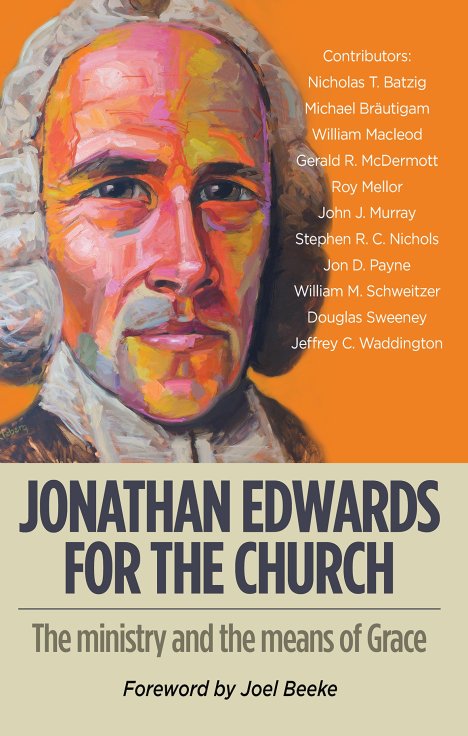
Conference speakers will be focusing on the theme: “Jonathan Edwards, For the Church: The Ministry and Means of Grace” corresponding the the 2015 book of the same title with chapters contributed by the conference speakers. [But the book here].
Jonathan Edwards For the Church is a conference to encourage the church in the UK. In a day of confusion, we pray it would be in the hands of Almighty God an instrument for reformation and revival. The topic for 2016 is one that delighted and animated Jonathan Edwards throughout his fruitful life: the Glory of God. Come join us; the speakers will have ministers or men training for ministry particularly in mind as they prepare, but all of God’s people are welcome.
A notable feature of the recovery of the Reformed faith in the United Kingdom was God’s use of American theologian Jonathan Edwards in the ministries and lives of the leaders. Thomas Chalmers, Charles Spurgeon, A. W. Pink, John Murray, and D. Martyn Lloyd-Jones all considered the discovery of Edwards’ writings as turning points in their ministries. Indeed, it is at least possible that the qualitative influence of Edwards has been greater here than it has been among the American church. Jonathan Edwards for the Church seeks to promote such usefulness in a new generation.
Permission to re-blog this post, which originally appeared here, was kindly granted by the author, Obbie Tyler Todd. Rev. Todd (M.Div & Th.M from SBTS) is Associate Pastor of Students at Zoar Baptist Church in Baton Rouge, Louisiana.
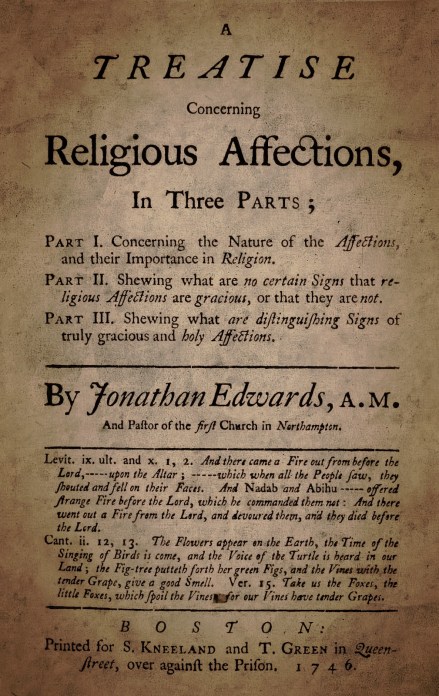
Yale Philosopher John E. Smith once suggested that the sum of Jonathan Edwards’ thought could be considered “one magnificent answer” to the question “What is true religion?”. Without question, Edwards’ most comprehensive attempt to formulate that answer is found in The Religious Affections. These so-called “affections” serve as the “springs of motion” that propel all of human activity: “In everything we do, wherein we act voluntarily, there is an exercise of the will and inclination; it is our inclination that governs us in our actions.” (25) Godly affections are those found specifically inside the church. These religious affections are the “fervent exercises of the heart” the Lord bestows upon His church for the promotion of “true religion.” Still, due to its timeless instruction on human nature and the heart of true worship, Religious Affections continues to transcend age and creed in its ability to speak to the Christian life. The following are three truths that Edwards’ magisterial work delivers to the modern church for meditation and practice.
Obbie Tyler Todd, Associate Pastor of Students, Zoar Baptist Church, Baton Rouge, LA
1. KNOWLEDGE OF GOD’S WORD AND TRUST IN ITS AUTHORITY
In his book Jonathan Edwards and the Church (2013), Rhys Bezzant eliminates the notion that Edwards’ ecclesiology was peripheral to his soteriology: “The church is not an afterthought in the otherwise individualist plans of God, but is the focused domain where God’s promises, presence, and purpose are to be discovered.” (ix) These three forces came together in the preached Word. The puritan religion was the religion of the Word and the one to which Jonathan Edwards wholly subscribed. As Edwards makes clear in The Religious Affections, any kind of accurate self-portrayal must begin in the Scriptures. Knowledge of self begins with true knowledge of God: “One who knew the heart of man better than we know our own hearts, and perfectly knew the nature of virtue and holiness, was the author of the Scriptures.” (229) God is the protagonist to the divine metanarrative and the one to whom we must continually be directed through His Word.
Throughout The Religious Affections, Edwards is insistent upon the fact that the Scriptures are God’s merciful self-revelation. Likewise, inspiration and illumination are both accomplished through the Spirit. Upon this divine authority, Edwards assures his readers that the Bible is our only trustworthy source in the things pertaining to salvation. Sinners must be “willing to have the Word of God rather than their own philosophy, and experiences, and conjectures, as their sufficient and sure guide.” (88) The authority of the Word is an issue that Edwards knew to be paramount in his own time and in the years to come: “The things revealed in the Word of God are so great, and so infinitely more important than all other things, that it is inconsistent with human nature, that a man should fully believe the truth of them, and not be influenced by them above all things in his practice.” (308) This is the confidence that Edwards had in the Word of God preached and believed: “Truly to see the truth of the Word of God, is to see the truth of the gospel.” (220) Edwards made a distinction between simple “notional” knowledge of the Gospel and a knowledge that “relishes and feels.” Biblical knowledge unaccompanied by a sense of holy beauty is worthless, according to Edwards. Conversely, Edwards exhorts his readers to seek “living upon Christ, and not upon experiences.” (103) Hence the Word of Christ is axiomatic to any ministry seeking to stave off rational and fanatical extremes.
2. WE DO THAT WHICH WE DESIRE MOST.
Long before John Piper invented the phrase “Christian Hedonism,” Jonathan Edwards introduced us to the “Religious Affections.” One of the truths contained in his magisterial work is that anywhere sinners have interests and exercise their wills, there is necessarily an inclination that dictates their behavior. According to Edwards, “Those acts which men delight in, they necessarily incline to do.” (317) These inclinations are what distinguish our pleasures from our displeasures. For example, if a young woman is bitter toward her parents when they forbid her from some unsavory activity, her displeasure must necessarily arise from an inclination to engage in that activity. Edwards knew that our loves define our hates, and our pleasures our displeasures.
Affections must have an object. Even a hardened sinner understands that to be “affectionate” implies someone receiving affection. The church’s primary task is therefore to designate Christ as the object of our affection. For unregenerate sinners in love with the world, Jesus cannot compete for the seat of their affections unless the seat-holder is dethroned. Therefore the “more vigorous and sensible exercises of the inclination and will of the soul” must find their telos and their satisfaction in Christ Jesus. Only then will human appetites be satiated.
According to the pastor from Northampton, “If men’s affection to God is founded first on His profitableness to them, their affection begins at the wrong end; they regard only for the utmost limit of the stream of divine good, where it touches them and reaches their interest, and have no respect to that infinite glory of God’s nature which is the original good, and the true fountain of all good.” (169) Our affections must never rest supremely in those benefits of Christ, but rather in Christ alone.
In order for the affections to rest in Christ, one must know Christ and His resurrection. In short, the Gospel must be fully understood and embraced. Edwards opines, “A man must first love God, or have his heart united to Him, before he will esteem God’s good his own, and before he will desire the glorifying and enjoying of God as his happiness.” (166) Gospel-less, ethical teaching will not suffice for transformative ministry. The concept of Christ-centered sanctification, for Edwards, was wrapped up in the idea of holiness. In The Religious Affections, Edwards’ eschatology informs his view of holiness, which in turn informs his view of humility. “It was never God’s design to give us any rules by which we may certainly know who of our fellow professors are His, and to make a full and clear separation between sheep and goats. On the contrary, it was God’s design to reserve this to Himself as His prerogative.” (120) The sheep and goats are indistinguishable today just as they were in Edwards’ post-Awakening era. Consequently, the identification of tares and wheat should be reserved for God in the eschaton. True religion, according to Edwards, was the power of godliness (Deut. 30:6). The pursuit of that godliness becomes the Christian mission in light of the mystery of election. This should prompt ministers of the Gospel to exhort their students to pursue holiness and to eschew licentious Christian living. According to Edwards, “Holiness, which is as it were the beauty and sweetness of the divine nature, is as much the proper nature of the Holy Spirit as heat is the nature of fire.” (129) A true love of God must begin with a delight in His holiness, not one’s own. In this sense, Religious Affections offers its readers a proto-“Christian hedonism,” recognizing that our desires and God’s glory are not mutually exclusive but rather consonant with the Gospel itself.
3. GOD’S GLORY MANIFESTED IN GOD’S LOVE.
Edwards has been called “the theologian of the first commandment” and with good reason. For him, love was central to theology: “For love is not only one of the affections, but it is the first and chief of the affections, and the fountain of all the affections. From live arises hatred of those things which are contrary to what we love, or which oppose and thwart us in those things that we delight in.” (36) In Edwards’ mind, love was the source of all affections, the well from which all inclinations were drawn. Love for God is the greatest commandment, and love for others the second greatest commandment. “Christians are Christlike,” Edwards remarked. (274) At the core of the Gospel message is love, and without love, one does not truly comprehend the truth of the Gospel. Edwards himself said in Religious Affections that he had no greater joy than to hear that his children walked in the truth. (329) Walking in that divine truth is epitomized by a life of love.
The love of God in His people is the means by which they are able to love others. And this is to His glory. A glimpse of God’s divine grace is the fire that ignites humble love for mankind. In Edwards’ mind, grace enables believers to see the beauty of God, to place him as the object of their affections. Therefore, in order to kindle a fire to serve, a pastor must place the glory of God as the supreme end of all ministry and life itself: “I know of no reason why a being affected with a view of God’s glory should not cause the body to faint, as well as being affected with a view of Solomon’s glory.” (60)
The glory of God was integral to Edwards’ very existence. It was all-encompassing. In fact, his extremely high view of Scripture was subservient to his extremely high view of God and His glory. He understood that nothing and no one else in the universe is worthy of worship other than God alone. For this reason, defining love in relation to God’s glory is ever so important. If sinners are taught that John 3:16 somehow means that they are deserving of God’s love, they will then carry a diminished view of grace. This naturally leads to a hidden belief in one’s inherent righteousness. On the other hand, when sinners are confronted with God’s glory as the determining influence behind salvation history, their worship is a humble worship. Loving a worthy God begins with an understanding of intrinsic human unworthiness. He is sovereign over all and set apart from all: “They that do not see the glory of God’s holiness cannot see anything of the true glory of His mercy and grace.” (183) At the bottom of grace and mercy is God’s glory.
Thirty years ago John Piper wrote a book calledDesiring God (1986). In it he famously stated that “God is most glorified in us when we are most satisfied in Him.” The concept was something Piper called “Christian Hedonism.” Aside from Scripture, he has consistently credited the crux of the idea to his theological hero Jonathan Edwards. And perhaps, through the help of John Piper’s prolific pen, millions of Christians will be drawn back to the genius of Religious Affections – a masterful work that continues to deliver spiritual gems to the modern church.
The following essay was written by Sarah Boss. It was originally published by the Wheaton Pub and also posted here at The Augustine Collective. This essay was also presented on 4/1/2016 at MCLLM (Midwestern Conference on Literature, Language, and Media) hosted by the English graduate department at NIU. Panel: “Fire, Nature, and Solitude: Transatlantic Romantic Trends.” EdwardsStudies.com thanks Sarah Boss for contributing this piece, and is grateful that she is following in her father’s footsteps in Edwards scholarship!
Herman Melville remarks in Moby-Dick, “Yes, as everyone knows, meditation and water are wedded for ever.” Whether “everyone” knows this is not certain, but two other stalwarts of American thought surely did. Jonathan Edwards and Henry David Thoreau both give water serious meditation—Thoreau perhaps more famously in Walden, while Edwards’s meditations on water appear throughout his work, but especially in his journal Images of Divine Things. Although these two men operate within contrasting schemata—Edwards extending the Puritan tradition of emblems and typology into the realm of nature, and Thoreau adhering to the transcendentalist veneration of nature—they meditate on the exact same image of water. In the chapter of Walden, “The Ponds,” and in Image no. 117 of Images of Divine Things, Thoreau and Edwards both reflect on the image of a pond which is so clear and still that it reflects the sky in its surface. A close reading of Edwards and Thoreau’s accounts of still water reveals a striking similarity in these two writers’ techne. They create parallel discourses on water, as they assert the water’s significance, describe the water vividly, then finally imagine a descent into the water. However, despite these similarities, they arrive at contrasting conclusions. For Edwards, such a lake is “death” and “darkness itself,” but for Thoreau, Walden is “remarkable” for its “purity.” Ultimately, their contrasting conclusions reveal irreconcilable differences in methodology, resulting in two distinct modes of typology.
Sarah Boss
Edwards begins Image no. 117 with an explicit statement of his typology. Traditionally, typology is the reading and understanding of Old Testament “types” in light of their New Testament “antitypes” or fulfillment, but Edwards extends his reading beyond Scripture to include nature. In this image, he frames his typological reading as a poignant thesis. He writes, “The water, as I have observed elsewhere, is a type of sin or the corruption of man, and of the state of misery that is the consequence of it.” By asserting that water “is a type of” sin and corruption, Edwards accomplishes two things: First, he announces that he will interpret a universal image of a body of water, rather than one specific lake or pond, thus universalizing his forthcoming interpretation. Second, he establishes a strong sense of typology by using a being verb rather than simile or metaphorical language, thus clearly equating the “type” with his reading of it. Edwards’s strong, direct language and the placement of a clear thesis at the beginning of his entry strengthen his typological interpretation. Edwards moves to demonstrate his thesis through a description of the water’s “flattering appearance.” He writes, “How smooth and harmless does the water oftentimes appear, and as if it had paradise and heaven in its bosom. Thus when we stand on the banks of a lake or river, how flattering and pleasing does it oftentimes appear, as though under were pleasant and delightful groves and bowers, or even heaven itself in its clearness …” Here Edwards uses vivid imagery of heaven reflected on a lake’s surface to illustrate the comparison between such water and deceptive sin. His use of “we” invites the reader to join him in a communal memory and empathize with his rendering of the image, drawing her to the water’s beatific appearance. The clarity of Edwards’s thesis, combined with his succinct but vivid imagery, creates a firm foundation for his interpretation.
Thoreau’s thesis is more nuanced. He begins his first account of Walden Pond, “The scenery of Walden is on a humble scale, and, though very beautiful, does not approach to grandeur, nor can it much concern one who has not long frequented it or lived by its shore; yet this pond is so remarkable for its depth and purity as to merit a particular description.” Here Thoreau may seem almost self-deprecating, but buried in this unassuming start is a quiet thesis, which he will aim to demonstrate through his description of the pond. By stating that Walden is humble and without grandeur, then claiming that it is nevertheless “remarkable,” Thoreau elevates Walden above other landscapes or bodies of water that may seem more grand. He differs from Edwards in that he does not propose to address a universal image of water, but rather one specific body and its special attributes. The characteristic that merits such elevation is Walden’s “purity.” Thoreau will spend the body of this description of Walden discussing its color. He describes Walden’s color as being “blue at one time and green at another,” and recalls, “I have discerned a matchless and indescribable blue light, such as watered or changeable silks and sword blades suggest, more cerulean than the sky itself.” Such is the purity and beauty of Walden that all other ponds are merely “yellowish” and “but muddy by comparison.” The contrast between Walden’s purity and other ponds’ muddiness lends Walden a special quality, as if it possessed some inherent goodness. Furthermore, like Edwards, Thoreau notes the reflection of the sky on the water’s surface. He writes of Walden: “Lying between the earth and the heavens, it partakes of the color of both,” and he notes again times when “the surface of the waves may reflect the sky.” Noting Walden’s purity enables Thoreau to argue that it “partakes” of both heaven and earth, essentially acting as a mediator between the two—physically, but also symbolically. Moreover, by claiming that Walden’s color is “more cerulean than the sky itself,” Thoreau elevates the water above heaven. Giving Walden this heavenly quality suggests a symbolic essence of the water and prompts the reader to consider the double meaning of “purity”—physically, in terms of color, but also metaphysically, through ontological value.
Although Edwards and Thoreau have thus differed slightly in form, with Thoreau creating a more nuanced thesis, the real deviation comes after their parallel descent into the water. Edwards, after describing the “paradise and heaven” depicted on the water’s surface, sharply reasserts his thesis: “But indeed, it is all a cheat.” He subsequently envisions a scenario in which he and the reader are successfully tempted to enter into the water: “If we should descend into it, instead of finding pleasant, delightful groves and a garden of pleasure, and heaven in its clearness, we should meet with nothing but death, a land of darkness, or darkness itself.” In Edwards’s account of a descent into the water, he emphasizes the “cheat” of the image and the stark contrast between appearance and reality. The “garden of pleasure,” with its Edenic connotations, is exposed as “a land of darkness.” Edwards’s tone and use of the hypothetical “if” demarcate this passage as an urgent warning, rather than mere naturalistic description. Whoever descends into the water, in Edwards’s account, undergoes a sort of transformation; however, in this transformation the water does not purify but kills.
Thoreau’s account, though containing a parallel descent into the water, could not be more different from Edwards’s. Expanding on his thesis of Walden’s purity, Thoreau writes, “This water is of such crystalline purity that the body of the bather appears of an alabaster whiteness, still more unnatural, which, as the limbs are magnified and distorted withal, produces a monstrous effect, making fit studies for a Michael Angelo.” The purity and unearthliness that appeared in the water are shown to be true by a descent into it. Thoreau’s bather is also transformed—not by death but by apotheosis—as she becomes immortalized as a living work of art. At the end of this passage on Walden, Thoreau finally asserts his typological reading of the pond, as water that is not only pure in its appearance but which also purifies those who experience it. Such a transformation, in which the bather transcends her own humanity, reveals the duality of meaning in Thoreau’s “purity.” The pure appearance of Walden—unlike any other water—transfigures whoever is willing to embrace it. So, too, does an intellectual embrace of Walden—seeing it for its true “remarkable” self—enable a purification and transcendence of the mind.
Ultimately, Edwards and Thoreau were able to arrive at these contrasting interpretations because of their differing methodologies. In composing these accounts, they drew from different sources and operated out of clashing ideological frameworks. Edwards’s source for his typology was vast, as he cited Scripture to confirm his interpretations of nature. In Image no. 156 Edwards writes,
The Book of Scripture is the interpreter of the book of nature two ways: [first] by declaring to us those spiritual mysteries that are indeed signified or typified in the constitution of the natural world; and secondly, in actually making application of the signs and types in the book of nature as representations of those spiritual mysteries in many instances.
In this entry, Edwards clearly presents Scripture as the foundational interpretative tool through which nature should be read. In Image no. 117 in particular, Edwards connects his reading of lakes back to Scripture. He concludes the entry with a footnote: “Prov. 5:3-6,” which is a reference to a “forbidden woman” whose appearance is pleasing and flattering—like Edwards’s lake—but whose “feet go down to death.” Although his naturalistic observations and typological logic are sound in themselves, Edwards presents Scripture as his final evidence. Although these verses do not mention water, they use metaphor to demonstrate the same type of sin, corruption, and consequent misery as Edwards’s thesis, thus communicating the same absolute truth. Additionally, Image of Divine Things displays an extensive consideration of water, as Edwards examines water in its vicissitudes and uses biblical references to interpret it. These include: Image no. 15, flowing rivers are the effusions of the Spirit; Image no. 27, the stormy sea is the wrath of God; Image no. 77, the confluence of rivers flowing in various directions into the ocean is divine providence; Image no. 155, spring streams that rise then dry up again represent hypocrites; and so on. This wide consideration of water allows Edwards to make an informed, nuanced interpretation of a specific type of water, supported both by biblical sources and comparison with other naturalistic observations.
By contrast, although Thoreau cites writers, philosophers, and scientists throughout Walden, he does not explicitly draw on extratextual sources when developing his account of the pond. Instead, he relies on his own empirical observations and poetic insight. He, too, is painstaking in his interpretation, as he seems to describe Walden exhaustively, even through seasonal changes. Yet he narrows his observations to focus on one specific pond—he can cannot come to a universal conclusion about ponds or lakes nor does he attempt to. He notes himself that his interpretation of Walden would be lost on anyone who has not been there. Moreover, in a tone of righteous indignation, Thoreau concludes “The Ponds”: “Talk of heaven! Ye disgrace earth.” This spirited conclusion reaffirms Thoreau’s own elevation of earth over heaven and his emphasis on a nature-centric typology, revealing the heart of difference between Edwards and himself. Edwards’s typology is a conduit for looking outward and obtaining knowledge about the God who exists above the natural world, while Thoreau’s typology flows from an inward sight, like Emerson’s transparent eyeball, by which one is able to see the god within.
Yet despite various similarities and differences in their typology, Edwards and Thoreau both acknowledge the spiritual significance of nature and its intentional symbolism. In Image no. 57, Edwards writes,
‘Tis very fit and becoming of God, who is infinitely wise, so to order things that there should be a voice of his in his works instructing those that behold them, and pointing forth and showing divine mysteries and things more immediately appertaining to himself and his spiritual kingdom. The works of God are but a kind of voice or language of God, to instruct intelligent beings in things pertaining to himself.
For Edwards, a typological truth embedded in nature is in accord with God’s own methods of instruction. To extend typology from the Book of Scripture to the Book of Nature only enhances God’s communication with humankind. Likewise, although Thoreau does not adhere to orthodox Christianity and traditional typology, he also posits an intentional, truth-laden symbolism inherent in nature. Concerning Walden, he writes, “I am thinking that this pond was made deep and pure for a symbol.” This language of intentional symbolism—being “made for” a symbol—communicates a natural typology similar to Edwards’s. Ultimately, Edwards and Thoreau’s differing typologies of lakes both point to the universal symbolism of nature and its epiphanic, not just aesthetic, value.
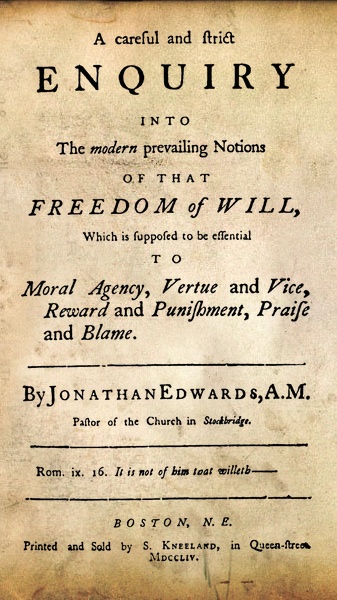
Jonathan Edwards’s Freedom of the Will is certainly not the easiest piece of literature in the world, nor is it the most accessible treatise Edwards ever wrote. In fact, on my first pass through this incredible volume, I remember asking myself a few times during the journey “Is it over yet?”
Pressing on, though, we do come to some important insights as to the nature of the human will in relation to the sovereignty of God. As you may already know, Edwards had a very high view of the sovereignty of God, as a representative of high Calvinistic orthodoxy in his own day. In fact, Edwards argues in Freedom for a position called “compatibalism,” which is to say, that Edwards believes that God’s sovereignty is ultimately compatible with human freedom, rightly understood.
For Edwards, God is radically free. If we want to talk about free will as a philosophical concept, Edwards would suggest we begin with God’s free will. He alone determines the course of human events and indeed the outcome of all of our lives. But Edwards also believes that human beings always act in ways that are consistent with their own nature. We too are “free” to act according to our own impulses. Yes, God determines and controls all things, but nevertheless, humans are free to act in complete concert with their own strongest dispositions. In fact, we always act in harmony with our heart’s strongest desire at the time. But this, for us, is precisely the problem. We are sinners.
Here, Edwards introduces the concepts of moral ability and natural ability. Human beings, he says, are obviously limited in their natural ability. This corresponds to what we can do within our physical limitations in time and space. I cannot bench press more than 200 lbs any more, for example. Nor can any of us reading this blog post fly without the aid of aircraft. But moral ability has to do with what our soul will not or cannot do. A drunk (in Edwards own illustration) is certainly able to put down his beer (natural ability) but it may be that he does not have the spiritual capability to refuse another drop (moral ability).
This explains why some people receive the Gospel and others do not. Left to our own, we have the complete natural ability to receive Christ, but the problem lies in our lack of moral ability. Namely, our hearts are corrupt and will not come to Him for clemency. Edwards argues that what is needed is for the Holy Spirit to override that selfish impulse within us which refuses the grace of God by giving us a new living “principle” (Edwards’s stock term for spiritual quickening) in the very heart.
His own best illustration is as follows: Suppose there was a great king who had two men in prison. The first man desired to come and beg before the King. If he could, he would run straightaway to the throne room and beg for mercy and clemency. The problem in the first case, Edwards says, is that the bars and walls of the prison prevent him. He has the moral ability to repent, but not the natural ability. Some people, Edwards argues, mistakenly assume that Calvinism implies that God’s determination holds back willing penitents from repenting!
But this, however, is not really the case with fallen man.
No, for fallen man, the problem is exactly the opposite: Now suppose that the bars and prison door are wide open for our second hypothetical prisoner. Nothing hinders his coming straight to the King’s throne. The jail door is wide open. The guard beckons him on! Unfortunately, this second man hates the King. To repent would be utterly despicable in his own eyes. He would rather not bow the knee to the King, even if it meant his freedom. He would rather spit in the King’s face given the chance! His problem is not his natural ability – in fact nothing hinders his coming but his own heart. The problem is that he is not morally able to come. His is a spiritual problem indeed.
Thus, once again we see that divine grace is needful to change the heart of the prisoner. In this way, by distinguishing moral and natural ability, Edwards builds his case and upholds God’s sovereignty in salvation AND man’s responsibility to repent.
These ideas are not in conflict, but are in fact, “compatible.”
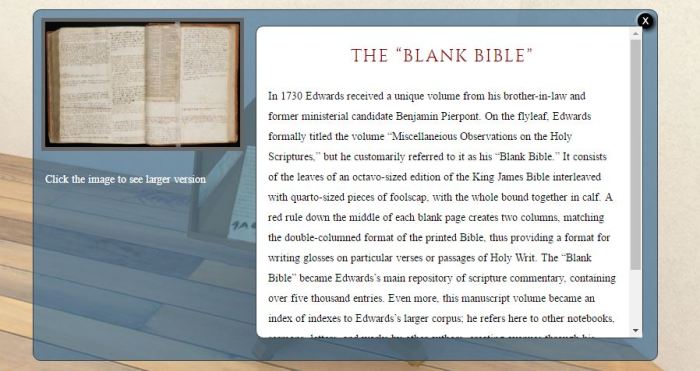
If you have not already discovered one of the coolest Jonathan Edwards sites on the web yet, let me introduce you to the Omohundro Institute for Early American History Quarterly.
On this page [click here] you can actually take a “virtual tour” of Jonathan Edwards’s person study, and examine (digitally of course) the personal affects of the Northampton Puritan, snooping through his desk, his notebooks, and other personal items.
William H. Kimnach and Kenneth P. Minkema provide the written commentary on the personal items. Here are some screenshots of what you can see.
An Essay on the Trinity is one of Jonathan Edwards’s shorter writings and part of his massive corpus of deep thinking about God’s being. Written some time in the 1750’s (probably) this essay, according to Paul Helm, was most likely held back from publication until long after Edwards’s death, since it contains what would seem to be, in some quarters, controversial thinking.
After all, in this essay, Edwards proposes somewhat of a modified “psychological model” for reflecting upon the interrelationship between the Three Persons of the Trinity, and their oneness and harmony. Although this concept (see below) had been espoused by one as eminent as St. Augustine many years before Edwards, Reformed theology in general as a tradition has not had much fondness or affection for “models” or “analogies” of any kind with regard to the Trinity; be that analogy the three-leaf clover, or water in its various forms (ice, water, steam), or the sun itself (fire, light, heat) etc.
Thus, a model of any kind attempting to describe the Trinity is shaky ground for some.
First, a little bit about this work: It is available to us in several different forms today, despite its late publication date of 1903. First, it comes in a nice, hardback 1971 volume edited by the aforementioned Paul Helm (pictured above, top). This edition comes to the reader alongside Edwards’s Treatise on Grace, and Observations on the Trinity (not to be confused with the Essay on the Trinity currently being discussed. Observations is primarily about the covenant of redemption, rather than God’s ontological being). Though I believe this monograph to be out of print, there are still several used copies to be found online or through used book sales. Fortuitously, my copy was signed by the editor (Helm) and dedicated to another theologian, John Frame! The second manner in which An Essay can be found is in various ebook formats like this one. Thankfully today, most ebooks grant us huge knowledge at our fingertips for mere pennies to the dollar.
Although Edwards likely intended its publication during his own lifetime, his sudden death prevented it from coming into popular view. (Edwards died in 1758). The work itself is but only thirty pages long, and can be read in one or two settings by the careful reader. In what follows, I will attempt to describe Edwards’s views of the Trinity as espoused in this short work.
First Edwards begins with the premise that God is infinitely happy in His own being. His opening salvo is filled with joy-language:
Tis common when speaking of the divine happiness to say that God is infinitely happy in the enjoyment of Himself, in perfectly beholding and infinitely loving, and rejoicing in, His own essence and perfections and accordingly it must be supposed that God perpetually and eternally has a most perfect idea of Himself, as it were an exact image and representation of Himself ever before Him and in actual view, and from hence arises a most pure and perfect act or energy in the Godhead, which is the Divine love, complacence and joy (1971, 99).
Here Edwards tips his hat to his main thrust and direction in this Essay. He is going to argue that when God thinks about Himself, He has a perfect self-understanding. He always thinks rightly and perfectly about Himself. This self-reflection brings Him great joy. Two aspects of this self-reflection are going to be emphasized over and over again in this essay: (1) God’s perfect knowledge of Himself and (2) God’s joy in this self-knowledge.
Now to the part that is controversial: Edwards believes that when God contemplates His own glory, this in part explains how the Son of God (the Second Person of the Trinity) can be eternally generated, without beginning or end. Note: Edwards does not use the word “create.” That would be to assert that one or more persons of the Trinity are creatures. Thus, this kind of argumentation is called the “psychological model.”
If God beholds himself so as thence to have delight and joy in Himself He must become His own object. There must be a duplicity. There is God and the idea of God, if it be proper to call a conception of that that is purely spiritual an idea (1971, 100).
Thus the Second Person of the Trinity, the Eternal Logos, is that perfect idea of Himself which God knows, perceives, and apprehends perfectly. As an infinite being, this results in a “duplicity” (his term), or another person being eternally generated in God’s self-understanding. Thus, this self-understanding is another “person” and is in some way distinct from the first. (Edwards is jealous NOT to lose the personality of the Three persons in his view on the Trinity!) He says in His own words,
Therefore as God with perfect clearness, fullness and strength, understands Himself, views His own essence…that idea which God hath of Himself is absolutely Himself…Hereby is another person begotten, there is another infinite eternal almighty and most holy and the same God, the very same divine nature (1971, 103, emphasis added).
He goes on to make the connection explicit between God’s self-knowledge and the Son of God,
And this person is the second person in the Trinity, the only begotten and dearly beloved Son of God; He is the eternal, necessary, perfect, substantial and personal idea which God hath of Himself; and it seems to me to be abundantly confirmed by the Word of God (1971, 103).
Whether or not this explains how God can eternally exist as Three Persons, I will let the reader decide. Obviously, Edwards includes much more nuance and thought than a brief synopsis like this one can contain in a simple blog post. But another question arises almost immediately. What about the Third Person of the Trinity? What about the Holy Spirit? To this point, Edwards has been emphasizing God’s self-knowledge. But in regard to the Holy Spirit, Edwards will now turn the attention to God’s joy in Himself. Listen:
The Godhead being thus begotten by God’s loving an idea of Himself and shewing forth in a distinct subsistence or person in that idea, there proceeds a most pure act, and an infinitely holy and sacred energy arises between the Father and Son in mutually loving and delighting in each other, for their love and joy is mutual…I think it is plainly intimated to us that the Holy Spirit is that love (1971, 108, emphasis added).
To summarize, it would be helpful to quote Edwards at length just one more time. This paragraph from page 108 of Helm’s 1971 edition I think is very clear:
The Father is the deity subsisting in the prime, unoriginated and most absolute manner, or the deity in its direct existence. The Son is the deity generated by god’s understanding, or having an idea of Himself and subsisting in that idea. The Holy Ghost is the deity subsisting in act, or the divine essence flowing out and breathed forth in God’s infinite love to and delight in Himself. And I believe the whole Divine essence does truly and distinctly subsist both in the Divine idea and Divine love, and that each of them are properly distinct persons.
Once again, whether this psychological model is convincing, I will let the reader decide. In layman’s terms what Edwards is saying here is simply this:
God is eternal. The Father is the “deity subsisting in the prime.” That is to say, the Father is who we think God is in standard theological definitions: eternal, omnipotent, holy, beautiful, and wise. In fact, God is so wise that when He thinks of Himself, His knowing and valuation is pure, holy, and precise. Unlike finite creatures, God’s self-knowledge lacks nothing. So glorious is His knowledge, that another “person” entirely is generated, the Son or the Logos. He is not created, but always was, is, and is to come. This must be, because God never began to think about Himself. Herein we have the Son. The Son is the Father’s pure, unmitigated, unfiltered self-knowledge.
But it does not end there.
Because God is a joyful God, truly rejoicing in His being (for His judgments and valuations are always morally perfect) He also takes great pleasure in the mutual recognition between Father and Son. This joy itself includes personality, and is the Holy Spirit, or we can say, God’s eternal joy and enjoyment between Father and Son. Thus, there is one God substantially, but because of the glorious infinity of God’s wisdom and joy, He eternally exists as Three Persons: God in the Prime (Father), God’s perfect self-knowledge (Son), and God’s joy in Himself (Holy Spirit).
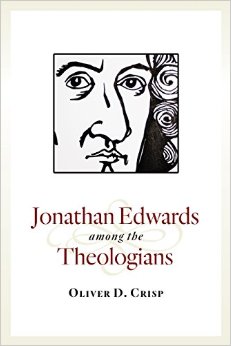
Today, EdwardsStudies.com had the opportunity to chat with Oliver Crisp, one of the most productive Edwards Scholars on the global scene today. Not only has Dr. Crisp had several significant works about Jonathan Edwards published to great reception in recent years, but his new work, Edwards Among the Theologians is also being received with accolades as well.
First question: What the heck happened to the beard? A couple years ago you were rocking the manly mug, now you look like a freshman again. What gives?
The beard comes and goes. A friend said to me recently, “Well, you can always grow it back!” I guess that’s true. Watch this space …
When I read your book Jonathan Edwards on God and Creation last year, I didn’t notice the accent. But when I listened to a talk you gave recently, I could tell you weren’t from Brooklyn. Give us two-cents worth of your back story.
I was born and raised in London, England. Went to Art School in London. Then went to study Divinity (Theology) in Scotland. Taught high school for a bit, got a ThM in Divinity also from Scotland. Became a trainee minister for three years. Wrote a PhD at King’s College, London. Then taught at the University of St Andrews for a couple of years before doing a Postdoc at the University of Notre Dame. After that we relocated to the West of England, where I taught at the University of Bristol. We had a year at the Center of Theological Inquiry, Princeton. Then, after a brief stint back in Bristol, we moved out to California to teach at Fuller Seminary, which is where I am now. I’m also about to start teaching a bit for the new Institute for Analytic and Exegetical Theology at the University of St Andrews.
How did you get hooked on Edwards?
Two sources: the first was John Piper’s Desiring God. The second was a pastor friend of mine who gave me a biography of Edwards to read as I went up to University as an undergraduate. It left me fascinated. As a consequence, I decided to read Edwards on the Will as an undergraduate. Then things really got out of hand and I ended up writing a PhD dissertation on him. The rest you know.
So what’s the deal: is Edwards a panentheist or a full-blown pantheist? Has the needle moved on your position?
No, I haven’t changed my view. I think Edwards is committed to panentheism (all-in-god-ism). I argued that in my book Jonathan Edwards on God and Creation (OUP, 2012), and others have said something similar. But I now think that there are tendencies within Edwards’s thought that press him in the direction of pantheism (all is god). He would never have embraced that, of course. But there are things he does say that seem to lead to that conclusion–and this was the conclusion that Charles Hodge came to in the nineteenth century as well. So I guess I think that there is more than one Edwards, depending on how you weight certain claims that he makes in his works.
You’ve just named one: the pantheism question. That is a pretty big change for me. Another: my views on his doctrine of the Trinity changed since my previous book. I read Kyle Strobel’s book on Jonathan Edwards and it made me rethink my own position. Although I don’t end up agreeing with Kyle, I think his interpretation makes a lot of sense and was the means by which I came to see something about Edwards’s account of the Trinity that I hadn’t seen before. I now think that Edwards presents a truly novel model of the Trinity–a very rare thing indeed.
In addition to these, the chapter on Edwards’s preaching is something I’ve not put in a monograph before. Also, putting Edwards in “dialogue” with other classical Christian thinkers enabled me to show how his views are often not quite what you’d expect. For instance, he turns out to have a much less straightforwardly orthodox account of creation than Arminius–not a conclusion some people will be expecting!
Your last chapter is on the orthodoxy of Edwards. Give us a hint as to where you land on that.
I think that, from a certain point of view, Edwards’s views press at the very boundaries of what most Christians will consider theologically orthodox. In the final chapter, I go into that in some detail, arguing (in keeping with Charle Hodge) that Edwards’s views press him beyond panentheism towards pantheism. Those who have read Edwards’s sermons and some of his more devotional works may be a bit shocked to read this, but it is nothing more than drawing out issues that are latent in his work. Edwards was a strikingly original thinker. Sometimes his originality gets him into trouble.
What are you working on right now? Any new projects?
I’m finishing up an Introduction to Jonathan Edwards co-written with Kyle Strobel. This should be going to Eerdmans for publication in the next couple of years. I’m also currently writing a book on the atonement for Baker Academic, entitled Substitution and Atonement.
Shout outs or recommendations?
Read Edwards. His works are available online via the Yale Jonathan Edwards site. Read his God’s End in Creation, and his Religious Affections. Then read some of the harder material. As to secondary sources: read Kyle Strobel’s book; read Douglas Sweeney’s recent work Edwards the Exegete, which is terrific; and, as a good work of reference, Michael McClymond and Gerald McDermott’s The Theology of Jonathan Edwardsis a significant contribution. Finally, read George Marsden’s biography of Edwards. You won’t regret it.
EdwardsStudies.com is pleased to be talking today with Kyle Strobel, noted Jonathan Edwards scholar, author of some great books on the Northampton Puritan, and also the son of the award winning writer, Lee Strobel. Kyle, I just gave copies of The Case for Christand The Case for Faith to an inquirer this very morning. What’s your dad up to these days?
Well, pretty much the same as usual – working on books and preaching. He is currently on faculty at Houston Baptist University teaching evangelism courses and is a teaching pastor at Woodlands church. These days he is enjoying being a grandfather quite a lot, so that takes up a good deal of his time!
I’m sure everyone asks, but what was it like growing up with a pretty well known speaker/writer as your father?
It is hard to summarize really. Mostly positive. It is a bit unusual when everyone seems to know your father and have an opinion about him. It is also unusual when people make all sorts of assumptions about you based on what they know about your father. But overall it was just normal for me.
How did you get started studying Jonathan Edwards?
When I went to the University of Aberdeen to work on my PhD in systematic theology I didn’t know what my dissertation topic would be. My supervisor mentioned Edwards because he knew I was particularly interested in the interplay between theology and spirituality. So I started reading Edwards seriously for the next six months, making my way through several of his major works, and at that point I was hooked!
You mention the Reformed tradition in your works and lectures from time to time. Did you grow up Reformed or was that something that you discovered later in life? Do you consider yourself part of the broader Reformed tradition today?
This is something that has come up later in life for me. I grew up somewhat antagonistic to Reformed theology, but like most people, I really didn’t know what that meant. I was confronted with a reductionistic and superficial version of it, and so I critiqued it for being reductionistic and superficial! I consider myself Reformed, but I do so in a very broad sense. I am not confessionally Reformed – although I love the confessions of the Reformed tradition. I am Reformed in a more methodological way. The task of Christian theology is to think well about God and the content of theology in light of God. I take that impulse to be at the heart of Reformed theology.
If you don’t mind my asking, where are you worshiping on the Lord’s Day?
I am on the teaching team at Redeemer Church in La Mirada, CA. I preach there monthly.
Basically, my Reinterpretation book is an attempt to provide a way to read Edwards. In other words, this book provides a hermeneutical key to reading Edwards well. If we are going to read Edwards well, as I argue, we have to read him as he wanted to be read. We have to take seriously his Reformed impulses and we have to understand the inner-logic of his thought. This leads us to an overall orientation and direction in which to read Edwards well. As I argue there, we have to read him from the top-down – and therefore from his doctrine of the Trinity through his doctrine of creation in light of his understanding of the consummation of all things. This allows us to triangulate doctrine in light of who God is, what creation is, and where God is leading creation. I test my analysis by looking at spiritual knowledge, regeneration, and religious affection, showing how my distinct reading can speak into these three topics.
Why is a “reinterpretation” necessary?
With only a handful of exceptions, I don’t think Edwards is often read theologically. Because of Perry Miller’s emphasis, I think, we often read Edwards as a radical philosopher who appended a generic Reformed theology onto an already established philosophical framework. I think this is misguided. But the problem is that Miller, and those following in his wake, have done a better job of casting a vision for how to read Edwards. Scholars have responded to Miller and his line, but they never really did much to establish an alternative reading (and way of reading). My work is an attempt to fill in that gap. This is why, for better or worse, I spend a lot of time in the footnotes outlining how my view relates to or (more often) undermines other views in the secondary literature.
When I was reading it, I thought to myself, “Man! This guy really likes the word ‘qua!’” Aside from your obvious enthusiasm for the Latin term, what else do you think this work contributes to the advancement of Edwards studies overall?
“Qua” is a great term! Next to giving a methodology for reading Edwards, I think the most important contribution would be my analysis of Edwards’s doctrine of God. I argue that Edwards changed his view of the Trinity and no one seemed to notice. I argue for a distinct view of how Edwards’s argument works in his “Discourse on the Trinity.” I argue that Edwards’s view of God is “religious affection in pure act” (what I call, in the book, “Personal Beatific-Delight”). In light of these features of Edwards’s doctrine, I seek to show how his emphases guide his theology.
I had two main audiences in mind with that book. I was aiming it at lay people, but I was particularly interested in folks who appreciate Reformed theology (or who call themselves “Calvinists”) and those who are interested in spiritual formation. For the first group, I wanted to show them what a distinctively Reformed view of spiritual formation could look like. No one has ever really outlined Edwards’s understanding of spiritual formation before, and so I wanted to offer that to folks. But I also wanted to show people interested in spiritual formation that a distinctively evangelical reading, albeit a Reformed version, would develop into a specific kind of spirituality. I wanted to show the laity (and pastors) that our theological views are not divorced from our understanding of the practical realities of the Christian life.
Things are going well. Along with my edited version of Edwards’s Charity and Its Fruits, I am co-editing a volume of Edwards’s spiritual writings for the Classics of Western Spirituality series. I am still editing academic works on Edwards, and Oliver Crisp and I are nearly finished with our introduction to Edwards’s Christian thought. This volume with Oliver is the next major addition to my project, because we believe this could be the go-to introduction to Edwards’s thought. I am writing three chapters outlining Edwards’s theology while Oliver writes three chapters outlining Edwards’s philosophy. The book is due at the end of the Summer with Eerdmans.
Are you going to continue studying Edwards, or are you going to open some new channels of study in the future?
I will slow down my research on Edwards a bit but I’ll never put it aside completely. I am a systematic theologian, so my interests are not primarily historical but doctrinal (not that I want to divide those two). Whenever I want to think about a doctrine I start with Edwards, and so that is where you see a lot of my work on Edwards come out. For instance, I have an article coming out with Harvard Theological Review called “Jonathan Edwards’s Reformed Doctrine of Theosis,” because I wanted to think through that topic more. I also have finished a chapter for a book on Edwards’s understanding of theologically anthropology, because that is a topic captivating me at the moment.
Any shout-outs or book recommendations for Edwards fans?
I am particularly excited about the essays in a new edited volume I did called The Ecumenical Edwards: Jonathan Edwards and the Theologians. What I like about this volume is that it includes Protestants of all kinds as well as Roman Catholic and Eastern Orthodox theologians writing on Edwards in relation to another theologian (or school of thought). It ended up becoming a fascinating volume. My good friend Rhys Bezzant has a volume out on Edwards and the church that everyone should read, and, of course, Oliver Crisp has a new book out on Edwards (I assume Oliver always has a new book out!). There is a lot of good work being done on Edwards right now, so it is an exciting time for the guild. I am in the middle of reading Doug Sweeney’s new book Edwards the Exegete and it is great. Everyone interested in Edwards will need to read it.
Kyle, thank you so much for taking the time to talk with us at EdwardsStudies.com today!







 Jonathan Edwards Studies