Natural and Moral Ability

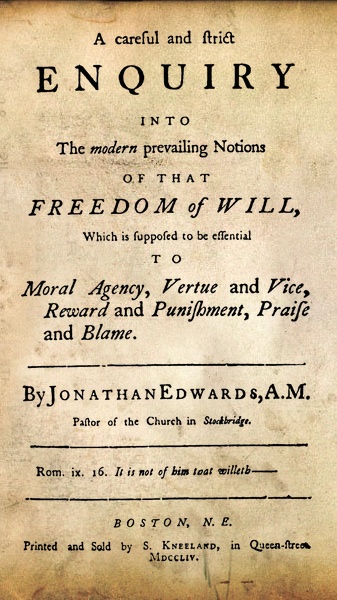
Jonathan Edwards’s Freedom of the Will is certainly not the easiest piece of literature in the world, nor is it the most accessible treatise Edwards ever wrote. In fact, on my first pass through this incredible volume, I remember asking myself a few times during the journey “Is it over yet?”

Pressing on, though, we do come to some important insights as to the nature of the human will in relation to the sovereignty of God. As you may already know, Edwards had a very high view of the sovereignty of God, as a representative of high Calvinistic orthodoxy in his own day. In fact, Edwards argues in Freedom for a position called “compatibalism,” which is to say, that Edwards believes that God’s sovereignty is ultimately compatible with human freedom, rightly understood.

fw

For Edwards, God is radically free. If we want to talk about free will as a philosophical concept, Edwards would suggest we begin with God’s free will. He alone determines the course of human events and indeed the outcome of all of our lives. But Edwards also believes that human beings always act in ways that are consistent with their own nature. We too are “free” to act according to our own impulses. Yes, God determines and controls all things, but nevertheless, humans are free to act in complete concert with their own strongest dispositions. In fact, we always act in harmony with our heart’s strongest desire at the time. But this, for us, is precisely the problem. We are sinners.

Here, Edwards introduces the concepts of moral ability and natural ability. Human beings, he says, are obviously limited in their natural ability. This corresponds to what we can do within our physical limitations in time and space. I cannot bench press more than 200 lbs any more, for example. Nor can any of us reading this blog post fly without the aid of aircraft. But moral ability has to do with what our soul will not or cannot do. A drunk (in Edwards own illustration) is certainly able to put down his beer (natural ability) but it may be that he does not have the spiritual capability to refuse another drop (moral ability).

This explains why some people receive the Gospel and others do not. Left to our own, we have the complete natural ability to receive Christ, but the problem lies in our lack of moral ability. Namely, our hearts are corrupt and will not come to Him for clemency. Edwards argues that what is needed is for the Holy Spirit to override that selfish impulse within us which refuses the grace of God by giving us a new living “principle” (Edwards’s stock term for spiritual quickening) in the very heart.

His own best illustration is as follows: Suppose there was a great king who had two men in prison. The first man desired to come and beg before the King. If he could, he would run straightaway to the throne room and beg for mercy and clemency. The problem in the first case, Edwards says, is that the bars and walls of the prison prevent him. He has the moral ability to repent, but not the natural ability. Some people, Edwards argues, mistakenly assume that Calvinism implies that God’s determination holds back willing penitents from repenting!

But this, however, is not really the case with fallen man.

No, for fallen man, the problem is exactly the opposite: Now suppose that the bars and prison door are wide open for our second hypothetical prisoner. Nothing hinders his coming straight to the King’s throne. The jail door is wide open. The guard beckons him on! Unfortunately, this second man hates the King. To repent would be utterly despicable in his own eyes. He would rather not bow the knee to the King, even if it meant his freedom. He would rather spit in the King’s face given the chance! His problem is not his natural ability – in fact nothing hinders his coming but his own heart. The problem is that he is not morally able to come. His is a spiritual problem indeed.

Thus, once again we see that divine grace is needful to change the heart of the prisoner. In this way, by distinguishing moral and natural ability, Edwards builds his case and upholds God’s sovereignty in salvation AND man’s responsibility to repent.

These ideas are not in conflict, but are in fact, “compatible.”

Take a Virtual Tour of Edwards’s Study

If you have not already discovered one of the coolest Jonathan Edwards sites on the web yet, let me introduce you to the Omohundro Institute for Early American History Quarterly.

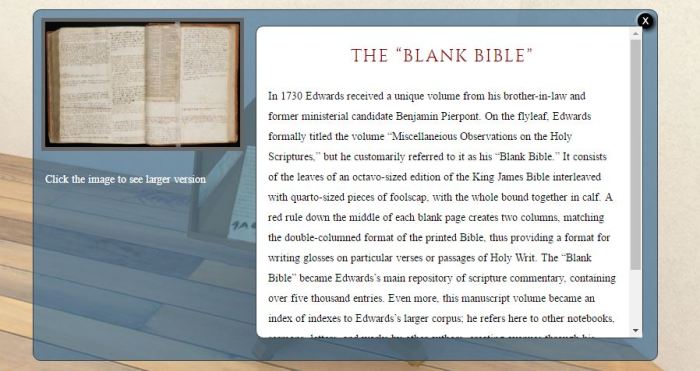
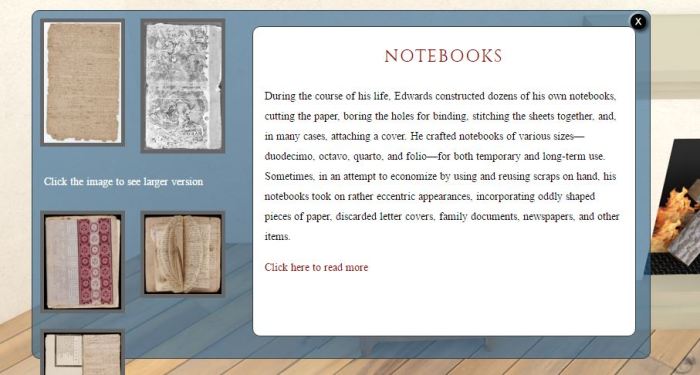
On this page [click here] you can actually take a “virtual tour” of Jonathan Edwards’s person study, and examine (digitally of course) the personal affects of the Northampton Puritan, snooping through his desk, his notebooks, and other personal items.

William H. Kimnach and Kenneth P. Minkema provide the written commentary on the personal items. Here are some screenshots of what you can see.

Edwards Study

Edwards Blank Bible 3

Edwards Notebooks


An Essay on the Trinity: Edwards and the Psychological Model (Synopsis)

An Essay on the Trinity is one of Jonathan Edwards’s shorter writings and part of his massive corpus of deep thinking about God’s being. Written some time in the 1750’s (probably) this essay, according to Paul Helm, was most likely held back from publication until long after Edwards’s death, since it contains what would seem to be, in some quarters, controversial thinking.

After all, in this essay, Edwards proposes somewhat of a modified “psychological model” for reflecting upon the interrelationship between the Three Persons of the Trinity, and their oneness and harmony. Although this concept (see below) had been espoused by one as eminent as St. Augustine many years before Edwards, Reformed theology in general as a tradition has not had much fondness or affection for “models” or “analogies” of any kind with regard to the Trinity; be that analogy the three-leaf clover, or water in its various forms (ice, water, steam), or the sun itself (fire, light, heat) etc.

Thus, a model of any kind attempting to describe the Trinity is shaky ground for some.

Edwards Studies

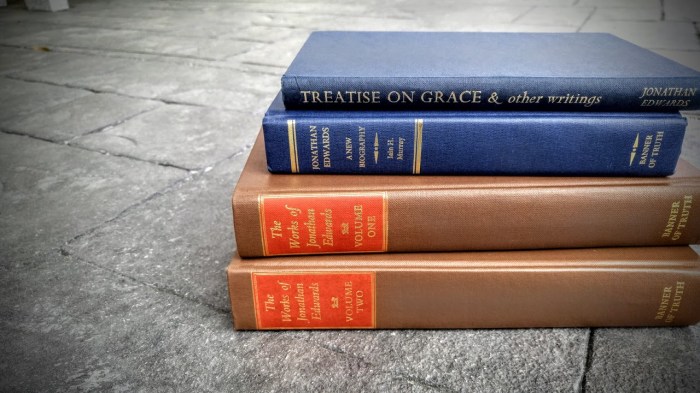
First, a little bit about this work: It is available to us in several different forms today, despite its late publication date of 1903. First, it comes in a nice, hardback 1971 volume edited by the aforementioned Paul Helm (pictured above, top). This edition comes to the reader alongside Edwards’s Treatise on Grace, and Observations on the Trinity (not to be confused with the Essay on the Trinity currently being discussed. Observations is primarily about the covenant of redemption, rather than God’s ontological being). Though I believe this monograph to be out of print, there are still several used copies to be found online or through used book sales. Fortuitously, my copy was signed by the editor (Helm) and dedicated to another theologian, John Frame! The second manner in which An Essay can be found is in various ebook formats like this one. Thankfully today, most ebooks grant us huge knowledge at our fingertips for mere pennies to the dollar.

Although Edwards likely intended its publication during his own lifetime, his sudden death prevented it from coming into popular view. (Edwards died in 1758). The work itself is but only thirty pages long, and can be read in one or two settings by the careful reader. In what follows, I will attempt to describe Edwards’s views of the Trinity as espoused in this short work.

First Edwards begins with the premise that God is infinitely happy in His own being. His opening salvo is filled with joy-language:

Tis common when speaking of the divine happiness to say that God is infinitely happy in the enjoyment of Himself, in perfectly beholding and infinitely loving, and rejoicing in, His own essence and perfections and accordingly it must be supposed that God perpetually and eternally has a most perfect idea of Himself, as it were an exact image and representation of Himself ever before Him and in actual view, and from hence arises a most pure and perfect act or energy in the Godhead, which is the Divine love, complacence and joy (1971, 99).

Here Edwards tips his hat to his main thrust and direction in this Essay. He is going to argue that when God thinks about Himself, He has a perfect self-understanding. He always thinks rightly and perfectly about Himself. This self-reflection brings Him great joy. Two aspects of this self-reflection are going to be emphasized over and over again in this essay: (1) God’s perfect knowledge of Himself and (2) God’s joy in this self-knowledge.

Now to the part that is controversial: Edwards believes that when God contemplates His own glory, this in part explains how the Son of God (the Second Person of the Trinity) can be eternally generated, without beginning or end. Note: Edwards does not use the word “create.” That would be to assert that one or more persons of the Trinity are creatures. Thus, this kind of argumentation is called the “psychological model.”

If God beholds himself so as thence to have delight and joy in Himself He must become His own object. There must be a duplicity. There is God and the idea of God, if it be proper to call a conception of that that is purely spiritual an idea (1971, 100).

Thus the Second Person of the Trinity, the Eternal Logos, is that perfect idea of Himself which God knows, perceives, and apprehends perfectly. As an infinite being, this results in a “duplicity” (his term), or another person being eternally generated in God’s self-understanding. Thus, this self-understanding is another “person” and is in some way distinct from the first. (Edwards is jealous NOT to lose the personality of the Three persons in his view on the Trinity!) He says in His own words,

Therefore as God with perfect clearness, fullness and strength, understands Himself, views His own essence…that idea which God hath of Himself is absolutely Himself…Hereby is another person begotten, there is another infinite eternal almighty and most holy and the same God, the very same divine nature (1971, 103, emphasis added).

He goes on to make the connection explicit between God’s self-knowledge and the Son of God,

And this person is the second person in the Trinity, the only begotten and dearly beloved Son of God; He is the eternal, necessary, perfect, substantial and personal idea which God hath of Himself; and it seems to me to be abundantly confirmed by the Word of God (1971, 103).

Whether or not this explains how God can eternally exist as Three Persons, I will let the reader decide. Obviously, Edwards includes much more nuance and thought than a brief synopsis like this one can contain in a simple blog post. But another question arises almost immediately. What about the Third Person of the Trinity? What about the Holy Spirit? To this point, Edwards has been emphasizing God’s self-knowledge. But in regard to the Holy Spirit, Edwards will now turn the attention to God’s joy in Himself. Listen:

The Godhead being thus begotten by God’s loving an idea of Himself and shewing forth in a distinct subsistence or person in that idea, there proceeds a most pure act, and an infinitely holy and sacred energy arises between the Father and Son in mutually loving and delighting in each other, for their love and joy is mutual…I think it is plainly intimated to us that the Holy Spirit is that love (1971, 108, emphasis added).

To summarize, it would be helpful to quote Edwards at length just one more time. This paragraph from page 108 of Helm’s 1971 edition I think is very clear:

The Father is the deity subsisting in the prime, unoriginated and most absolute manner, or the deity in its direct existence. The Son is the deity generated by god’s understanding, or having an idea of Himself and subsisting in that idea. The Holy Ghost is the deity subsisting in act, or the divine essence flowing out and breathed forth in God’s infinite love to and delight in Himself. And I believe the whole Divine essence does truly and distinctly subsist both in the Divine idea and Divine love, and that each of them are properly distinct persons.

Once again, whether this psychological model is convincing, I will let the reader decide. In layman’s terms what Edwards is saying here is simply this:

God is eternal. The Father is the “deity subsisting in the prime.” That is to say, the Father is who we think God is in standard theological definitions: eternal, omnipotent, holy, beautiful, and wise. In fact, God is so wise that when He thinks of Himself, His knowing and valuation is pure, holy, and precise. Unlike finite creatures, God’s self-knowledge lacks nothing. So glorious is His knowledge, that another “person” entirely is generated, the Son or the Logos. He is not created, but always was, is, and is to come. This must be, because God never began to think about Himself. Herein we have the Son. The Son is the Father’s pure, unmitigated, unfiltered self-knowledge.

But it does not end there.

Because God is a joyful God, truly rejoicing in His being (for His judgments and valuations are always morally perfect) He also takes great pleasure in the mutual recognition between Father and Son. This joy itself includes personality, and is the Holy Spirit, or we can say, God’s eternal joy and enjoyment between Father and Son. Thus, there is one God substantially, but because of the glorious infinity of God’s wisdom and joy, He eternally exists as Three Persons: God in the Prime (Father), God’s perfect self-knowledge (Son), and God’s joy in Himself (Holy Spirit).

See also my short video on Essay on the Trinity. 

Interview: Oliver Crisp on “Jonathan Edwards Among the Theologians”

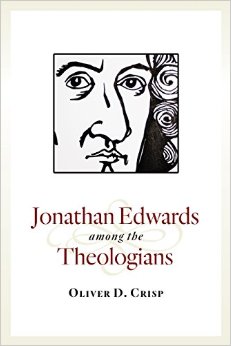
Today, EdwardsStudies.com had the opportunity to chat with Oliver Crisp, one of the most productive Edwards Scholars on the global scene today. Not only has Dr. Crisp had several significant works about Jonathan Edwards published to great reception in recent years, but his new work, Edwards Among the Theologians is also being received with accolades as well. 
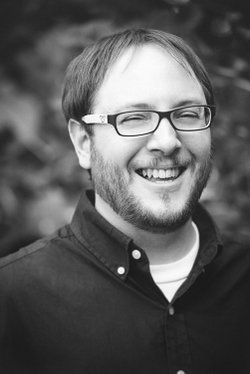
First question: What the heck happened to the beard? A couple years ago you were rocking the manly mug, now you look like a freshman again. What gives? 
 
The beard comes and goes. A friend said to me recently, “Well, you can always grow it back!” I guess that’s true. Watch this space …
olivercrisp1
 
When I read your book Jonathan Edwards on God and Creation last year, I didn’t notice the accent. But when I listened to a talk you gave recently, I could tell you weren’t from Brooklyn. Give us two-cents worth of your back story. 
 
I was born and raised in London, England. Went to Art School in London. Then went to study Divinity (Theology) in Scotland. Taught high school for a bit, got a ThM in Divinity also from Scotland. Became a trainee minister for three years. Wrote a PhD at King’s College, London. Then taught at the University of St Andrews for a couple of years before doing a Postdoc at the University of Notre Dame. After that we relocated to the West of England, where I taught at the University of Bristol. We had a year at the Center of Theological Inquiry, Princeton. Then, after a brief stint back in Bristol, we moved out to California to teach at Fuller Seminary, which is where I am now. I’m also about to start teaching a bit for the new Institute for Analytic and Exegetical Theology at the University of St Andrews.
 
How did you get hooked on Edwards? 
 
Two sources: the first was John Piper’s Desiring God. The second was a pastor friend of mine who gave me a biography of Edwards to read as I went up to University as an undergraduate. It left me fascinated. As a consequence, I decided to read Edwards on the Will as an undergraduate. Then things really got out of hand and I ended up writing a PhD dissertation on him. The rest you know.
 
So what’s the deal: is Edwards a panentheist or a full-blown pantheist? Has the needle moved on your position?
 
No, I haven’t changed my view. I think Edwards is committed to panentheism (all-in-god-ism). I argued that in my book Jonathan Edwards on God and Creation (OUP, 2012), and others have said something similar. But I now think that there are tendencies within Edwards’s thought that press him in the direction of pantheism (all is god). He would never have embraced that, of course. But there are things he does say that seem to lead to that conclusion–and this was the conclusion that Charles Hodge came to in the nineteenth century as well. So I guess I think that there is more than one Edwards, depending on how you weight certain claims that he makes in his works.
 
What is the new ground you are covering in Jonathan Edwards Among the Theologians. Any new or fresh insights since your previous works came out? 
41hxmitxbkl-_sy344_bo1204203200_
 
You’ve just named one: the pantheism question. That is a pretty big change for me. Another: my views on his doctrine of the Trinity changed since my previous book. I read Kyle Strobel’s book on Jonathan Edwards and it made me rethink my own position. Although I don’t end up agreeing with Kyle, I think his interpretation makes a lot of sense and was the means by which I came to see something about Edwards’s account of the Trinity that I hadn’t seen before. I now think that Edwards presents a truly novel model of the Trinity–a very rare thing indeed.
In addition to these, the chapter on Edwards’s preaching is something I’ve not put in a monograph before. Also, putting Edwards in “dialogue” with other classical Christian thinkers enabled me to show how his views are often not quite what you’d expect. For instance, he turns out to have a much less straightforwardly orthodox account of creation than Arminius–not a conclusion some people will be expecting!
 
What are some of the primary sources you are digging through in Edwards Among the Theologians? 
 
The major works of Edwards such as Freedom of the Will; God’s End in Creation; and Original Sin. Also, his Discourse on the Trinity, and his notebooks, as well as some of his sermons.
 
Your last chapter is on the orthodoxy of Edwards. Give us a hint as to where you land on that. 
 
I think that, from a certain point of view, Edwards’s views press at the very boundaries of what most Christians will consider theologically orthodox. In the final chapter, I go into that in some detail, arguing (in keeping with Charle Hodge) that Edwards’s views press him beyond panentheism towards pantheism. Those who have read Edwards’s sermons and some of his more devotional works may be a bit shocked to read this, but it is nothing more than drawing out issues that are latent in his work. Edwards was a strikingly original thinker. Sometimes his originality gets him into trouble.
 
What are you working on right now? Any new projects? 
 
I’m finishing up an Introduction to Jonathan Edwards co-written with Kyle Strobel. This should be going to Eerdmans for publication in the next couple of years. I’m also currently writing a book on the atonement for Baker Academic, entitled Substitution and Atonement.
 
Shout outs or recommendations? 
 
Read Edwards. His works are available online via the Yale Jonathan Edwards site. Read his God’s End in Creation, and his Religious Affections. Then read some of the harder material. As to secondary sources: read Kyle Strobel’s book; read Douglas Sweeney’s recent work Edwards the Exegete, which is terrific; and, as a good work of reference, Michael McClymond and Gerald McDermott’s The Theology of Jonathan Edwards is a significant contribution. Finally, read George Marsden’s biography of Edwards. You won’t regret it.

Interview with Kyle Strobel

EdwardsStudies.com is pleased to be talking today with Kyle Strobel, noted Jonathan Edwards scholar, author of some great books on the Northampton Puritan, and also the son of the award winning writer, Lee Strobel. Kyle, I just gave copies of The Case for Christ and The Case for Faith to an inquirer this very morning. What’s your dad up to these days? 

Well, pretty much the same as usual – working on books and preaching. He is currently on faculty at Houston Baptist University teaching evangelism courses and is a teaching pastor at Woodlands church. These days he is enjoying being a grandfather quite a lot, so that takes up a good deal of his time!

61hffrdjjl-_ux250_

I’m sure everyone asks, but what was it like growing up with a pretty well known speaker/writer as your father?

It is hard to summarize really. Mostly positive. It is a bit unusual when everyone seems to know your father and have an opinion about him. It is also unusual when people make all sorts of assumptions about you based on what they know about your father. But overall it was just normal for me.

How did you get started studying Jonathan Edwards? 

When I went to the University of Aberdeen to work on my PhD in systematic theology I didn’t know what my dissertation topic would be. My supervisor mentioned Edwards because he knew I was particularly interested in the interplay between theology and spirituality. So I started reading Edwards seriously for the next six months, making my way through several of his major works, and at that point I was hooked!

You mention the Reformed tradition in your works and lectures from time to time. Did you grow up Reformed or was that something that you discovered later in life? Do you consider yourself part of the broader Reformed tradition today?

This is something that has come up later in life for me. I grew up somewhat antagonistic to Reformed theology, but like most people, I really didn’t know what that meant. I was confronted with a reductionistic and superficial version of it, and so I critiqued it for being reductionistic and superficial! I consider myself Reformed, but I do so in a very broad sense. I am not confessionally Reformed – although I love the confessions of the Reformed tradition. I am Reformed in a more methodological way. The task of Christian theology is to think well about God and the content of theology in light of God. I take that impulse to be at the heart of Reformed theology.

If you don’t mind my asking, where are you worshiping on the Lord’s Day? 

I am on the teaching team at Redeemer Church in La Mirada, CA. I preach there monthly.

Let’s start with your much harder book, Jonathan Edwards’s Theology: A Reinterpretation. Tell us, in layman’s terms, what you are trying to accomplish here. 

Basically, my Reinterpretation book is an attempt to provide a way to read Edwards. In other words, this book provides a hermeneutical key to reading Edwards well. If we are going to read Edwards well, as I argue, we have to read him as he wanted to be read. We have to take seriously his Reformed impulses and we have to understand the inner-logic of his thought. This leads us to an overall orientation and direction in which to read Edwards well. As I argue there, we have to read him from the top-down – and therefore from his doctrine of the Trinity through his doctrine of creation in light of his understanding of the consummation of all things. This allows us to triangulate doctrine in light of who God is, what creation is, and where God is leading creation. I test my analysis by looking at spiritual knowledge, regeneration, and religious affection, showing how my distinct reading can speak into these three topics.

Why is a “reinterpretation” necessary?

With only a handful of exceptions, I don’t think Edwards is often read theologically. Because of Perry Miller’s emphasis, I think, we often read Edwards as a radical philosopher who appended a generic Reformed theology onto an already established philosophical framework. I think this is misguided. But the problem is that Miller, and those following in his wake, have done a better job of casting a vision for how to read Edwards. Scholars have responded to Miller and his line, but they never really did much to establish an alternative reading (and way of reading). My work is an attempt to fill in that gap. This is why, for better or worse, I spend a lot of time in the footnotes outlining how my view relates to or (more often) undermines other views in the secondary literature.

When I was reading it, I thought to myself, “Man! This guy really likes the word ‘qua!’” Aside from your obvious enthusiasm for the Latin term, what else do you think this work contributes to the advancement of Edwards studies overall? 

Qua” is a great term! Next to giving a methodology for reading Edwards, I think the most important contribution would be my analysis of Edwards’s doctrine of God. I argue that Edwards changed his view of the Trinity and no one seemed to notice. I argue for a distinct view of how Edwards’s argument works in his “Discourse on the Trinity.” I argue that Edwards’s view of God is “religious affection in pure act” (what I call, in the book, “Personal Beatific-Delight”). In light of these features of Edwards’s doctrine, I seek to show how his emphases guide his theology.

Your book Formed for the Glory of God: Learning from the Spiritual Practices of Jonathan Edwards is much more accessible for lay readers. Who did you have in mind when you wrote it? 

I had two main audiences in mind with that book. I was aiming it at lay people, but I was particularly interested in folks who appreciate Reformed theology (or who call themselves “Calvinists”) and those who are interested in spiritual formation. For the first group, I wanted to show them what a distinctively Reformed view of spiritual formation could look like. No one has ever really outlined Edwards’s understanding of spiritual formation before, and so I wanted to offer that to folks. But I also wanted to show people interested in spiritual formation that a distinctively evangelical reading, albeit a Reformed version, would develop into a specific kind of spirituality. I wanted to show the laity (and pastors) that our theological views are not divorced from our understanding of the practical realities of the Christian life.

In the appendix, you mention The Jonathan Edwards Project. Tell us a bit about that. How is progress going? 

Things are going well. Along with my edited version of Edwards’s Charity and Its Fruits, I am co-editing a volume of Edwards’s spiritual writings for the Classics of Western Spirituality series. I am still editing academic works on Edwards, and Oliver Crisp and I are nearly finished with our introduction to Edwards’s Christian thought. This volume with Oliver is the next major addition to my project, because we believe this could be the go-to introduction to Edwards’s thought. I am writing three chapters outlining Edwards’s theology while Oliver writes three chapters outlining Edwards’s philosophy. The book is due at the end of the Summer with Eerdmans.

Are you going to continue studying Edwards, or are you going to open some new channels of study in the future? 

I will slow down my research on Edwards a bit but I’ll never put it aside completely. I am a systematic theologian, so my interests are not primarily historical but doctrinal (not that I want to divide those two). Whenever I want to think about a doctrine I start with Edwards, and so that is where you see a lot of my work on Edwards come out. For instance, I have an article coming out with Harvard Theological Review called “Jonathan Edwards’s Reformed Doctrine of Theosis,” because I wanted to think through that topic more. I also have finished a chapter for a book on Edwards’s understanding of theologically anthropology, because that is a topic captivating me at the moment.

Any shout-outs or book recommendations for Edwards fans? 

I am particularly excited about the essays in a new edited volume I did called The Ecumenical Edwards: Jonathan Edwards and the Theologians. What I like about this volume is that it includes Protestants of all kinds as well as Roman Catholic and Eastern Orthodox theologians writing on Edwards in relation to another theologian (or school of thought). It ended up becoming a fascinating volume. My good friend Rhys Bezzant has a volume out on Edwards and the church that everyone should read, and, of course, Oliver Crisp has a new book out on Edwards (I assume Oliver always has a new book out!). There is a lot of good work being done on Edwards right now, so it is an exciting time for the guild. I am in the middle of reading Doug Sweeney’s new book Edwards the Exegete and it is great. Everyone interested in Edwards will need to read it.

Kyle, thank you so much for taking the time to talk with us at EdwardsStudies.com today! 


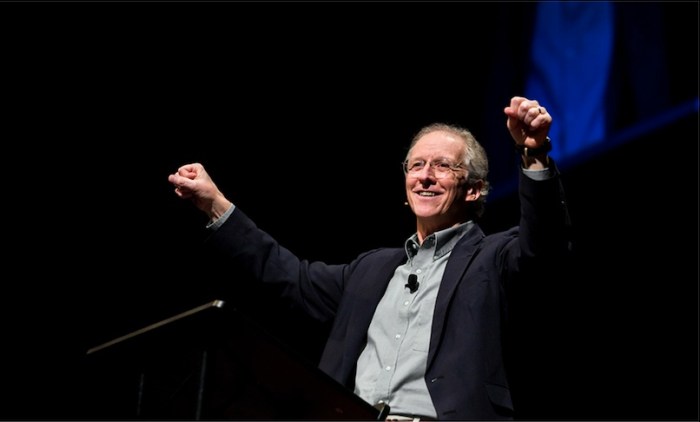
The Sermon that Reignited the Edwards Craze of the 1990’s: John Piper’s “The Pastor as Theologian”

At his 1988 Pastor’s Conference at Bethlehem Baptist Church, John Piper preached his first “Biography” message which would launch an annual tradition and a new genre category on the greatly helpful Desiring God site. Each year subsequently, Piper would read the works of one particular pastor, theologian, or missionary and give a biographical sketch at one portion of the conference. Most year’s he would then take questions for the time remaining.

For the first year, Piper chose as his subject – ultimately the first of many such sketches – his dead mentor, Jonathan Edwards. In this message, Piper sketches Edwards’s life, and gives a short history of the Bethlehem Pastor’s own reading of Edwards: first with An Essay on the Trinity, then The Freedom of the Will, The Nature of True Virtue, and the Religious Affections.

For me as for many of the new young Edwards enthusiasts, this talk sparked an interest in the man and the message of Jonathan Edwards. Piper passionately showed how the Northampton Puritan simultaneously held his “God-besotted worldview” with a massively beautiful God, how he labored daily to enjoy the Scriptures God gave the Church, as well as how Edwards maintained vigorous study habits throughout his days with Bible and pen in hand.

I suspect that this single message was as responsible as any other individual factor (although there were many) in relaunching the Edwards craze among young scholars. Piper’s passionate plea to take up the worldview of Edwards, with its gloriously central view of God’s sovereignty, and to take it back into pulpits all over the world.

Here is the audio link. 

piper-large


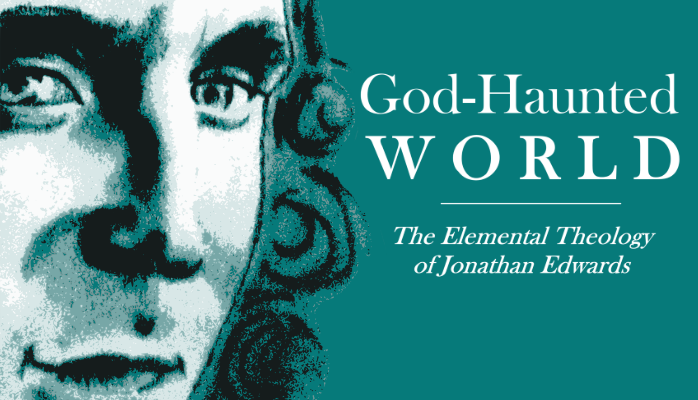
Interview with Rob Boss, Ph.D on His New Book: God-Haunted World: The Elemental Theology of Jonathan Edwards


Today, EdwardsStudies.com has the privilege of talking with Rob Boss about his new book God-Haunted World: The Elemental Theology of Jonathan Edwards.
aaeaaqaaaaaaaaymaaaajgm3odu1zdjlltjmogutngq1ms1hnjzlltczzthiodiznmflzg

Tell us a little about yourself Rob, how long have you been studying Jonathan Edwards, and how did you get interested in his works?

Thank you for the invitation, Matthew. My first encounter with Edwards was in 1994 while reading Michael Crawford’s Seasons of Grace: Colonial New England’s Revival Tradition in Its British Context (OUP, 1991). Soon afterward I purchased the Banner of Truth edition of Edwards’ works and began reading Freedom of the Will. It was an experience akin to drowning, but I persevered until I finished the Hickman edition of Edwards’ works. I then started collecting the Yale edition.

My interest in Edwards has been driven primarily by my experience of God’s grace. I found in Jonathan Edwards a doctor of the soul who could diagnose spiritual ailments and prescribe treatments that heal. His ability to direct persons to repentance and faith in Jesus Christ resonated deeply with me.

After pastoring a church in Oklahoma I returned to Southwestern Baptist Theological Seminary for Ph.D. work in church history, where I wanted to continue my study of Edwards. It was at Southwestern that I met my dissertation supervisor, Robert Caldwell. Caldwell is a careful JE scholar who studied under Doug Sweeney and has written books on Edwards’ trinitarian theology and theology of awakening.

You scored a sweet review from Douglas Sweeney and have a recommendation from Kenneth Minkema as well. Those guys are pretty awesome in our quarters. How did you score those reviews? Have you worked with them before?

“Sweet” is an apt (and even Edwardsean) description. I am very thankful that they requested review copies of my book.

I first met Ken Minkema in October of 2007 at Northampton, MA. Under the direction of Richard Hall, a conference was convened at First Churches of Northampton on the theme of “Jonathan Edwards and the Environment.”

I presented papers at a series of Northampton conferences in 2007, 2008, and 2010. Participants included Ken Minkema, M.X. Lesser, Stephen Nichols, Rhys Bezzant, Gerald McDermott, Michael McClymond, Robert Caldwell, Oliver Crisp, and other Edwardsean scholars. It was a stimulating time to say the least.

Tell us about the title of the book God-Haunted World.

The title of the book is a story in itself. When I returned to seminary for doctoral work, I met Stephen Dempster, a noted OT scholar visiting from Canada. Though from a different field, he was full of encouragement and advice. We had a number of inspiring discussions on Edwards’ typology and natural theology. During one of our exchanges, he described Edwards’ worldview as “God-haunted” and encouraged me to write a book about it.

I registered the domain name godhauntedworld.com and began writing furiously. At the end of a couple of months, I showed my writing to Caldwell, who wisely suggested that I reduce it to 20 or so pages and submit it to a journal. Instead of submitting it for publication, I submitted it to the 2007 Northampton conference on “Jonathan Edwards and the Environment.” My paper was titled “God-Haunted World: An Edwardsean Rationale for Saving the Creation.” I soon received notice that my paper had been accepted. I was elated!

In the following years, I stuck with the “God-haunted world” theme and tried to bend my doctoral papers in that direction.

What do you mean by “The Elemental Theology of Jonathan Edwards.”

“Elemental” denotes the role of nature or the elements in Edwards’ emblematic theology.

Take us through the flow of the book. How do you progress through the content?

The book begins with a brief historical survey of the emblematic worldview of the Renaissance and its adoption by post-Reformation Protestants and emblem writers. I examine some emblematic works of select individuals such as Ralph Austen, John Bunyan, Benjamin Keach, Cotton Mather, and others. I then compare Edwards’ notebook “Images of Divine Things” with theirs, noting poetic quality, doctrinal content, and the primacy of Scripture over nature. I identify Edwards’ project as a reinscripturation of the world and I explore the main theological categories of his intertextual, devotional worldview.

Tell us about some of the main works of Edwards that you discuss in this book.

I focus mainly upon his typological notebook “Images of Divine Things,” with reference to his Miscellanies, Scientific Writings, and Sermons.

What do you want readers to capture about President Edwards, the man himself, by reading this work?

I hope that readers will better understand the meditative Edwards. I want to introduce them to Edwards’ intensely devotional, reinscripturated worldview which he summed up perfectly in “Image” no. 70,

If we look on these shadows of divine things as the voice of God, purposely, by them, teaching us these and those spiritual and divine things, to show of what excellent advantage it will be, how agreeably and clearly it will tend to convey instruction to our minds, and to impress things on the mind, and to affect the mind. By that we may as it were hear God speaking to us. Wherever we are and whatever we are about, we may see divine things excellently represented and held forth, and it will abundantly tend to confirm the Scriptures, for there is an excellent agreement between these things and the Holy Scriptures.

As I mention in the book, familiar objects such as spiders, arrows, death, sun, rain, plants, animals, and human events are transformed into powerful and affecting mental images in Edwards’ preaching and writing. The entire world is a vivid illustration of spiritual truth, truly a second book of revelation which provides powerfully affective images both comforting and frightful.

How did your research change your views about Edwards, if at all, during the process of writing?

A significant turning point in my understanding of Edwards came when I began to classify Edwards, Bunyan, and others like them as creative evangelical theologians. They believed that a poetic disposition is requisite to a proper understanding of Scripture and the world.

This is fascinating to me, especially since both E.O. Wilson and Richard Dawkins have given the poet-scientist an exalted role in properly interpreting the world. In Unweaving the Rainbow, Dawkins says that nature should inspire scientists to write poetry in order to transform worldviews. Jonathan Edwards says that creation is poetry. The difference is huge.

Reading Tibor Fabiny’s work helped me see Edwards in a wider context which included Luther, Shakespeare, emblem writers, and the English Baptist Benjamin Keach.

Writing about Edwards’ poetic worldview of similitudes and correspondences can be a frustrating exercise. One wants to see, touch, and manipulate his system of thought; at least I do. A recent breakthrough came when I started visualizing Edwards’ thought through complex network graphs. I was able to include some of these visualizations in the book, and am doing more on ElementalTheology.com.

The cover art is pretty cool. Who came up with that concept?

Full credit goes to my younger daughter, Sarah. While she was home on summer break from Wheaton College I took advantage of her artistic abilities and commissioned her to create a “new and cool” Edwards with a piercing and direct gaze. I think she nailed it. She also copy edited the book (though any remaining mistakes are entirely my own).

Have you read Oliver Crisp’s new work Edwards Among the Theologians?

I have read selections of it and am eager to finish it. His work is simply remarkable.

What are you reading right now?

In addition to the Bible, I am currently rereading Notes on Scripture, WJE, vol. 15, along with some Dostoevsky and Steinbeck.

Are you done with Edwards yet, or are you going to keep digging for future works?

There is much more to be explored … Edwards’ theology is an ocean of great breadth and immense depth.

Thanks for interviewing with us, Rob. Any parting thoughts or recommendations for readers of EdwardsStudies.com?

I leave you with a cool quote from Mark Noll’s America’s God: From Jonathan Edwards to Abraham Lincoln, 444.

Attentive readers of these pages will realize that if I had to recommend only one American theologian for the purposes of understanding God, the self, and the world as they really are, I would respond as the Separatist Congregational minister Israel Holly did in 1770 when he found himself engaged in theological battle: “Sir, if I was to engage with you in this controversy, I would say, Read Edwards! And if you wrote again, I would tell you to Read Edwards! And if you wrote again, I would still tell you to Read Edwards!

Sam Storms: Edwards on Original Sin

Note: this article originally appeared on SamStroms.com where dozens of excellent articles can be found on the theology of Jonathan Edwards. 

Perhaps no one in the history of the Church (aside from Pelagius) was more vocal and persistent in objecting to the reformed doctrine of imputation and original sin than was John Taylor (1694-1761) of England. His views were made explicit in a volume he wrote in 1735 entitled,The Scripture-Doctrine of Original Sin. Certainly the best testimony to the influence of Taylor’s work was that provided by Jonathan Edwards (1703-58):

“According to my observation, no one book has done so much towards rooting out of these western parts of New England, the principles and scheme of religion maintained by our pious and excellent forefathers, the divines and Christians who first settled this country, and alienating the minds of many from what I think are evidently some of the main doctrines of the gospel, as that which Dr. Taylor has published against the doctrine of original sin.”[1]

Taylor’s disdain for the reformed doctrine of imputation and original sin was grounded upon one foundational principle that he held to be inviolable: sin and guilt are entirely personal.One person’s sin is his alone and cannot be reckoned or charged to the account of another. Neither can guilt in any sense be corporate apart from the voluntary consent of all persons involved. “A representative of moral action,” said Taylor, “is what I can by no means digest. A representative, the guilt of whose conduct shall be imputed to us, and whose sins shall corrupt and debauch our nature, is one of the greatest absurdities in all the system of corrupt religion.”[2]Concerning Adam and Eve, he insisted that as the sin “they committed was personal, done only by them; so also must the real guilt be personal, and belong only to themselves; that is, no other could, in the eye of justice and equity, be blameable and punishable for that transgression, which was their own act and deed, and not the act and deed of any other man or woman in the world.”[3]

Taylor argues that only the person who has a “consciousness” of sin can justly be held guilty for it. It is absurd to suppose that an infinitely righteous God would charge with a crime persons who had no hand or choice in its execution, indeed, a crime committed before they even existed. Such is possible only on the “purely imaginary”[4] supposition that one man’s consciousness, and therefore liability of guilt, is transferable to another. To charge God with such an act is “highly profane and impious.”[5]

Finally, in a statement that fairly shook with indignation, Taylor sums up his feelings concerning the reformed doctrine of original sin:

“But that any man, without my knowledge or consent, should so represent me, that when he is guilty I am to be reputed guilty, and when he transgresses I shall be accountable and punishable for his transgression, and thereby subjected to the wrath and curse of God, nay further that his wickedness shall give me a sinful nature, and all this before I am born and consequently while I am in no capacity of knowing, helping, or hindering what he doth; surely anyone who dares use his understanding, must clearly see this is unreasonable, and altogether inconsistent with the truth and goodness of God.”[6]

Is imputation immoral? Is it unjust? Is it wrong for God to hold us accountable for the sin of Adam? Many have responded to these questions, but none with more creativity and depth than Jonathan Edwards. What was his solution to the problem posed by the doctrine of original sin?

If we are to understand Edwards’ solution to this problem we must come to terms with two crucial and controversial concepts he developed: his doctrine of “continuous creation” and his theory of “personal identity.” We will begin with the doctrine of continuous creation (creatio continua).

Who “Caused” It?

According to this doctrine, the initial creation ex nihilo of all things was but the first act in a never-ending series of creative acts whereby God each moment preserves and upholds the existence of all things. The same power required to bring an entity into being is required to sustain it in or as being. Therefore, the distinction between “creation” and “preservation” or “conservation” is only semantic, not conceptual. Edwards argues that it is by means of a continuous creation from instant to instant that all created substance, both material and immaterial, is preserved in being. Thus he says that

“God’s preserving created things in being is perfectly equivalent to a continued creation, or to his creating those things out of nothing at each moment of their existence. If the continued existence of created things be wholly dependent on God’s preservation, then those things would drop into nothing, upon the ceasing of the present moment, without a new exertion of the divine power to cause them to exist in the following moment.”[7]

The doctrine of continuous creation simply asserts that the existence of any and all entities at any and all times is the immediate effect of divine power. Edwards would insist that event B always follows event A, not because A is the efficient cause of B, but because God has ordained that when A occurs (an event that God produces ex nihilo), B will follow. What you and I might call a causal sequence Edwards calls a series of divine acts. All substance and all events are productions of divine power, continuous creations. Event B does not follow event A because of some mechanistic impact of A on B. The principle on account of which B necessarily follows A is the will of God operating on B so that it will follow A. It is the divine wisdom which has determined that it was fitting for B to follow A and for A to precede B in the order of nature (and not anything in A or B themselves).

TO READ THE REST OF THIS ARTICLE, CLICK OVER TO SAMSTORMS.COM

Three Years in the Mind of a Genius: Reflecting on Reading My Dead Mentor

One of the best pieces of advice I ever received was to pursue a handful of theological mentors as a lifelong learner. I believe it was John Piper who wrote something to that effect in one of his books. He had chosen Jonathan Edwards as one of his own “dead mentors,” and I too began to be intrigued by the idea that I could take just a few of the great dead theologians and study their thinking reflectively. I mean, really delve deeply into their thought and way of life to absorb as much as possible about them.

In some sense, we must all choose between reading broadly and reading deeply to some extent. We could choose, for instance, to read quite broadly from a bit of Augustine, Luther, and Edwards here,  and then a little bit of Warfield, Lewis, Piper, Packer and others there. In fact, I see great value in that sort of enterprise. After all, I do want to be well read, and I think most other scholars, theologians, and pastors feel the same. But we’d probably have to skim across the top, and read just a few of their well known works to really get to know each of them.

Another approach could be to choose to read deeply and reflectively in just one or two of these authors, if perhaps only for a few months or years at a time. After all, the shortness of human life, the finitude of our humanity, and the competition for our time from other endeavors in life (such as the priority of church, ministry, and family) all necessarily limit our scope and ability to read all that we want to read.

So I took Piper’s advice and for the last three years, I have been trying to live in the mind of just two men, the dead theologian Jonathan Edwards, and the living theologian John Frame. I have to admit that this has been very good for my overall thinking.

I chose Jonathan Edwards for my doctoral dissertation at Reformed Theological Seminary, and I didn’t look back. I made this decision consciously, and having already sampled quite a bit of his material in prior years, especially his sermons. I determined to read Edwards for a number of reasons: 1. Edwards represents some of the best thinking in my own tradition, Reformed or Calvinistic evangelicalism. 2. Edwards is regarded as one of the best, if not the best, theologian America has ever produced. I could read him in his own language, English, untranslated. 3. But my third reason was most important: he spoke about joy as much or more as any other theologian I know of. If Luther is the theologian of justification, and Calvin is the theologian of the Holy Spirit, Edwards must certainly be the theologian of joy.

Stressed and worn by several hard years of pastoral ministry, I needed a good dose of joy and Edwards was just the one to give it to me. My topic for my dissertation then became “Jonathan Edwards’s Theology of Joy.”

So for the past three years I have been studying the life and ministry of Jonathan Edwards. I read his Religious Affections, The End for Which God Created the World, The Nature of True Virtue, The Distinguishing Marks, Freedom of the Will, and many more.

In the best sense of the word, I have stalked him. I’ve been rummaging through his major works. I’ve been ruminating in his personal papers and Miscellanies. Even eavesdropping into his private letters. And I have found joy everywhere.

[See also my post: Top Ten Edwards Books]

In the coming months, I hope to publish my findings from my dissertation more broadly so that others too can savor the gleanings of joy that I found in Edwards. But before I wrap up this post, I want to give just a few reasons why you too should consider spending a few months or years in the mind of a genius like Edwards.

1. Choosing a dead theologian takes us out of our limited culture and experience and puts us into the midst of the trials and struggles of saints who have gone before us. I especially appreciated walking with Edwards as he found joy in the tumults of his own times: the threats of Native Americans, the tensions regarding the Great Awakening, and even the looming danger of such diseases as tuberculosis, which eventually took the life of his friend David Brainerd. These struggles, although greatly different from our own, actually show us how much we have in common.

2. Reading a dead theologian helps us to think perspectivally. As I go through my day, reading my Bible, talking to my staff, playing with my children – I can’t help but be myself. None of us can be anything other than ourselves! And yet reading deeply and reflectively in another man’s works helps us to see life (even our Bibles!) through another lense. Through another perspective. Having read dozens of books by and about Edwards, I can’t help but ask myself “How would Edwards have viewed this?” or “What would Edwards have done about this problem?” Considering our situations from another perspective helps us to be more objective thinkers and overall, more creative and credible preachers, and writers (or artists, homemakers, or engineers as the case may be).

3. Finally, by reading a dead theologian, I got a fresh glimpse of Edwards’s God. The Northampton Puritan helped me to see God again and in bright, daring new ways. The God of Sinners in the Hands of an Angry God is certainly different from the milder, more domesticated God of many seeker-friendly churches today! Edwards expanded my view of God’s greatness; His holiness, justice, and power. Most of all, and perhaps this is particular to Edwards, I saw God again as Holy Trinity. Edwards is constantly reminding his readers that salvation is accomplished by a thrice-holy God, ever existing as Father, Son, and Holy Spirit. And this God – is relentlessly joyful in Himself.

Matthew Everhard is the senior pastor of Faith Evangelical Presbyterian Church in Brooksville, Florida and the curator of EdwardsStudies.com. 

Jonathan Edwards’s Blank Bible

Jonathan Edwards’s Blank Bible

(Editor’s Note: This post originally appeared on Bible Design Blog on May 28, 2015).

The Blank Bible

Two famous men in Colonial-American history owned Bibles that had literally been cut to pieces and then stitched back together again.

The first, was Thomas Jefferson – more concerned with morality than divinity – who famously edited out the miraculous and the supernatural from Scripture. Hardly an orthodox Christian by any definition, Jefferson simply cut away the portions that he did not like.

The other man was the famous New England Puritan, Jonathan Edwards (1703-1758), considered by some to be the greatest scholar that America has ever produced. Edwards’s own rebound Bible had an entirely more sacred purpose – he took copious notes on nearly every major section of Scripture.

The story of this particular Bible is relentlessly fascinating.

Edwards Blank Bible2

What is the Blank Bible?

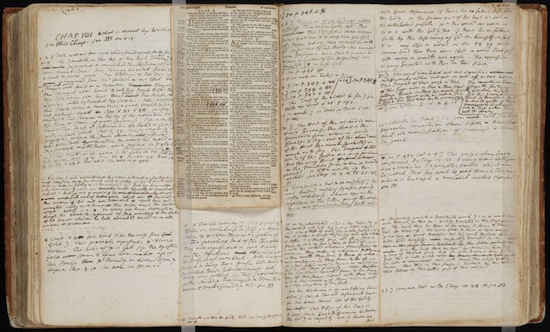
Dubbed by most (including Edwards himself) as the “Blank Bible,” the official title of the manuscript is technically “Miscellaneous Observations on Holy Scripture,” and can be found today in the Beinecke Rare Book and Manuscript Library at Yale University. There, you can see it yourself – possibly handle it even – provided of course that the curator is in a good mood, and that you lick the orange Cheetos powder off your fingers before touching it.

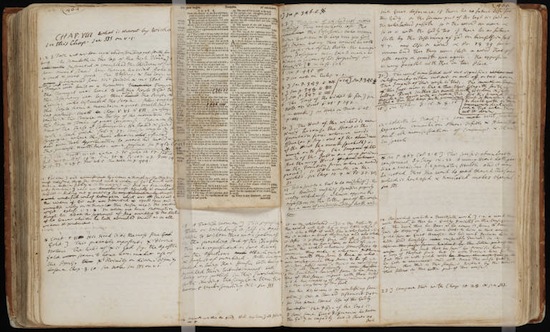
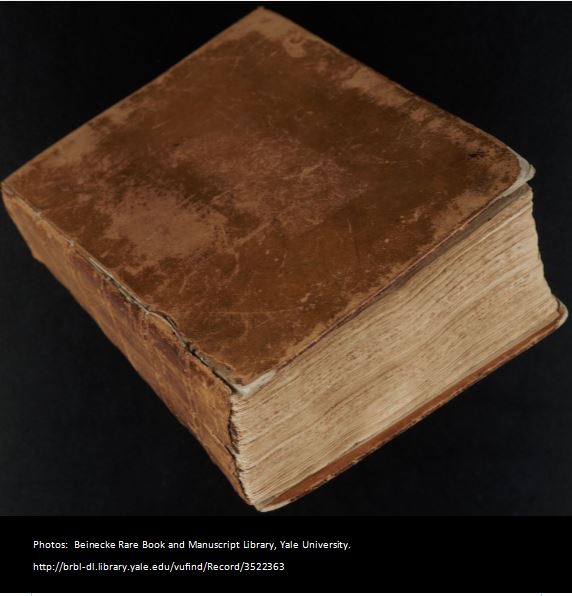
The Blank Bible is entirely unusual in construction: it is really two books in one. It consists of a large 9.5 X 7.5 inch blank writing notebook, nearly three inches in girth, into which an entire miniature King James Version of the Bible has been meticulously stitched. Bound in brown leather over board , the book literally looks like one larger volume ate a smaller one for dinner.

Picture something the size of an ESV Study Bible, but fatter at the top than the bottom. From the side view, it looks like a python trying to squeeze down a meal.

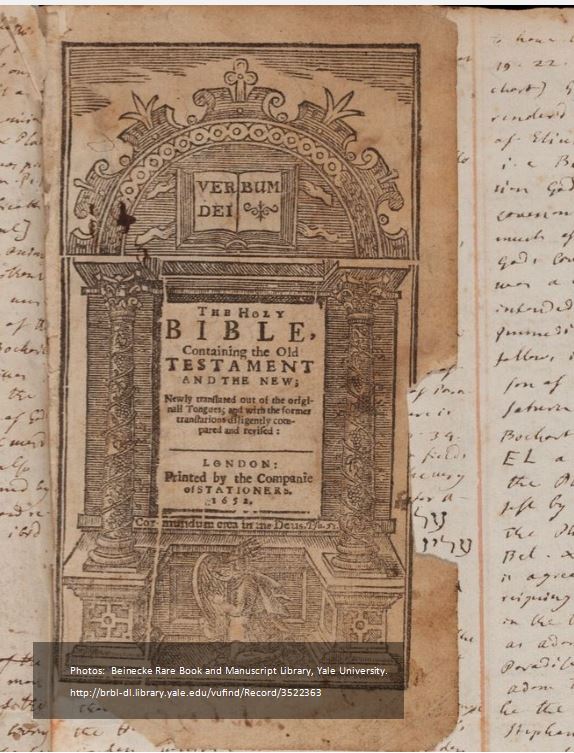
The smaller book, a 1653 King James Bible, printed in London by the “Company of Stationers” is a miniscule, double-column, AV with both side and center column references, along with some study notes provided by the publisher to boot. Someone (not Edwards) who was very skilled in bookbinding took apart both original books, first removing their signatures and cutting apart the individual sheets, and then splicing together the larger blank pages with the smaller text of the KJV. Finally, the boundary sewed the newer, larger work together as an irregularly shaped monolith.

Blank Biblec

History of the Strange Apparatus

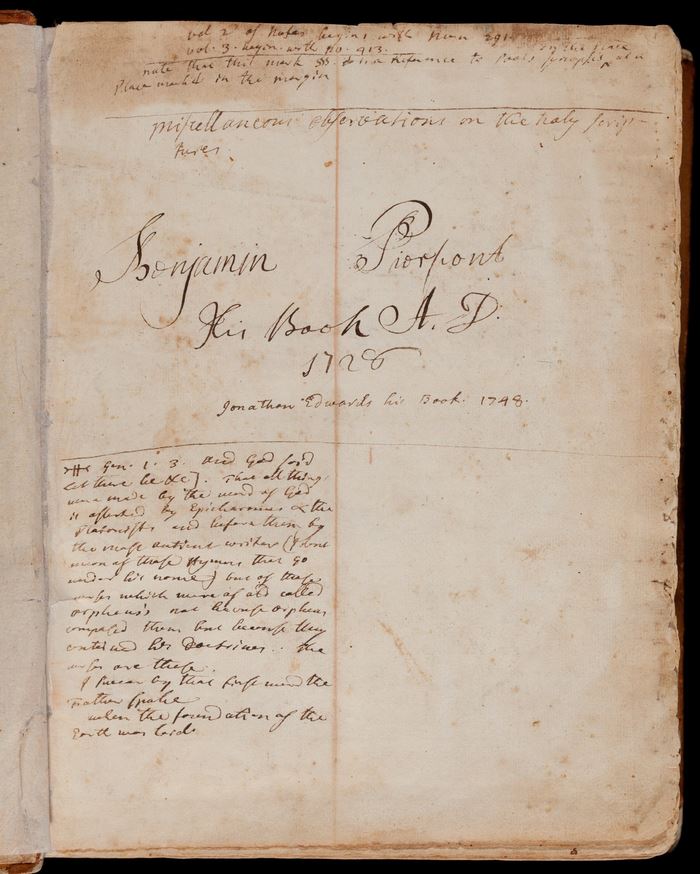
Apparently the Blank Bible came into Edwards’s possession through family: it bears the name and handwritten signature of his brother-in-law, Benjamin Pierpont, and is dated by the same in his own script in 1728. A young candidate for ministry, Pierpont never actually ended up being ordained unfortunately. Apparently, he came into some controversy with the local clergymen having acted “apishly” around the young ladies, and was dubbed unfit for public ministry. Sadly, he died sometime thereafter.

Clearly interested in owning the unique book himself – no others like it exist – Edwards obtained possession of the Blank Bible sometime around 1730, probably through the mediation of Sarah his wife. Whether Benjamin could see that his ministry career was going nowhere and gave it to Edwards himself before he died, or whether it came to Edwards as part of the deceased’s estate is unknown. However it came into Edwards’s possession, it had already collected around 70 of Benjamin’s own thoughts and comments on Scripture. No matter. All the New Hampshire Puritan would do is add another 5,506 entries or so over the next thirty years.

The Bible itself is still in remarkably good condition. Its high traffic wear is from daily use, not at all from neglect or abuse. One theory holds that the current cover is itself yet another rebind. The fact that the signatures appear to have been tightened up against the inner columns, resulting in a smaller gutter, suggests that it was used so much by Edwards that the minister again took it to a professional, who cinched the signatures even tighter, added a newer cover and sewed it up again for a third time. A note in the flyleaf from Edwards himself dating the book to 1748 (almost twenty years after he received it) may support that theory.

Blank Biblef

So You Want to Read it Huh?

In terms of its contents, the Blank Bible contains a treasure trove of information for Jonathan Edwards scholars to devour. As a matter of fact, some people are surprised to know that there are thousands of pages of Edwards’s materials that have still never been published. This volume, too, has only recently come into publication thanks to scholar Stephen J. Stein who meticulously transcribed Edwards’s nearly indecipherable handwriting into the 24th Volume of the complete Yale edition Works of Jonathan Edwards (2006).

This is a good news/bad news deal for eager readers, though. The bad news is that if anyone wants to actually read the thoughts of Edwards on various texts throughout the Bible in the published volume of the Yale Edition, they will have to fork over $225.00 claims to do so.

The good news is that the Jonathan Edwards Center at Yale University has graciously hosted the entire volume digitally, published for free on the internet, alongside a host of other Edwards manuscripts, sermons, and treatises.

Blank Bible3.JPG

Writing Your Own ‘Miscellaneous Observations’

For some, this unique book will create a desire to replicate a Blank Bible of their own. For those who are interested in creating their own ‘Miscellaneous Observations on Scripture,’ there are options. It may not be feasible to do what Edwards’s Bible managed to do – merge two existing volumes into one. But it may be possible to attempt what Edwards did in spirit at least. Today, high quality Bible publishers have given us a number of options for those who want to work closely with the sacred text: just like a Puritan!

First, consider a wide margin edition. I have written about the glory of these editions elsewhere as has Mark. While you may not be able to pour 5,506 entries into the space just over an inch wide on either margin, at least you won’t have to dip your quill into the ink to write every third letter either.

Second, Crossway is making some really cool journaling Bible options now too. Their new single column journaling Bible improves on the previous edition, now by reducing the text of Scripture down to one column instead of two columns. In this way, confusion between which column of Scripture you are referring to in the lined margin space is eliminated.

If neither of these options work for you, it is still possible to acquire loose-leaf editions of several major Bible translations. Although you’ll never get that sweet leather smell, a three ring binder will give you the ability to add notes as your collection of “Miscellanies” grows.

So, go make a “Blank Bible” like Jonathan Edwards! Just don’t edit out the parts you don’t like as did Thomas Jefferson and become “Sinners in the Hands of an Angry God.”


– Matthew Everhard is the Senior Pastor of Faith Evangelical Presbyterian Church in Brooksville Florida. He is the author of Hold Fast the Faith: A Devotional Commentary on the Westminster Confession of 1647 and a few other shorter books. 


Sources:

“The Blank Bible.” Ed. Stephen J. Stein. Jonathan Edwards Center at Yale University Online. Works of Jonathan Edwards. Vol. 24. http://edwards.yale.edu/archive. Accessed April 2, 2015.

All pictures courtesy of the Beinecke Rare Book and Manuscript Library.