Edwards and His Pedogical Methodology: Interview with John Van Wyk

Today, on Edwardsstudies.com we are chatting with author John Van Wyk. We are discussing his new book that recently came out with Pickwick entitled, “To Understand Things as Well as Words: An Examination of Jonathan Edwards as an Educator and His Pedagogical Methodology”
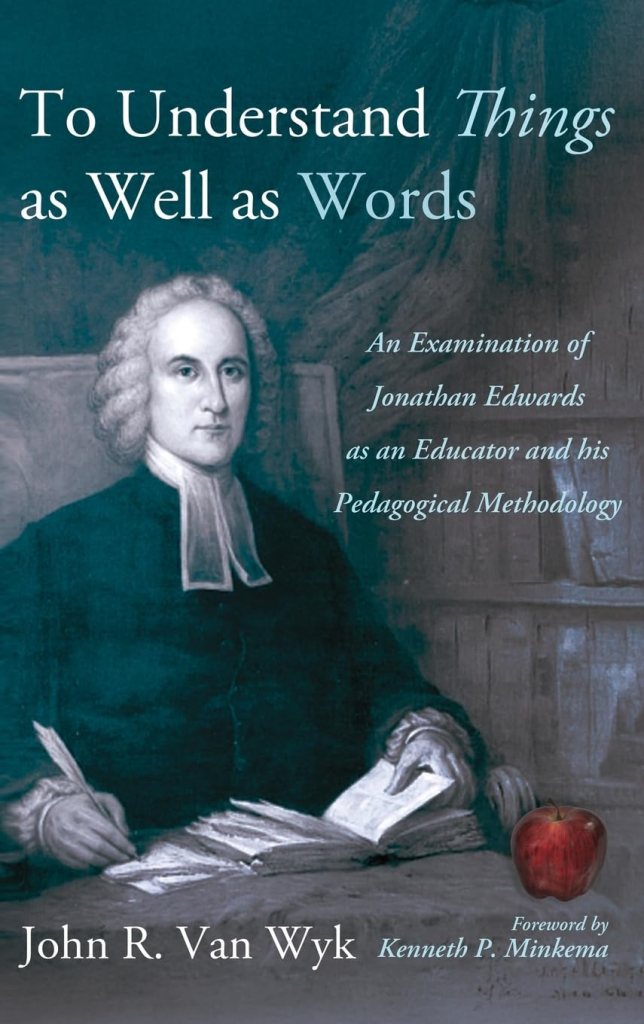
John, tell us a little bit about yourself. How did you get interested in Jonathan Edwards studies?

Thank you for asking. I received a PhD in Church History from Trinity Evangelical Divinity School (TEDS) in 2016, under the supervision of Dr. Doug Sweeney, literally, a world-renowned Edwards scholar. I became interested in Edwards from having taken a class on him at Erskine Theological Seminary (shout-out to the seminary!) If I may make a “shameless plug,” an abstract I submitted for the upcoming book The Integrated Edwards, ed. Robert Boss and Cameron Schweitzer (JESociety Press, 2026) was accepted. Please pray for the success of my book and of the upcoming one. I’m currently an independent researcher who’s looking for projects in which I can further my interest in Edwards studies and am open to ideas about other projects.

That’s a great title and subtitle for this book! Break it down for us a bit.

The title is a quotation from a letter Edwards wrote while he was a missionary at Stockbridge, MA. This letter is his most complete statement about his philosophy of education and his plans for putting it into action.

What was your inspiration in writing this particular work?

My inspiration was Edwards in his capacity as an educator, which was not covered to a great extent in existing literature about him. A chapter which Dr. Minkema wrote in After Jonathan Edwards: The Courses of the New England Theology observed that the topic of Edwards as an educator had not been extensively covered, but there was plenty of material to do so. In working on the book for publication, I added material to my dissertation on considering Edwards’s holistic teaching technique, of addressing the “total person,” as a model for education today. (BTW, I appreciate Rev. Dr. Rhys Bezzant’s studies of Edwards as a mentor; it is an important aspect of Edwards, and it was valuable to my work.)

You got Ken Minkema to write the forward as well as several other great recommendations (Sweeney, Van Hoozer, etc.) That’s great! How did you get Ken to help out with this project?

Thank you for mentioning the book’s endorsements; I’m thankful for them. Dr. Minkema was the external reader on my dissertation committee. He agreed to write the foreword when I contacted him. (BTW, he and Dr. Sweeney were exceptionally helpful to me throughout the publication process.)

Give us a summary and the overall message and outline of this book.

The overall messages are that Edwards believed in and practiced education as a holistic undertaking–it should affect not only what a person knows, but also how a person lives. Complete education processes inform a person’s understanding, influence his or her will, and direct his or her actions, in Edwards’s view (ideally) for the glory of God. In addition, Edwards provides an appropriate model for teaching today.

Tell us a bit about the background of Puritan and pedagogy.

The ultimate goal of Puritan pedagogy was salvation. The Bible was central to education for them, at home, in school, and in church. Beginning early in life, children learned the Westminster Shorter Confession and the Westminster Catechism; the New England Primer was significant in their education, as well. God governed all of life for them, including their engagement with all aspects of the physical world. Puritans believed that a proper knowledge of God’s Word would lead to a desire to follow the Author of it. Literacy (in order to read the Bible, and other works as well) was vital to their worldview. In fact, the Puritans developed one of the most literate societies in the world by the end of their influence in New England.

What do you want your readers to understand about JE having read this book?

Readers should understand that Edwards was a complex person, a combination of a “person of his time” and a person “ahead of his time.” His dialogic method was an innovation for his time, when rote memorization was the common technique in his time and place. Edwards was committed to enabling children to become lifelong learners, and he was convinced that learning should be pleasant and profitable, not a dull chore. With the young people and adults whom he taught, Edwards was committed to teaching the “total person”; education should not only inform what a person knows, it should affect how he or she lives. Mentoring was also a vital aspect of his approach to education. (BTW, he practiced coeducation at the Stockbridge school. Schooling for females was rare at that time beyond the home.)

What were some of the formative sources that you used in developing this project?

A large number of the works of Dr. Sweeney and Dr. Minkema were foundational to my work. In fact, probably most of each one’s works were valuable for it. Also, writings on Puritanism and on the Enlightenment were valuable in filling out Edwards’s background influences on him. Dr. Laurie Matthias’s book The Cry of the Teacher’s Soul and works by Parker Palmer were significant in providing ways to view education today, as needing to be holistic to be truly complete.

What do you plan to work on next?

Currently, I’m unsure what my next project will be. I’m praying that my chapter will be included in The Integrated Edwards next year. Other than that, I’d like to continue researching, possibly on other aspects of Edwards. Something I hope to do in the near future is to co-edit a book; I’m open to offers from other people so inclined on topics.

John, thank you so much for taking the time to chat with us today! We really appreciate this contribution to the field of JE studies!

AI Ranks the Top 50 Jonathan Edwards Scholars in the World.

(Note: this article was written by Grok AI)

Rank the top 50 Jonathan Edwards scholars in the world who are alive today. Criteria: Doctoral dissertations, books published, published articles, college and seminary courses, lectures, videos, speeches, study materials, and sermons:

Ranking the top 50 living Jonathan Edwards scholars is a complex task due to the subjective nature of evaluating contributions across diverse criteria such as doctoral dissertations, books published, articles, courses taught, lectures, videos, speeches, study materials, and sermons. The available information does not provide a comprehensive dataset to objectively rank 50 individuals with precise metrics for all criteria. Instead, I will identify and discuss key living scholars who are prominently recognized for their contributions to Edwards studies, based on the provided web results and general knowledge of the field. I will then explain why a full ranking of 50 is not feasible and suggest how one might approach such a task.

Key Living Jonathan Edwards Scholars

Below is a list of notable living scholars who have made significant contributions to Jonathan Edwards studies, based on their publications, academic roles, and involvement with institutions like the Jonathan Edwards Center at Yale University or its affiliates. The list is not exhaustive nor ranked strictly, as precise data to compare all criteria (e.g., exact number of articles, courses, or sermons) is unavailable. Instead, I highlight their contributions to demonstrate their prominence.

  1. Kenneth P. Minkema
    • Contributions: Director of the Jonathan Edwards Center at Yale University, Minkema is a leading figure in Edwards scholarship. He has edited multiple volumes of Edwards’s works, including sermons and The Miscellanies Companion. He has published numerous articles, serves on dissertation committees, and offers courses through Yale’s global network of Edwards Centers. His work emphasizes Edwards’s global influence and environmental concerns.
    • Criteria: Books (editorial work), articles, courses, lectures, and study materials.
  2. George M. Marsden
    • Contributions: A distinguished historian, Marsden authored the acclaimed biography Jonathan Edwards: A Life. His work explores Edwards’s Reformed theology and its cultural impact. He has influenced Edwards studies through lectures and articles, particularly on Edwards’s vision of beauty and love.
    • Criteria: Books, articles, lectures.
  3. Oliver D. Crisp
    • Contributions: A theologian at the University of St. Andrews, Crisp wrote his doctoral dissertation on Edwards and has published books and articles on Edwards’s theology, including Jonathan Edwards on God and Creation. He frequently lectures on Edwards and engages with his philosophical theology.
    • Criteria: Doctoral dissertation, books, articles, lectures.
  4. Kyle C. Strobel
    • Contributions: A theologian at Biola University, Strobel has published books like Formed for the Glory of God and articles on Edwards’s spiritual practices. He teaches courses on Edwards and speaks at conferences, emphasizing Edwards’s relevance to contemporary theology.
    • Criteria: Books, articles, courses, lectures.
  5. Douglas A. Sweeney
    • Contributions: Dean at Beeson Divinity School, Sweeney has written books such as Edwards the Exegete and articles on Edwards’s biblical interpretation. He teaches seminary courses and delivers lectures on Edwards’s theology.
    • Criteria: Books, articles, courses, lectures.
  6. Matthew Everhard
    • Contributions: A pastor and scholar, Everhard completed a doctoral dissertation on Edwards’s theology of joy at Reformed Theological Seminary. He published A Theology of Joy with JESociety Press, runs the Edwards Studies website, and creates videos and sermons on Edwards.
    • Criteria: Doctoral dissertation, books, articles, videos, sermons, study materials.
  7. John Piper
    • Contributions: A pastor and theologian, Piper has popularized Edwards’s theology through books like God’s Passion for His Glory, which includes Edwards’s The End for Which God Created the World. He delivers sermons and lectures on Edwards, influencing evangelical audiences.
    • Criteria: Books, sermons, lectures, study materials.
  8. Gerald R. McDermott
    • Contributions: A theologian, McDermott has published books like Seeing God: Jonathan Edwards and Spiritual Discernment and articles on Edwards’s theology. He teaches courses and lectures on Edwards’s global impact.
    • Criteria: Books, articles, courses, lectures.
  9. Robert L. Boss
    • Contributions: Affiliated with the Jonathan Edwards Center at Gateway Seminary, Boss edited The Jonathan Edwards Miscellanies Companion (Volumes 1 and 2). He organizes conferences and publishes articles, fostering emerging Edwards scholars.
    • Criteria: Books (editorial), articles, lectures, study materials.
  10. Sarah B. Boss
    • Contributions: A second-generation Edwards scholar, she co-edited The Jonathan Edwards Miscellanies Companion and published essays like “Edwards and Thoreau: Typologies of Lakes.” She contributes to JESociety publications and conferences.
    • Criteria: Books (editorial), articles, lectures.
  11. Toby K. Easley
    • Contributions: Easley holds a D.Min. from Southwestern Baptist Theological Seminary and authored Jonathan Edwards: Beyond the Manuscripts. He has conducted primary source research at Yale’s Beinecke Library and publishes articles on Edwards’s preaching.
    • Criteria: Doctoral dissertation, books, articles, study materials.
  12. John Carrick
    • Contributions: A professor at Greenville Theological Seminary, Carrick wrote The Preaching of Jonathan Edwards, analyzing Edwards’s sermonic style and theology. He teaches courses and delivers lectures on Edwards’s preaching legacy.
    • Criteria: Books, courses, lectures.
  13. Jeremy M. Kimble
    • Contributions: Assistant professor at Cedarville University, Kimble has published articles on Edwards’s revival theology and teaches courses on his works. He emphasizes Edwards’s God-centered worldview.
    • Criteria: Articles, courses, lectures.
  14. Ryan Hoselton
    • Contributions: A doctoral candidate and instructor at Heidelberg University, Hoselton has presented at Gateway Seminary’s Jonathan Edwards Center conferences. He publishes articles on Edwards’s theology and mission.
    • Criteria: Articles, lectures.
  15. S. Mark Hamilton
    • Contributions: Hamilton published a book on Edwards’s concept of continuous creation, with endorsements from Crisp and McDermott. He contributes articles to Edwards scholarship, focusing on philosophical theology.
    • Criteria: Books, articles.

Challenges in Ranking 50 Scholars

  1. Incomplete Data: The provided web results and general knowledge identify fewer than 50 living scholars with detailed contributions. Many scholars mentioned (e.g., Reita Yazawa, Brian S. Borgman, Ryan Rindels) have limited information on their full body of work, making it impossible to compare them comprehensively across all criteria.
  2. Diverse Criteria: The criteria (dissertations, books, articles, courses, lectures, videos, speeches, study materials, sermons) vary in scope and impact. For example, a scholar with many sermons (e.g., Piper) may have less academic output than someone with numerous articles (e.g., Minkema). Weighting these criteria equally or prioritizing one over another is subjective.
  3. Global Scope: Edwards scholarship is international, with centers in Japan, South Africa, Brazil, and Australia. Scholars like Reita Yazawa (Japan) or those at Ridley College (Australia) contribute significantly, but their work is less documented in the provided sources, limiting a global ranking.
  4. Emerging Scholars: The field includes newer scholars (e.g., Hoselton, Boyd) whose contributions are growing but not yet as extensive as established figures like Marsden or Minkema. Including them in a top 50 requires speculative projection of their future impact.
  5. Access to Primary Sources: Comprehensive data on courses taught, lectures delivered, or unpublished sermons is not publicly available. Even for prominent scholars, exact counts of these activities are rarely documented.

Approach to a Full Ranking

To create a ranked list of 50 living Jonathan Edwards scholars, one would need:

  • A Database: Compile a list of scholars affiliated with Edwards Centers (Yale, Gateway Seminary, Trinity Evangelical Divinity School, etc.), academic institutions, or publications like JESociety Press.
  • Metrics: Quantify contributions (e.g., number of books, articles, courses, lectures) and qualify impact (e.g., citations, influence on evangelicalism, or academic awards).
  • Survey: Contact Edwards Centers and scholars for self-reported data on courses, lectures, and unpublished works.
  • Weighting System: Assign weights to criteria based on their significance (e.g., books > articles > sermons) or use a balanced scoring system.
  • Peer Review: Validate the ranking with input from Edwards scholars to ensure fairness and accuracy.

Conclusion

The scholars listed above are among the most prominent living contributors to Jonathan Edwards studies, based on their publications, teaching, and public engagement. Kenneth P. Minkema stands out for his leadership at Yale’s Edwards Center, while George Marsden and Oliver Crisp are notable for their influential books and theological insights. Matthew Everhard and John Piper bridge academic and pastoral audiences, creating accessible study materials and sermons. However, a definitive ranking of 50 scholars is not possible with current data due to gaps in information and the complexity of comparing diverse contributions. For further exploration, resources like the Jonathan Edwards Center at Yale (edwards.yale.edu) or Edwards Studies (edwardsstudies.com) offer extensive bibliographies and scholar networks.,,,.