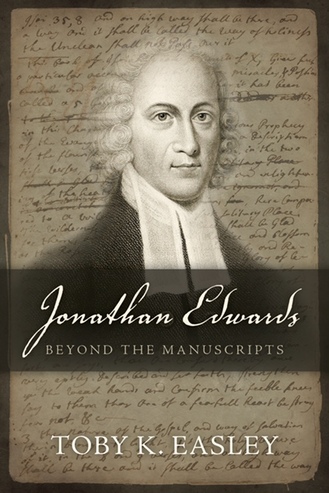
Book Review – “Jonathan Edwards: Beyond the Manuscripts,” by Toby K. Easley

You have probably already heard something of Jonathan Edwards’s reputation as a preacher. It has been said that Edwards was a drab manuscript reader who held his notes just a few inches from his face. It has been said that when he did look up occasionally from his ink-quill notes, the famed Puritan held his gaze unflinchingly, fixed upon the bell rope, dangling helplessly near the back of the plain-style church.

You may have even gone on to actually read many of Edwards’s long-form sermon manuscripts, and wondered whether you wouldn’t have been bored nearly to death yourself listening in the Northampton Church for hours upon end! And yet somehow this man was used as a spark in one of the greatest revivals in the history of our young nation, in the Great Awakening (1740-1742).

So, how do we reconcile the fact that Edwards has a reputation as a mere dissertation reciter (apparently bringing no more panache and flare into the pulpit than a court-stenographer), with the fact that Edwards is also the famed fire-and-brimstone herald of Sinners in the Hands of an Angry God, which shook its hearers to the ground in Enfield Connecticut?

This is the challenge that Dr. Toby K. Easley (D.Min, Southwestern Baptist Theological Seminary) tackles in his new book Jonathan Edwards: Beyond the Manuscripts.  Simply stated, Dr. Easley  seeks to discover whether Jonathan Edwards ever progressed as a preacher. Did he get better as he aged? Could he ever put away the notes? Did he ever go “off script”? Could he ever set aside his well-prepared treatises and simply let fly from the sacred desk?

In other words, did Edwards ever go “beyond the manuscripts?”
438583

In this exceptionally well-written work, Easley argues that, yes, Edwards did progress as a preacher. He did learn new ways to articulate his well-formulated and richly ornate sermons. Throughout this work, Easley traces the personal development of Jonathan Edwards as a preacher and homiletician. To do so, Easley monitors closely three factors: (1) First Edwards’s personal biography. Dr. Easley guides us through the chronological events which shaped Edwards as a preachers. (2) Second, Easley interacts with some of the sermons themselves as pieces of oratory and rhetoric, examining and comparing their content. (3) Third – and this is what makes the book relentlessly fascinating – Easley personally combed through many of the sermon manuscript notebooks themselves, looking for clues as to how Edwards progressed (or stagnated?) as a preacher and orator. To do so, Easley ventured to Yale’s Beinecke Library to study them firsthand. In fact, as readers will see, Easley identifies five stages through which Edwards progressed as a pulpiteer.

The following are the handful of stages (in this reviewer’s own words) which Dr. Easley identifies in Jonathan Edwards as a developing preacher. Many readers will find that they too have tread some of the same ground ourselves over the years.

1. The Listener. Edwards began his preaching career far before he ever wrote a sermon or entered a pulpit. Most preachers do. He began as a sermon hearer. As the son of another Puritan divine of note, Timothy Edwards, and the grandson of the famed preacher Solomon Stoddard (who by the way, eschewed notes and advocated for impassioned and informed extemporaneous sermons), young Jonathan learned what a sermon ought to sound like far before he ever preached one. His own father’s methodology probably influenced his work from an early age, and Edwards’s penchant for accuracy, depth, and clarity likely bound him to well-structured written forms from early on.

2. The Manuscript Addict. In his earliest stages of sermon manuscripting, Edwards wrote his thoughts out in the fullest possible way. This would prove to become a difficult, but not impossible, habit for Edwards to break. He clearly preferred thinking his thoughts out in long form before entering the pulpit to address God’s people in the church. His other writings such as his Miscellanies bear this truth out. He thought pen in hand, and couldn’t help it. His early stages of preaching in New York, Bolton, and Northampton show sermons that most closely resemble written treatises: full, precise, and well-ordered. Early on, Edwards began with the standard Puritan sermon order of Text, Doctrine, and Application (Use), and would hardly deviate from this for the rest of his life. This stage of full manuscripting would continue, for the most part, throughout the 1720’s and 1730’s.

3. The Experimenter.  As Edwards further progressed in his career, he began using some modifications to the full-manuscript form. This may have been motivated by his desire to excel in the areas that his grandfather Stoddard had excelled, namely in delivery, and it may also have been encouraged by the shortage of paper, which Edwards consumed ravenously for all of his writing projects. He began using some abbreviations, and even symbols to convey words and even fuller thoughts. For instance, he uses a circle with a dot in the middle to represent “the world.” Or an X for Christ, or a concept related to Christology.

We should be very clear here: Edwards never did fully throw away the full-manuscript format, even as he sought to make his manuscripts more “user friendly” for delivery. Arched, horizontal lines across the duodecimal sized handmade notebooks, often served as visual cues, marking major sections. Some words were printed in all capitals to stand out and help summarize entire paragraphs while preaching. These flourishes were helpful for those moments when the preacher utilizes extempore expressions, and then returns to his notes to recover his bearing. Sermons for funerals or public occasions (preaching for the Boston clergy, for instance) continued to be written out in full hand however.

4. The Whitefield Admirer: A major leap seems to have happened in Edwards’s thinking about homiletics when George Whitefield came to town. In Whitefield, Edwards saw firsthand just how powerful oratory can be, when the preacher does not use prepared notes, but instead delivers the sermon from memory. Eye contact, easy of expression, natural speech – all seemed more powerful from Whitefield’s noteless exhortations. From this point on, Edwards appears to have been convicted to some degree about the deficiencies of his own preaching, perhaps hearing the now-gone voice of his Grandfather Stoddard echoing in his mind as well. Though he could not quite fully ditch the manuscripts, this period after 1740 begins to show evidence that Edwards tried harder and harder to make his notes briefer and more portable for pulpit delivery. Sinners in the Hands of an Angry God, for instance exists in two extant forms: one which is written in full, and another which exists in a bare minimal outline form.

5. The Mature Orator: The final stage of development took place, according to Dr. Easley, after Edwards left Northampton and began preaching to the Indians at Stockbridge. Here, he had to balance two different congregations; one English speaking and the other a Native American congregation through an interpreter. In this stage, Edwards re-preached prior sermons, and simplified many others as he worked on his major works such as Freedom of the Will. Commonly, he dropped technical terms and adopted illustrations from nature, hunting, and the broader human experience. The very nature of these congregations almost forced Edwards to learn new ways to communicate besides his well-tailored manuscript recitations.

If I might interject my own thoughts at this point – I wonder what would have happened if Edwards had gone to Stockbridge before Northampton? If he had learned to preach the simpler before the more complex? Would his time with the Mahicans have enabled him to speak more comfortably to his Colonial audience as he developed greater confidence in a more natural or free-speaking manner? We can only guess. God’s sovereignty ordered Edwards’s life as it has unfolded in our history books, and Stockbridge would be the conclusion to his career rather than the beginning.

Interestingly, Easley tells us the story of the time that Edwards – close to the time of his death – lectured for the students at Princeton holding them spellbound for nearly two hours. According to eyewitnesses, the time passed as if it was but a few moments. Edwards was riveting. As the eager young students consumed Edwards’s rich teaching, we can only wonder what it would have been like to see and hear Jonathan Edwards in his “prime,” confident, mature, and completely competent; having learned to preach in various settings with masterly control. Sadly, there are no recordings of Edwards, and we have only the eyewitness accounts and the manuscripts to help us. History tells us that Edwards died only a few weeks into his tenure as college president.

Overall, Jonathan Edwards: Beyond the Manuscripts is excellent.

Throughout, it contains applications for modern preachers learning our sacred art of exhortation. Dr. Easley gives many and varied suggestions for his pulpiteering readers, and one just may find some notable similarities between Edwards’s preaching journey and his own. To find one fault in this work, I could wonder why more pictures where not included of the manuscripts themselves. Easley describes them capably enough, but I often found myself asking, “I wonder what that manuscript looked like!” Only two pictures of the manuscripts themselves are included in the back, and I would have liked to see firsthand what some of Edwards’s sermons looked like, particularly in his outlining periods. But this is only a minor critique, and the book certainly excels this one flaw.

Perhaps many of us too, would do well to consider Jonathan Edwards’s journey as we press on to go “beyond the manuscripts.”

Interview with Dr. Jeffrey Waddington

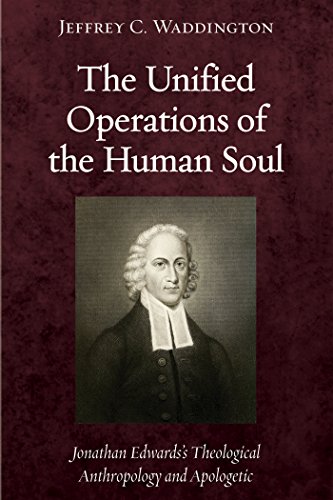
Edwards Studies is pleased to be talking today with Dr. Jeffrey Waddington, a voice that you may find familiar from his excellent work on the Reformed Forum. Besides being a frequent contributor on the podcast East of Eden, Dr. Waddington is an ordained minister in the OPC and an occasional contributor to Reformation 21. He is also the author of The Unified Operations of the Human Soul: Jonathan Edwards’s Theological Anthropology and Apologetic. 

Pleased to have you Jeff!

Brother, I am thrilled to be able to spend time with you today. I was looking around your EdwardsStudies.com site and am quite impressed with the architecture and interior design of the place. Excuse me while I take a swig of my piping hot blondie coffee! You have outdone yourself in bringing together a multimedia extravaganza of Edwards articles, videos, and reviews. I am overwhelmed. It warms the cockles of my heart!

jeff-recording-ctc-photo

We will talk about your book in just a few moments, but tell us what is going on with the Reformed Forum lately? Are there big plans for the East of Eden show? There have only been a couple in 2015 and just one in 2016. What gives?

The Reformed Forum board recently met over the net (and though I was absent) and the big topic of discussion is our upcoming third annual theology conference at Greyslake, IL in October. We have thoroughly enjoyed the first two conferences and look forward the teaching and the interaction with the folks who come from all over the US and Canada. As for East of Eden the slackened pace of getting this podcast out is simply a matter of logistics for the three of us involved: Nick Batzig from the Savannah area, David Filson from Nashville, and myself from the greater Philadelphia area. We love doing the podcast and hope to get back into a regular routine. Please pray that the Lord would grant us schedules that mesh and the energy to tend to our pastoral charges and do the podcast and all the other writing we do. Thanks for asking about the forum and the Edwards podcast.

How did you get into Jonathan Edwards? Was it through John Piper like the majority of us, or through your English Literature class like a few others of us around here?

Years ago as a Salvation Army officer (Wesleyan-Arminian pastor) I picked up a copy of Iain Murray’s bio on Edwards but did not read it until I came into the Reformed community through a PCA congregation in Ithaca, NY. I actually had read a fair bit of John Piper and loved him. But I did not act on his hints sprinkled throughout his various books and articles. And I did read Edwards in my tenth grade English class back in 1980 but I was not a believer at the time. I remember reading “Sinners in the Hands of an Angry God” and not being bothered by it at all. It was the plain gospel truth. Of course, as you know, Matthew, Edwards could rhapsodize just as lyrically on the joys of heaven as a world of love. Anyway, where was I? Oh yeah. I came into the Reformed community and purchased the two volume Banner of Truth edition of The Works of Edwards and began reading a little at a time. When I came to the Philly area to study at Westminster Seminary I purchased Piper’s delightful annotated edition of Edwards’s The End of Creation and fell in love with the aesthetic on display in the very way Edwards wrote The End. After that I took an independent study with Sam Logan, then president of Westminster and thoroughly enjoyed myself. That course was based on the taped lectures of John Gerstner on Edwards. Gerstner was just brilliant. Now as you know I have my differences with Gerstner, which are not inconsiderable, but in this series (which I would love to see on CD or MP3) he just shines. While I entered the PhD program at Westminster intent on doing something with Abraham Kuyper’s common grace doctrine, Sam Logan convinced me to work on something to do with Edwards. So I eventually took the PhD seminar on Edwards that Sang Lee offered at Princeton Theological Seminary. I took that course in 2003, just after his volume in the Yale edition of Edwards’s Works had been published. It was delight to learn from Lee, with whom I differ as well. He was gracious and an enjoyable professor. I had the privilege and pleasure of helping him edit the Princeton Companion on Jonathan Edwards. It took me a very long time to complete my PhD but I finally did under the supervision of William Edgar at Westminster. Edgar is a brilliant apologist interested in all things cultural. He was knowledgeable and encouraging.

Your 2015 book is entitled The Unified Operations of the Human Soul: Jonathan Edwards’s Theological Anthropology and Apologetic. Break that down for us – first the title, then the subtitle. What are you doing here?

51tfzgnar8l

The book is slightly revised version of my Westminster dissertation (very slightly revised!) for which I was awarded a PhD in 2013. I am challenging John Gerstner’s contention that Edwards was an exemplar of the classical method of apologetics. The heart of my argument is that Edwards rejected the hierarchical faculty psychology of the day (for instance as advocated by “Old Brick” Charles Chauncey, Edwards’s Boston nemesis). Faculty psychology at its worst thinks of the human soul as made up of three little agents called will, intellect, and emotions (or in Edwards’s case, just intellect and will). Edwards, I would argue, advocates the standard Reformed and Puritan notion of the convergence of the distinct yet inseparable powers or capacities or capabilities of the human soul. It is one person who wills, thinks, or feels. So the expression “unified operations of the human soul” simply tries to capture that facet of Edwards’s thinking that is capsulized in his notion of the new sense. The new sense or spiritual understanding involves the whole person or whole soul. Someone can understand to a certain extent the truth of the Christian faith without embracing it or being wowed by it. I was that way for many years. I am a preacher’s brat and a preacher myself. But I did not come to faith in Christ until I was 18 years old. Again this is somewhat standard Reformed anthropology (er…, doctrine of man). The new sense is at the heart of Edwards’s apologetic. He knew his intellectual endeavors defending the Christian faith against Enlightenment thinking would not bring a person to Christ without the Holy Spirit working a new heart in him or her. We might say with good reason that the true religious affections were the heart of Edwards’s apologetic. Affections are not to be equated with the emotions. I would argue, as others have as well, that affections are thoughtful volitions or we might say clear-headed thoughts that stir the will and emotions. Affections therefore have a volitional, emotive, and intellectual component. The subtitle is all about how Edwards’s understanding of man interacted with his view of the apologetic task. The heart of the book is the chapter on the relation of the intellect and will and how they must work together in regeneration to bring about true saving faith. The defense of the faith (the apologetic task) involves, to use the language of the Westminster assembly divines, the enlightenment of the mind and the renewal of the will. In that chapter I challenge Gerstner’s notion of the indirect effects of sin on the human mind. I interact with Alvin Plantinga’s use of Edwards on this topic in his justly famous Warranted Christian Belief to get at the problem. So in the end I argue that Edwards was an eclectic apologist who reflects his educational background and era and so draws from various philosophical streams that can assist him in making a biblical case for whatever doctrine Edwards is seeking to defend. The esteemed church historian Doug Sweeney kindly reviewed the book on the Jonathan Edwards Center at TEDS website. Where I might challenge Dr. Sweeney, who is gracious as the day is long, is his suggesting I was trying to make Edwards look like a presuppositional apologist. I am a presuppositionalist myself, or better, a covenantal apologetics guy. And I did argue that Edwards resembles Cornelius Van Til at times. I would still argue that. But Edwards insofar as Edwards was Reformed and his defense of the Christian faith reflected that, that far he looks like Van Til. Don’t worry if you don’t know who Van Til is. That may be a conversation for another time. I would be happy to fill your readers in on that score.

If you would, talk briefly about how Edwards saw humanity under this classic fourfold rubric: how man was created, fallen, redeemed, and consumated? Help us understand how these “states” work together. 

Edwards read his Bible but he also read the Scottish Presbyterian Thomas Boston’s Human Nature in its Fourfold State in which Boston unpacks the movement of man as created good and holy, the fall of man into sin and misery, his restoration plus in redemption, and the summing up of redemption in the consummate state when all the saints and angels gather together to live with the Triune God in the new heavens and new earth. Man’s thinking capacities reflect his spiritual condition in each state. The only way to transition from the fallen state to a redeemed state is if the Father draws the unbeliever, with the Holy Spirit working in the heart of the unbeliever so that they freely embrace Jesus Christ by faith, repenting of his or her sin and pursuing holiness. Edwards followed this basic Reformed understanding of how a sinner becomes a saint.

How does this fit together with the Imago Dei (the image of God) in man? Did Edwards see this as a key component in man’s identity? 

The image of God is a big deal for Edwards and figures prominently in his defense of the doctrine of original sin. Adam and Eve were created in righteousness, holiness, and knowledge. In other words, they were not created neutral. Edwards follows the standard view that the image has a broader and narrower reference. The broad reference is to our ability to think, communicate, relate. I would call these the preconditions for exercising the image in the narrower reference. The narrow reference refers to our holiness, righteousness, and knowledge. Adam and Eve possessed the image in both senses at creation and for some time thereafter. In the fall, we lost the image in its narrow sense but retained, in a twisted and defaced manner, the broad image. Redemption restores the lost narrow image and in fact goes beyond mere restoration. Yes, this was a key component of Edwards’s understanding of who and what man is.

You have used the word “analog” in your writings. Is that an Edwardsian phrase? How does he view man as an analog of God, and what does that say about God’s nature and attributes? 

The question closely follows on the last and overlaps with it a bit. When I say that man is an analog (or analogue for you dictionary geeks out there) of God, I am talking about how we were created to reflect God in our very being and beliefs and behavior. This is not Edwards’s language although I do think it reflects his theology. I guess I could say that the word analog images the reality Edwards is getting at when he talks about the way that man resembles God his maker. Edwards understood that God is Creator and man is creature but he also saw that we are called to hunger and thirst after righteousness. We are to be holy. And with the coming of the Son in the flesh, we are to be conformed to the image of the Son (an image of the Image, we might say) Jesus Christ. God, Edwards tells us, has an intellect and will (this enters into Edwards’s discussion of the Trinity, but that is a discussion for another day too) and so do we. Our intellect and will worked harmoniously in the garden but the fall brought a disruption to that harmony. Redemption restores it. And we spend the whole of our Christian life growing into greater and greater conformity to God so that we once again image forth in our own lives the Son of God Jesus Christ (as argued, for instance, in Eph. 4:24 and Col. 3:10). Edwards talks about this throughout his sermons and in the treatise on The End of Creation and the Religious Affections, etc.

Let’s tie in the “apologetics” aspect here. Give us a brief rundown of how Edwards goes about defending these constructions against the pressing threats he perceived in his own day.

Edwards did not pen an apologetics handbook or manual. If he had it would have made my life easier. Maybe! We have to glean his understanding of how to defend the Christian faith from his actual defense. Edwards attacks his opponents head on. But I would argue he does it graciously but with surgical precision. In Original Sin Edwards goes after the notion that Adam and Eve were created neutral and that we sin merely by imitation of bad examples. he deconstructs the idea that death is a blessing and affirms a Reformed notion of the imputation of Adam’s sin to us (albeit with his own creative touches). In Freedom of the Will Edwards defends the compatabilist notion that God’s sovereignty and human responsibility coexist when properly understood. Edwards’s target is libertarian free will. Edwards’s rejection of faculty psychology is on full display here. Edwards reduces the idea of libertarian free will (that we have the ability to choose A or B from a state of complete equilibrium under no influence of prior motives). Take a look at Edwards’s sermons and semi-private notebooks and you will see how he reacts to deism and other challenges to the Christian faith. Edwards affirms common grace (that the Holy Spirit is active in the world mitigating the worst effects of sin and allowing for human flourishing to occur and for the gospel to be spread and for sinners to become saints and come into the church) and he affirms natural or general revelation. This is God’s revelation of himself in creation (including us human creatures). Edwards also affirmed something called the “prisca theologica” or primitive theology. This is the idea that the human race has passed along accounts of revelation from Adam to Noah to Abraham to whoever and that this accounts for some similarities between different religions and is a form of special revelation and general revelation. This primitive theology cannot save since it is twisted and perverted as it gets past down from generation to generation. But it means, among other things, that no one is free from exposure to God’s revelation in nature, primitive theology, and Scripture (special revelation). Edwards was an acute and effective apologist. I do not happen to think he was perfect. I think we have made progress since his day and would not want to go back to his day. But he is not afraid to use sanctified reason and Scripture in his defense of the faith and that is a good thing.

Do you have more research to do in this area or do you have any plans for future projects along these lines?

I am interested in everything (well, almost) theological (and philosophical, political, military, and historical, etc) and so my work extends well beyond Edwards. In that regard I suppose I am like Edwards himself. However, I try to keep abreast of the latest developments in Edwards scholarship and always am reading something by or about Edwards. As Piper would say, Edwards is one of my constant companions and conversation partners. I am looking on doing something where I compare Edwards on the unified operations and the work of the 19th and 20th century Dutch Reformed biblical theologian Geerhardus Vos on the soul. I once noted on Facebook that Vos wrote in four pages in his newly translated Reformed Dogmatics on the soul what i tried to say about Edwards in my dissertation in more than 200 pages. Ugh!! I would also like to do work on Edwards the exegete. Perhaps I may revisit the question of how much influence John Locke had on Edwards. I am one who does not think it was as radical as others have thought. Feel free to make recommendations brother!

How about some shout outs and recommendations for our readers. 

Marsden’s  Life is the best biography on Edwards. It is well written and makes Edwards understandable in terms of his own age. Murray’s bio is still worth reading. I think Stephen Nichols’s Jonathan Edwards: A Guided Tour of His Life and Thought is a wonderful intro to the life and thought of Edwards. McDermott and McClymond’s Theology of Jonathan Edwards is encyclopedic, but I have many major reservations about the book (and not just because they critique me in a few footnotes!). Craig Biehl’s Infinite Merit is a magisterial treatment of Edwards’s understanding of justification within the broader spread of God’s purposes in Christ and his unchanging rule of righteousness. This website has to be must read as well. Check out reformedforum.org for articles and podcasts related to Edwards and Reformed theology in general. Various websites connected with the Alliance of Confessing Evangelicals (reformation21 and Place for Truth, for instance) are worth checking out. I also frequent the Desiring God site and love various Piper books. I also recommend checking out the Gospel Coalition site as well. This is not to say I agree with everything these sites or authors say. But they are worthwhile. There are many others.

Thank you so much for chiming in Jeff! Hope you will write an article or so for us here at Edwards Studies, can we count on that from you sometime brother? 

Absolutely. Let me have some recommendations and I will run with them.

The Rhetoric of the Revival: The Language of the Great Awakening Preachers, by Michal Choinski (Book Review)

Rhetoric is, in essence, the power of spoken or written words.

Considered in this way, rhetoric is the force of both oral and printed language to guide or compel one’s audience to think, feel, or respond in a certain way to a given message. Rhetoric is used in political speeches. It is used in court testimony. Yes, it is used in sales pitches too. And it is most certainly employed in preaching.

As preachers, the proponents of the Great Awakening in America (1739-1745) used rhetoric as a tool to better convey the power of the Gospel to the hearts of their hearers in their own time and setting. We ought not to fault them for that. Of course, they were hoping to lead their churches and open-air audiences towards faith in Jesus Christ and to “awaken” their lives to eternal realities.

In his new book The Rhetoric of the Revival: The Language of the Great Awakening Preachers, young scholar Michal Choinski treats his readership to an outstanding and thorough evaluation of the rhetorical pulpit devices of such men as Jonathan Edwards, George Whitefield, and Gilbert Tennant among others. Although the whole history of rhetoric in preaching would certainly make for a very fine study (as would a study of rhetoric geared towards modern best practices in preaching), Choinski limits the parameters of this intensive work to those preachers centering around the time of the Great Awakening in the colonies in America.

41serf2askl-_sx333_bo1204203200_

The fact that intentional uses of rhetorical strategies were employed in the especially fervent times of the Awakening should not come as a surprise to anyone. While the term “rhetoric” can sometimes have the distasteful flavor of purposeful manipulation, the practice itself is rooted in nothing less than the desire and intention of the preacher or speaker to give a message that is compelling and persuasive to his audience. In this way, there is nothing “wrong” with using rhetorical strategies. After all, if a Bible preacher believes the Gospel is true, he should deliver his message of hope as effectively and as forcefully (read: persuasively) as he is able. Certainly Stephen’s sermon in Acts 7 as well as Paul’s sermon on Mars Hill in Acts 17 both bear marks of rhetorical strategy. Both witness to the biblical mandate to speak the truth of the Word of God with both winsomeness and power with the goal of persuasiveness in mind.

A few more words about this book will precede a general survey of its contents.

Michal Choinski

First of all, it is noteworthy that this book is the first in a new series of monographs published by the Jonathan Edwards Center at Yale University. This new series, in cooperation with by Verlagsgruppe Vandenhoeck & Ruprecht is entitled “New Directions in Jonathan Edwards Studies” and Michal Choinski’s contribution constitutes Volume 1 of this exciting new line. Some readers of EdwardsStudies.com will recall that both Kenneth Minkema and Michal Choinski have already been interviewed on this page.  If this first edition is an indication of what is to come, Edwards devotees are sure to greatly benefit from this series as it unfolds. What we have here in Choinski’s work is a first-rate work of scholarship and technical expertise, without sacrificing readability. Choinski, by the way, teaches American Literature at the Institute of English Studies at the Jagiellonian University of Krakow, Poland.

The book opens with a standard evaluation of rhetoric, its history, key definitions, and development. Choinski here pays special attention to its Greek roots, marking observations by Aristotle, Cicero and others. In fact, Aristotle defined rhetoric as a “faculty of considering all the possible means of persuasion on every subject” (p. 15). Traditionally, Choinski tells us, rhetoric is considered under five headings as follows: invention, arrangement, style, memory, and delivery (p. 18). Among these headings rhetorical speech can be further evaluated under such marks as clarity, grandeur, beauty, character, and sincerity, among others (p. 25).

In a subsequent section, Choinski makes the leap from rhetorical speech in general to preaching in particular. After all, giving a sermon is one of the most important forms of human-to-human oral communication. Here, Choinski considers contributing ideas from such men as St. Augustine and Erasmus, the noted humanist. Arriving closer to his historical period of choice, Choinski gives the reader an important reminder when he notes that “The core of Puritan preaching that emerged from medieval schemes after the tide of the Reformation is encompassed in the fundamental effort to understand God’s Word and to explicate it to the hearers” (p. 36, emphasis added).

From the Puritans, then, to the Colonial preachers, Choinski begins to focus the lens closer and closer to the revivalist preachers which stood upon the shoulders of their forefathers. These men advanced the rhetorical strategies of preaching to include such novelties as camp meetings and open-air gatherings. As religious services sometimes moved from the pulpits to the fields,  what constituted preaching methodology necessarily changed as well, especially when accommodating the poor and larger audiences, then previously possible in “meeting house” settings. This is not to say, however, that the Great Awakening was a purely out-of-doors social movement. But surely the power of awakening-style preaching intentionally modified to  utilize the maximal power of persuasion possible.

At this point, Choinski enumerates several factors that seem to be quintessential of revivalist preaching. It incorporated to various degrees (1) intensified emotions on the part of the speaker and the audience, (2) encouraged implicitly or explicitly bodily manifestations among hearers, (3) was attended by extraordinary occurrences such as perceived signs and wonders, (4) raised issues of necessary spiritual discernment (5) prompted tensions between clerical and lay authority, (6) and resulted in new associations, organizations, and institutions (p. 46-47).

Pages 52-54, though short, are key for understanding the rest of the text. Here Choinski discusses several hallmarks that will be discussed often throughout the rest of the work, notably the drive or push towards hearers experiencing the “new birth” as the ultimate goal of revival preaching; the unapologetic stirring of such emotions as fear, joy, enthusiasm, and disgust from the audience; and even the utilization of delivery techniques heretofore considered as “theatrical” (Whitefield will be a case in point on this matter, later; see his section in pages 117-146).

In a section that may feel like an unnecessary digression from the main topic (p. 55-56), Choinski then takes the reader through a brief history of three successive generations of Puritan colonialists in America, briefly recounting some key of the players, events, and the overall cultural mood. Here of course, he mentions the famous “Half-Way Covenant” so controversial to those who felt the force of its compromise firsthand.

Finally then – and I do admit that Choinski has taken us the long route to get here – we get to the meat and the heart of the book. From this point forward, we are settling in to discuss the six revivalist preachers that the writer will analyze for the rest of the book. In other words, we adjust from a wide-angle to close-up lens. Edwards scholars will breathe a sigh of relief that the Northampton Sage comes first in order (yes!), and gets a full treatment of three of his sermons; namely The Future Punishment of the Wicked (p. 82-92), Sinners in the Hands of an Angry God (p. 93-105), and The Distinguishing Marks (p. 106-116).

Readers of this website will want to find the nearest hammock and a glass of cold ice-tea in order to settle in and enjoy this part. This is why we bought the book in the first place!

In my view, Choinski does his finest work combing through these three Edwardsian sermons. His section on Sinners is particularly riveting in my view. He analyzes Edwards’s choice of imagery, and metaphor, even his use of the tension-retaining present tense. All the while, he notes how Edwards carefully selected each verbal component of his sermon to strike the very heart of the reader with sheer terror. He discusses Edward’s structure and pace. He dissects Edwards’s use of “sensual tactility” (p. 94). Edwards’s goal here, he notes, is to induce a sense of “emotional despondency” (p. 99), and Edwards does that very well! Choinski notes, “for the moment of the delivery of this part of the discourse, the congregation gathered to listen to the preacher, in their minds actually becoming the sinners in the hands of an angry God” (p. 100, emphasis added).

Choinski calls these subtle twists and turns of language “inexplicit communicative stragegies hidden under the verbal layer and interwoven with it” (p. 93). Brilliant. Together, these rhetorical strategies build slowly, yet irrevocably  upon the shoulders of the congregation. As history has well recorded, the sermon landed in Enfield like a bolt of electricity from the sky. Edwards hardly finished the sermon due to the outbreak of fervent emotion from troubled listeners. His “rhetoric of revival” hit the mark perfectly.

I have one quibble with Choinski, despite the thoroughness and remarkably informative content of this work. I sincerely wish he had chosen Heaven is a World of Love rather than giving us two sermons from Edwards (back to back) on Hell. This would have been a wonderful way to dispel Edwards’s undue reputation as a merely “fire and brimstone” preacher. Back to back, Sinners and Heaven would have been a powerful tandem to show how Edwards was just as capable of driving his audience towards the ecstasies of joy as well as the throes of terror.

Attentive readers will greatly enjoy Choinski’s work in Whitefield and Tennent as well as Edwards. Studies of Dickinson, Parsons, and Croswell add texture to the overall analysis. Lesser known preachers, they are remarkable in their own right and worthy of consideration.

Overall, I found this book to be excellent. Choinski’s writing is lucid and clear. His pace is sometimes slower than I would like, but this is a doctoral dissertation converted to a book after all! It is informative, well-written and complete. Truly, this is a magnificent study on a completely engaging topic. His sources are well chosen, and his use of Edwards and Whitefield contribute to our beloved field of study remarkably.

Had he chosen Heaven is a World of Love to analyze rather than double-dip on the brimstone, it would have been even one notch better in my view.


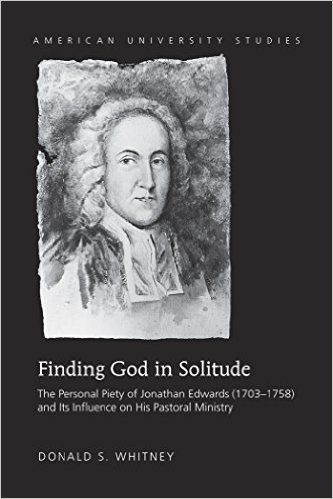
Don Whitney’s Finding God in Solitude: The Personal Piety of Jonathan Edwards and Its Influence on His Pastoral Ministry (Book Review)

Back in May, Edwards Studies had the opportunity to interview Dr. Don Whitney about his 2014 work, published by Peter Lang, entitled Finding God in Solitude: The Personal Piety of Jonathan Edwards and Its Influence on His Pastoral Ministry. In that brief interview, Dr. Whitney was able to share with our readers how he came to know and love Jonathan Edwards (read the interview here). As many of you probably already know, Dr. Whitney has a great fascination with the spiritual disciplines of the Christian life (prayer, fasting etc.) and has written about these themes extensively in his more popular books such as Spiritual Disciplines for the Christian Life and Praying the Bible among others.

donal-s-whitney

In this brief  book review, we will delve more fully into his published dissertation on Jonathan Edwards and explore some of its primary themes. As the title suggests, the book primarily centers around two questions: First, how did Jonathan Edwards practice the spiritual disciplines? And secondly, how did his practice of these acts of piety effect his pastoral leadership? This is an interesting question, because Whitney is attempting to examine the intersection (conflict even?) between the Northampton Sage’s personal spiritual quest and his public leadership in the local church.

41xj9h6bqzl-_sx331_bo1204203200_

The book opens in the introduction with the primary task of the study in view stated clearly “The goal of this study is to evaluate the personal piety of Jonathan Edwards and the extent to which it influenced his pastoral ministry” (1).

As all dissertations do (this one reads very smoothly, like a well written book, but its academic genesis is not entirely concealed from the reader) he begins with definitions. Here, Whitney focuses on a few important definitions of terms such as “piety,” and “godliness.” In doing so, he is busy about the work of setting the parameters for an historical understanding of who the Puritans were, so crucial to his study. Whitney avers “There was no more characteristic ingredient of the English Puritan tradition than its emphasis on fervency in general and devotional piety as an expression of truly Biblical Christianity, and there was no more faithful heir to that tradition than Jonathan Edwards” (16).

Rounding out his introductory section, Whitney illuminates his readers on several important characteristics of Puritan ministers, namely their emphasis on catechizing (25), preaching (27-30), and the pastoral care of church members, including the controversial implementation of the Half-Way covenant (33). Concluding the first part of the book, Whitney notes the ascendance and increasing popularity of Edwards studies in general, and acknowledges hoping to contribute positively to the same by examining more fully how Edwards’s own personal practices of devotional piety helped (or in some ways even hindered) his ecclesiastical leadership.

In the first full chapter, Whitney gives his readers a very able summary of Edwards’s life and ministry. This is essentially a very compressed biography of the Awakening Preacher. And while this section does not necessarily break any new ground on the life of Jonathan Edwards, it does give the reader the benefit of a refresher course, or perhaps even an inauguration, into the basics of Edwards’s primary life events. Not surprisingly, Whitney tells of Edwards’s early life, conversion, education, marriage to Sarah, early ministry endeavors, revival encounters, and discusses his primary written sources. He also tells of his dismissal from the Northampton Church, foreshadowing his forthcoming assessments of Edwards possible failures as a pastor. Finally, concluding the chapter, he tells of Edwards’s time in Stockbridge (his most productive years from a written standpoint), as well as his short term as president of Princeton, and finally his death.

In chapter two, Whitney begins to focus in more closely on Edwards’s practices of piety, or to use his own preferred parlance, his “spiritual disciplines.” Here, the reader finds much encouraging material which sounds very much like some of the positive illustrations given in his more popular books, especially Spiritual Disciplines for the Christian Life. In many ways, this chapter highlights Edwards very favorably. For instance, Whitney commenting on Edwards’s obvious love for the Lord, says “As Jesus was fully God, Edwards yearned for the closest possible relationship with Jesus. As Christ was the perfect man, Edwards wanted to harmonize every part of his life with the example of Christ” (77). Thus Edwards’s driving passion above all things was glorifying God in his life and emulating God’s Son in his sanctification.

Among the practices of Edwards’s piety discussed, it is clear that he favored and tended towards those which emphasized the structured consumption of the Bible. Thus, Bible reading, Bible memory, and copious notetaking on Scripture are predominant aspects of Edwards’s daily discipleship (78-81). Whitney says, “Care should be taken not to overlook the essential fact that prayerful study and prolonged meditation on the text of the Bible was the supreme means by which Edwards sought to know and experience God and to pursue conformity to the person and work of Jesus Christ” (81, emphasis added). Whitney believes that Edwards did not assign to all spiritual disciplines equal weight, at least in terms of his practice. Instead, he gave those practices which emphasize heavy doses of Bible consumption the most effort and time. For Edwards, his great joy was in reading and digesting the Bible. His copious Miscellanies and Notes on Scripture bear witness in this regard. It is hard to find much fault with a man so devoted to the Bible.

This is not to say, however that Edwards did not practice other spiritual disciplines. As Whitney catalogs, Edwards also practiced fasting (his rigorous monitoring of his diet is famous), journaling, and he led his family and children in regular gathered worship at the table and catechism in his study. More than that, there is no question that Edwards was also a man of prayer, as well as a man of the book. As for prayer, Edwards writes in one place that it “seemed natural for me, as the breath by which the inward burnings of my heart had vent” (85). Of course, the participation in the sacraments and public church attendance hardly need be mentioned since Edwards was a congregational minister for most of his professional life.

Yet at the same time, Whitney begins to notice a pattern in Edwards’s life that has been also observed by most others who examine the wigged Puritan’s life: Edwards by far preferred those spiritual disciplines that take place when one is completely alone in solitude as over against those practiced alongside other Christians. Hence, Whitney considers “solitude” as a separate but overlapping practice of its own (97-101). Along the way, Whitney drops hints that this preference for being alone will ultimately cause greater problems for Edwards in regards to his social and ecclesiastical relationships. This observation is not necessarily novel on Whitney’s part, but it does illustrate the practical truth that our personalities often bear impact on our public ministry (for better or for worse) in some ways.

In one interesting section (103-108), Whitney considers whether or not Edwards might have been a “mystic.” Though many definitions of this term have been offered, no particular category seems to fit Edwards neatly here. His great work The Religious Affections definitely show that Edwards preferred the revealed truth in Scripture as over against personal revelations of various kinds (dreams, visions, impressions on the mind, etc). Yet at the same time, there are instances in his Personal Narrative when he seems to describe ecstatic experiences, and at least one “vision” of Christ that defies tidy categorization. Eventually, Whitney admits that the definition of “mystic” is in the eye of the beholder, and allows the reader to draw his or her own conclusion.

In chapter three, Whitney then turns his attention to the minister’s public life. Quoting Samuel Hopkins, Whitney mentions that Edwards “commonly spent thirteen hours every day in his study” (109). This is hardly a public aspect of ministry, of course. But this time alone would bear fruit from the pulpit. And while this might be considered extremely pious pious by some, other readers will begin to draw more and more attention to the fact that this habit of solitude was not necessarily helpful as regards his relationships with his parishioners or the people of Northampton in general.

For his part, Edwards believed that his best use of time – even for the sake of his people – was alone in writing. For this reason, Whitney uses this chapter to summarize some of Edwards’s attempts to use solitude for the sanctification of his church. Obviously he dutifully prepared sermons intended for public proclamation (119). The pulpit was the most obvious place where his personal piety and public duties met and overlapped. But Edwards also crafted scores of thoughtful, insightful letters for the edification of many people: family, friends, ministers, inquirers, and church members. In some ways, Edwards was probably a better counselor through these means than in person. Even in writing his longer treatises and books, Edwards usually had the good of the godly collective in mind: he wrote to address problems he perceived in his own local church and in the broader evangelical community.

At the concluding section of the book, Whitney makes clear what thoughtful readers have already begun to suspect all along: Edwards was an extraordinary gifted man, whose practices of piety and gifts for ministry saw their best use in personal (even private) hours in the study. At the same time, his withdrawn and unsocial temper probably cost him respect in the eyes of many people. There is no doubt Edwards was “pious” by the best definition, however. Whitney says, “The list of Edwards’s devotional practices is so evidently congruent with those set forth in the Bible that doubters of this assertion must accept the burden of proof to identify a recognized practice of piety that cannot also be found in Edwards’s life” (133). This is all very good.

Edwards’s ultimate goal, Whitney notes, is described best on pages 136-137. Here the author states clearly that Jonathan Edwards sought happiness above all, defined correctly as “glorifying God and enjoying Him forever.” I concur with this assessment wholeheartedly. This may come as a surprise to some who view Edwards as a staunch, dry, cold, doctrinally bent Puritan. But it does not come as a surprise to anyone who has read much of Edwards’s own works. His pursuit of joy, Whitney believes, is part and parcel of his pursuit of the spiritual disciplines. “Edwards was willing to sacrifice, if necessary, any happiness in this world-since it was temporary-in order to experience unending happiness in Heaven” (136). But it also must be observed that he found the most joy alone in Christ rather than with other believers.

So, did Edwards’s predilection for solitude hurt him as a pastor? Many think yes. Whitney does too, and admits that as far as his own congregation was concerned, Edwards’s impersonal temper probably caused him harm in the long run in terms of his congregant’s opinion of their minister. In many ways, he clearly had trouble relating to common folk, and their ability to relate to and understand their pastor suffered for it. The “Bad Book Case” and the Communion Controversy are a case in point. All the while, Whitney contends, Edwards sought to use his God-given gifts to the betterment of his people, even if what Edwards yearned to use most (his gifts of writing) were not duly appreciated in his own time.

Towards the end of the book, Whitney makes a most interesting comparison between Jonathan Edwards and the Puritan Richard Baxter (149). Baxter spent much time traveling from home to home in his parish personally catechizing his fellow churchmen. In this section, Whitney wonders on paper who had the greater impact. Edwards or Baxter? Whitney says that “In terms of example, nearly all pastors would probably find greater success in following something closer to Baxter’s methods than Edwards” (150). If pastors are looking for a role model, he thinks it better to emulate Baxter. And yet Whitney also seems to think that despite this, Edwards had the greater and longer impact in terms of church history due to the legacy of treasures Edwards left us in print. It would be hard to argue with that assessment.

Overall, I recommend this book wholeheartedly and enthusiastically.


Edwards Conference 2016 Audio Links

2016 Talks & Sermons

We’ve got all the audio links up and ready for your thoughtful consideration, thanks to the good and kind folks who sponsored the Edwards Conference 2016 this year.

wp-1

Revd Dr Kevin Bidwell
Devotion on Matthew 6  –  The Lord’s Prayer & the Glory of God


Revd Iain H Murray
“Jonathan Edwards & Preparation for Revival


Revd Dr Gerald McDermott
“Can Reason Tell Us Anything About God? Edwards Against Modern Protestant Theology”


Revd Dr William Schweitzer
“A True Sense of the Glory of God: Jonathan Edwards & the Beatific Vision”


Revd Andrew Kerr
Sermon on: The Glory of God in Isaiah 6:1-8  –  Motivation for Ministry


Revd Dr Kevin Bidwell
Devotion on 2 Thessalonians: 2  –  The Glory of God in the Day of The Lord 


Revd Dr Iain D Campbell
“Religious Affections to the Glory of God”


Dr Douglas Sweeney
“God Glorified through the Forward March of Time: Jonathan Edwards & the History of Redemption”


Revd Dr Guy Waters
“Jonathan Edwards, The Gospel of John, & the Glory of God”


Revd Dr Michael Bräutigam
“Jonathan Edwards on the Transformative Power of Contemplating the Beauty of Jesus Christ”


Panel Discussion


Why Was Jonathan Edwards a Postmillennialist? By Obbie Tyler Todd

[Editor’s Note: The following article has been reposted, with permission by the author, from The Edwardsian. Please visit Obbie Tyler Todd’s site devoted to the study of the life and works of Jonathan Edwards.]

In 1959, C.C. Goen declared that Jonathan Edwards was “America’s first major postmillennial thinker.” It was not a compliment. According to Goen, Edwards’ heterodoxy catalyzed this unique strain of eschatology and subsequently steered America in the direction of “manifest destiny.” Finding no trace of postmillennialism in Puritan creeds such as the Westminster Confession of the 1640s, Goen locates the origin of this “new” end-times theology in Edwards. Despite the historical lacunae in Goen’s tenuous thesis, it still indicates a development in the way this particular eschatology was perceived. While Edwardsian scholarship has grown exponentially since the efforts of historian Perry Miller, Edwardsian eschatology has done the exact opposite. In some sense postmillennialism has gone the way of the theological dodo, begging the question: why was Jonathan Edwards a postmillennialist?

Over a century after Edwards’ death, the modified postmillennialism of modern thinkers like Shailer Matthews and Harry Emerson Fosdick repulsed conservative theologians. According to George Marsden, “Postmillennialism, by far the prevalent view among American evangelicals between the Revolution and the Civil War, helped provide the framework for this approach to secularization.” Postmillennialist liberals were typically optimistic about the spiritual progress of the culture. Where fundamentalists saw the rise of evolutionary theory and the loss of prayer in schools, modernists saw the dawn of the age of knowledge and understanding. (Most fundamentalists responded instead with rapture eschatology.) New York City pastor Harry Emerson Fosdick, who both summarized and inaugurated the fundamentalist-modernist controversy in 1922 with his famous “Shall the Fundamentalists Win?”, declared, “I believe in the victory of righteousness upon this earth, in the coming kingdom of God whereon Christ looking shall see of the travail of his soul and be satisfied, but I do not believe in the physical return of Jesus.” Much like its science curriculum, postmillennialism had evolved. And many scholars pointed the finger at Jonathan Edwards.

Edwards’ eschatology, while unique today, contained elements rather typical for his time. According to John F. Wilson, “Edwards thought on postmillennialism represented, therefore, nothing remarkably new until the Enlightenment transformed it.” In other words, it wasn’t Edwards who adapted millennial thought; it was later postmillennialists who adapted Edwards. For example, like most Reformation thinkers since Luther, Edwards’ interpretation of Revelation led him to identify the Pope as the Antichrist. Moreover, consistent with his epoch, Edwards’ millennial hopes were inextricable with his view of America as a covenant people. The Northampton Sage’s covenant theology contained both the covenant of grace and a national covenant that made heavy use of fast sermons and jeremiads calling the “peculiar” people of God to repentance. Like the “Jewish church,” America’s corporate identity as a chosen people manifested a strong sense of hope for deliverance in the earthly future. For this reason Harry Stout has called the federal covenant the “master organizing principle of New England culture.” Therefore, despite his departure from the Half-Way Covenant (“Stoddardeanism”), Edwards also drank deep from the well of American covenantalism.

An impressive panoply of Edwards’ postmillennialism is found in his An Humble Attempt to Promote Explicit Agreement and Visible Union of God’s People in Extraordinary Prayer for the Revival of Religion and the Advancement of Christ’s Kingdom on Earth, Pursuant to Scripture Promises and Prophecies Concerning the Last Time (1748). In this publication, Edwards outlines not simply a vision for the American church, but a global expansion of Christ’s kingdom. In his very first sentence Edwards declares, “In this chapter we have a prophecy of a future glorious advancement of the church of God.” Edwards’ ecclesiology stretched far beyond Northampton or Stockbridge or New England; it was an international vision suited for a global Great Commission.

For Edwards, the Great Awakening of the 1730s and 1740s served as the prelude or possibly even the beginning of the millennial reign of Christ upon the earth. Therefore, evident in other works such as A History of the Work of Redemption (1774), Edwards interpreted the events of his time through a deeply Christological lens that saw significance and meaning in everything – from British battles with Catholic France to the rise or fall of orthodoxy in a local association. He very much believed himself to be living in the midst of a global Awakening of biblical proportion, even arguing that the triumphs of the Antichrist in Revelation 11 (the slaying of the witnesses) and Revelation 16 (the timing of the pouring out of the vials) must have occurred prior to the Protestant Reformation. Edwards’ postmillennialism provided a sanguine worldview capable of sustaining such weighty expectations of glory.

Edwards outlines his global vision of Christian unity as such: “As ‘tis the glory of the church of Christ, that she, in all her members, however dispersed, is thus one, one holy society, one city, one family, one body; so it is desirable, that this union should be manifested, and become visible; and so, that her distant members should act as one, in those things that concern the common interest of the whole body, and in those duties and exercises wherein they do with their common Lord and Head, as seeking of him the common prosperity.” (Humble Attempt) The telos of the millennium, according to Edwards, was the realized union of God’s people with one another and with their Head. For this reason Rhys Bezzant has dubbed Edwards both an “ecclesial internationalist” as well as an “ecclesial millennialist.” His eschatology was horizontal as well as vertical. The postmillennial optimism that died with the world wars of the twentieth century was birthed in the open-air pulpits of a revolutionary Awakening. According to Allen Guelzo, “It was the fondest hope of Jonathan Edwards that the Great Awakening of the 1740s was simply the overture to the Day of Judgment and the thousand-year reign of God directly on earth, the Millennium, when ‘religion shall in every respect be uppermost in the world.’”

Edwards understood the millennial reign as primarily exercised through the church. Christ’s rule would be extended as the church expanded steadily through the success of the Gospel. The millennium itself, according to Edwards, was the climax to the history of the church that “witnesses Christ’s rule with minimal opposition in the world, with the saints in heaven as co-rulers through the church militant on earth.” (Jonathan Edwards and the Church, 153) In order to fulfill the inauguration of Christ’s millennial reign on earth, Edwards included in Humble Attempt a summary of a “Memorial” sent by ministers from Scotland rallying for an international prayer meeting. In it Edwards set forth his hope that ministers would encourage their congregants to meet for weekly “concerts of prayer.” These meetings would be the means through which God would consummate his salvific work around the world. Avihu Zakai locates this penchant for revival and insists, “By placing revival at the center of salvation history, Edwards conditioned many generations of Protestants in America to see religious awakenings as the essence of sacred, providential history.” In some sense Edwards’ postmillennialism has reached relative extinction in most evangelical circles. In another sense it lived on in the national optimism of successive American generations. Taking seriously the covenant made between God and His people, Jonathan Edwards was a postmillennialist who interpreted the monumental events of his age through an acutely Christological and especially optimistic lens.

So You Wanna Be an Edwards Scholar? An Authoritative Introduction for Newbies

So, you’ve heard John Piper preach on Jonathan Edwards’s majestic view of eternal joy.

You’ve even followed that up by reading Desiring God and a couple other Piper books, all featuring dozens of quotations and snippets from the dead Puritan Pastor from Northampton. And now you’ve officially joined a growing cadre of pastors, scholars, and interested layman in declaring:

I want to be a Jonathan Edwards scholar! 

But with literally thousands of pages of material in print by and about Jonathan Edwards, with Edwards’s own works and books numbering in the dozens; all while hundreds of doctoral dissertations float around in the academisphere, and seeming innumerable websites devoted to the famed Colonial wig-wearer proliferate – just where does one actually begin anyways?

In this article, I want to suggest a few of the most important tips and strategies you will need to know in order to become a wizened Jonathan Edwards aficionado. 

Edwards Scholar

1. Read “Sinners in the Hands of an Angry God,” But Don’t Read it Alone. 

Probably everyone who  knows anything about Jonathan Edwards knows about his great sermon Sinners in the Hands of an Angry God. It’s true that Sinners is Edwards’s most reprinted piece, being contained in dozens of anthologies and collections. It’s also true that the preaching of Sinners at Enfield was one of Edwards’s defining moments in the First Great Awakening. Clearly it is a masterpiece of both rhetoric and a classic exemplar of period pulpit oratory, being filled with stunning and memorable imagery. But it is not true that this piece can be read alone. I was talking with an English teacher recently who taught American literature in the public schools for over 30 years, but had never read anything more from Edwards than Sinners in the Hands of an Angry God. Inwardly, I died for her, since Edwards has so many other well known sermons that balance the obvious horror in this great message.

I would recommend balancing Sinners in the Hands of an Angry God with a healthy dose of two other sermons. First, I recommend Heaven is a World of Love, the concluding sermon in Edwards’s series on 1 Corinthians 13, entitled Charity and Its Fruits. For one thing, Edwards’s view of Heaven will go far in showing his amazing ability to articulate the joys of Heaven too, beside the terrors of Hell. For another thing, Heaven is a World of Love will give the reader perhaps a better example of Edwards’s overall sermonic skills and tendencies, since the reader is not captivated exclusively by the striking imagery so dreadfully presented in Sinners.

A second sermon that perhaps even better illustrates the overall themes and emphases of Edwards’s preaching is A Divine and Supernatural Light. This particular sermon is probably closer to the very center of Edwards’s overall message to the people of his Northampton church and the Puritan listeners of his day. A Divine and Supernatural Light  contains many of the quotations and paragraphs that John Piper regularly uses in his sermons which may have even gotten you interested in studying Edwards in the first place. You will likely find this sermon both enjoyable and somewhat familiar.

Once you read these and a few more of Edwards’s most well known sermons (God Glorified in Man’s Dependence; The Excellency of Christ; God’s Sovereignty in the Salvation of Man etc.) you are probably ready to go on to a good biography or two.

2. Biographies. 

With a compelling historical figure like Jonathan Edwards, whose story is central both to the development of Reformed theology and to American history, there are no shortage of biographies available. Not only that, but many of the printed materials about Jonathan Edwards contain brief summaries of his life. Of course, you will want to be familiar with the shaping forces of what made Edwards who he really was – his period, his family life, and the pressures both ecclesiastical and familial which molded him.

So it’s probably time to settle down into a good biography.

I would recommend two (or three): The first is the masterful biography done by George M. Marsden, Jonathan Edwards: A Life. This is probably the fullest treatment of Edwards that exists in print. In my own view, it excels all those that came before it. If you are daunted by the nearly 600 pages of detailed and documented information, thankfully Marsden has also given us a shorter treatment that I have reviewed here in his brief paperback, A Short Life. If both of those books whet your desire to delve into the biographical materials even further, I would also suggest you go on to read Iain Murray’s great book too for another perspective altogether.

3. The Online Edwards Center at Yale University. 

Now, having perused some of Edwards’s most famous sermons, and read a good biography or two on his life, you are ready to be truly inagurated into the fraternity that is Edwards scholarship by becoming aware of the greatest treasure trove available yet: the materials on the website of the Jonathan Edwards Center at Yale University. 

Thankfully, the Jonathan Edwards Center at Yale University has done the whole world a major solid. The JEC has in fact, put everything – and I mean everything – online. For free.

This website has everything you will ever really need, all in one place. Do you want to dig into the Miscellanies? No problem. They are searchable here. Do you want to read Original Sin with the technical introduction to this important book? It’s here. Would you like to get into Edwards’s typological writings and read his Images of Divine Things? That too is all here. Complete and page numbered; ready for your academic citations. As a matter of fact, all 26 volumes of the printed works of Jonathan Edwards are online- free – for the taking. In fact, there are also enough digital volumes (not otherwise available in print form) to take you up to a grand total of 73 volumes of complete Works!

This of course is more than any mortal man can ever read in one lifetime, so you will have to be selective and take it at bite-sized chunks. Maybe we should talk about something more manageable… How about just an ordinary paperback?

4. Consider Print Paperbacks. 

If you are like me, you don’t just want to stare at a screen all day. You want something to hold in your hand. You want something you can take to the beach or tuck in your leather satchel without having to worry about eye-strain. As we all know, reading on the Kindle, tablet, or smartphone screen has its drawbacks for sure.

That’s why the Lord created paperbacks!

Once again, we find ourselves enjoying an over-abundance of blessing when it comes to studying Jonathan Edwards. Almost all of his major works are available in paperback editions, by a variety of publishers. Some are printed and laid out better than others, though, and the quality of readability varies. But at this point, the budding Edwards scholar should be choosing a few of Edwards’s most important works, and beginning reading them more thoroughly.

Personally, I recommend the Religious Affections. This is the Puritan Preacher’s attempt to help take a middle-of-the-road position on charismatic and emotional expressions, while still supporting the Revivals’ emphatically, despite their unusual manifestations. In short, this is one of his most important books.

In my opinion, all serious Edwards readers should have a copy of the Religious Affections, and begin underlining and annotating it. Understanding what Edwards says in this book (and also perhaps The Distinguishing Marks) is key to understanding Jonathan Edwards overall.

5. Familiarize Yourself with Edwards’s “Collected Works”

But should you find yourself wanting to have ALL of Edwards’s most important books and treatises in print form, you might want to consider obtaining either the Two Volume Set or begin collecting the authoritative Yale Works.

Let me differentiate the two.

  • The Two Volume Set. I have talked about this set previously here, so I won’t repeat what I’ve already said. But I simply must mention this: The Two Volumes has MOST of the major works of Edwards and certainly all of his most discussed and analyzed writings. However, it does have one major disadvantage – the print size (miniscule!) and quality are seriously lacking. Personally, I find this frustrating enough to cause me to pass it up every time I even think about pulling it off the shelf.
  • The Yale Works. The Yale Works is strong where the Two Volumes are weak – a great print quality, a nice large font, scholarly introductions to everything contained between two hard covers, and excellent background information. But this too has one major hurdle – the price is often prohibitive, costing nearly $100 or more per volume, although Volumes 1, 2, and 4 do come in paperback. Yikes.

6. Get to Know a Few Contemporary Edwards Scholars.

As you advance in your studies in Edwards, chances are you will find yourself becoming more and more familiar with some of your colleagues who have been reading and writing about JE for years. I am sure you will discover your own favorite authors as I have. Personally, I recommend delving into some of the works of the scholars that have been interviewed on this website including: Ken Minkema, Oliver Crisp, Rhys Bezzant, and Kyle Strobel.

7. Follow on Social Media.

Finally, let’s stay connected on social media. We live in a connected age. I have met and collaborated with several of the readers of this blog already. You can follow Edwards Studies both on Facebook and Twitter. I also have a series of short videos on YouTube that will give you 120-second introductions to some great JE stuff.

Happy studies!

Two New Academic Works

In this video, we look at two new academic works that have recently been published. They are:

  1. Finding God in Solitude: The Personal Piety of Jonathan Edwards (1703-1758) and Its Influence on His Pastoral Ministry by Donald S. Whitney.
  2. The Rhetoric of the Revival: The Language of the Great Awakening Preachers by Michal Choinski.

Interview with Michal Choinski: The Rhetoric of Revival

Edwardsstudies.com is talking today with Michal Choinski, the author of the new book The Rhetoric of the Revival: The Language of the Great Awakening Preachers published by V&R Academic. Michal teaches American literature at the Institute of English Studies of the Jagiellonian University in Krakow, Poland. 

Michal, before we launch into The Rhetoric of Revival, why don’t you take a moment to introduce yourself to our readers: where did you grow up, and how did you get interested in JE?

41serf2askl-_sx333_bo1204203200_

Well, I was born in Tarnów, in southern Poland – to attend the Jagiellonian University I moved to Kraków, where I did my MA in English literature in Shakespeare’s political drama. Then I decided to switch to American literature for my doctoral studies and for some time I was hesitating about which area of study to chose. A good friend of mine, Marta Gillner-Shaw, who now also teaches at the Jagiellonian, mentioned on some occasion Edwards’s Sinners at that time. Of course, I remembered the text vaguely from my introductory courses to American Literature. I reread the sermon, and was amazed by its rhetorical artistry. I guess when I had read it as a sophomore I just could not appreciate it fully. Then, the more of Edwards I read, the more interesting his language turned out to be. I also got interested in the phenomenon of the awakening itself, especially of its language-related aspects – from the perspective of Polish culture and religion, it seemed particularly fascinating, if not even exotic. So, this is what got me started with my research.

Tell us a little bit about what you are doing in the Jagiellonian University? What do you cover in your courses in American literature? Do you find Polish students interested in uniquely American writings? 

The classes I teach include mainly general literature survey courses. Apart from these, I run MA and BA seminars as well as “specialized courses” that are not compulsory but that students may select if they are interested. One such class concerns Southern writers, like Flannery O’Connor, Eudora Welty, or Harper Lee. My other courses include American Presidential Rhetoric and Shakespeare’s drama. What I think particularly strikes a chord with my students is contemporary American poetry and drama. We do not have time to read much of Edwards, though – Sinners, of course, fragments of Personal Narrative and I always try to make time to take a look at Edwards’s letters – for instance the one he sent to his daughter from Stockbridge in March 1753. My students are always puzzled about why he offers Esther to send her a rattlesnake, or about the recipe for jam he includes in the postscriptum. This helps in presenting Edwards as real person rather than just another blurry name of the American past.

Michal Choinski

Apart from teaching, I research Edwards’s writings using computer methods together with my colleague, Jan Rybicki. For instance, with the help of stylometric software used to determine the authorship of texts, we have been able to determine to what extent Thomas Foxcroft, Edwards’s literary agent and editor, amended and modified his writings.


You mentioned to me in an email that it took you over ten years to write The Rhetoric, tell us a bit about how it all developed.

Well, yes, almost ten years, if you include all the research time. I did my reading on rhetoric and American colonial culture during my doctoral studies for four years, and then after my defense in 2011, it took me almost five more years to transform the dissertation into a book. I was very lucky to receive two research fellowships at the JFK Institute at Freie Universität Berlin where I could access rich collections on American studies. Meanwhile, I was also preoccupied with translating the Yale Edwards Reader into Polish, which also consumed insane amount of time and diverted my attention elsewhere. But, of course, if it was not for my tendency to procrastinate, I would have done it earlier.

Give us the “big E on the eye chart” for this book – what’s it all about?

In the book, I tried to characterize the sermons of the Great Awakening preachers, and to understand why their language bore such an impact on the colonial audiences. The oratory the New Lights used, the “rhetoric of the revival” was very innovative, and met with massive reactions from the colonial audiences. The first chapters outline the basis of rhetorical theory, discuss the transition from rhetoric to preaching, and the rhetorical tradition of the earlier generation of colonists. “Rhetoric” is the big word for this book – I wanted to point out its importance as a great method of enquiry, as well as a means of continuity within American revival tradition. Then, in the analytical part, I introduce different Great Awakening preachers and study their sermons, paying close attention to the minutiae of figures and arguments they use.

You chose Edwards as well as some others (Whitefield, Tennent). How did you choose your subjects? 

I study the sermons of six preachers: Jonathan Edwards, George Whitefield, Gilbert Tennent, Jonathan Dickinson, Jonathan Parsons and Andrew Croswell. All of them were engaged in the Great Awakening and all of belonged to the “New Lights” group, the proponents of the revival. Through my choice, I have tried to include both the prominent ministers everyone knows about, as well as those pulpit orators whose discourses have not been in the main academic spotlight. My goal in the selection of sermons was to present the diversity and richness of the Great Awakening rhetoric and to illustrate different aspects of the colonial “rhetoric of the revival”, be it persuasiveness,  theatricality, or its experiential and confrontational character.

You look at three particular sermons of Jonathan Edwards. Why did you choose these three? 

Yes, with Edwards I look into three sermons: Sinners in the Hands of an Angry God, The Future Punishment of the Wicked Unavoidable and Intolerable and The Distinguishing Marks of a Work of the Spirit of God – I wanted each of them to demonstrate a different aspect of Edwards’s “rhetoric of the revival”. The choice for the first one was rather obvious. You can hardly attempt at discussing Edwards’s pulpit oratory without studying Sinners – although with this sermon, because it is such a famous (or infamous) text, you also have to take into account the bulk of critical literature. In my study of Sinners I stressed how the changes in perspective and the use of a “deictic shift” allowed Edwards to transport his hearers mentally into the figurative imagery. Then I look into how in Future Punishment the preacher employs a wide variety of rhetorical ploys to create rich sensory images designed to elicit an emotional reaction from the audience. Finally, The Distinguishing Marks helps me to demonstrate Edwards’s skill of argumentation in a theological debate.

Your book is Volume 1 in the exciting series “New Directions in Jonathan Edwards Studies” in cooperation with The Jonathan Edwards Center at Yale University. That’s got to be pretty thrilling.

Yes. I was very happy and honored when Professor Kenneth Minkema from Jonathan Edwards Center at Yale University proposed the publication of my dissertation in the series. He was also very patient with addressing all my doubts and problems concerning the whole process.

Any book, conference, or website recommendations? 

I mentioned digital humanities and Edwards studies earlier. Robert Boss’s book “God-Haunted World: The Elemental Theology of Jonathan Edwards” as well as the webpage with his beautiful visualizations is something any person interested in Edwards should definitely take a look at.

Thanks for joining us Michal!

Thank you so much for having me!


Interview with Dr. Rhys Bezzant

Today EdwardsStudies.com has the opportunity to talk with Dr. Rhys Bezzant, the Dean of Missional Leadership and Lecturer in Christian Thought at Ridley College in Melbourne, Australia. He is also the author of Jonathan Edwards and the Church published by Oxford University Press (2013).

Dr. Bezzant, thank you so much for taking the time to talk with us. That’s quite a title you have over there at Ridley: “Dean of Missional Leadership.” Tell us about what you are up to at the College these days. What courses are you teaching?

rhys

Don’t be too impressed! Outside of regular classes, I have pastoral responsibility for a cohort of students who want to serve in a variety of ministry settings within Australia, often on the front line of outreach: campus workers, Bible translators, youth pastors, children’s workers, church planters … I get the title to try to capture something of the breadth of the task! Apart from that, I teach Church History, Christian Worship, and some theology classes.

Any future Edwards scholars being reared under your tutelage there, I would imagine?

I talk a lot about Edwards in Australia, because not many other people do! Our teaching of church history has more often than not been oriented towards Britain, but new global impulses mean the church in Australia increasingly understands itself in relation to the US and Asia. I often say my goal is to make Edwards a household name, but only if the Lord Jesus is better known! It can be a tough gig getting students to think about further research in church history, because our churches need evangelists and pastors so desperately.

Give us a good lead as to what we might learn about JE in your book “Jonathan Edwards and the Church.” 

51a2bcew96nl-_sx329_bo1204203200_

What I tried to do in that book is work through all the stages of Edwards’s ministry, and show what he taught about the church at any moment. So it is a chronological analysis of his ecclesiology. Basically, he is a great Protestant, who sees the center of the church as the ministry of Word and sacraments, but adds to that definition the ways in which the church is central to the development of God’s purposes in the world. His ecclesiology is dynamic and responsive, not just institutional or clerical. God’s promises have to be held together with God’s presence and purposes. The church is like a tree, deeply rooted in theology but also responsive to its environment.

If I’m not mistaken, you have another book coming out about Edwards as a mentor. This sounds pretty cool. Are you working with the “log college” educational concept for ministers in this book, or do you mean something else by the term “mentoring”?

Yep, presently I am working on a book about Edwards’s ministry of mentoring. I think he was a better pastor than is sometimes imagined, and his mentoring was exceptionally effective. Mentoring is such a synthetic skill-set, drawing on Scriptural themes, historical examples, cultural norms and pastoral insights, so this topic gives me ample scope to understand features in Edwards’s pastoral labours often overlooked.

Any applications from your studies on mentoring that you think can be applied to educational leadership in our context today, in the modern world?

It takes much longer than it used to shape a future minister. There is so much to unlearn first. And the costs of serving in a church are much more significant than they once were. Mentoring helps in the process of growing in character, skills, and confidence. Seminary professors aren’t always the best people to do the mentoring, but at least we should start there. Intentional face to face experiences in education are more and more prized in a high-tech world.

Tell us a little bit about the Jonathan Edwards Center in Australia. What goes on over there?

Our job is to promote the texts and teachings of Edwards, and the history of evangelicalism more generally. We hold occasional conferences, public lectures, and Masters units for the professional development of clergy. Ridley holds the biggest collection of Edwardseana in Australia.

Are you in pretty frequent communication with the other JE Centers around the world? Let’s see there’s Yale, the one at TEDs, one in South Africa too…

Yep, the network based around the mother ship at the Yale Divinity School has been fantastic for me, when there are so few local Edwards scholars. Ridley hosted an Edwards Congress last year with representatives from every continent, built on the fellowship of the JE Centers worldwide.

Well, thank you so much for taking the time to stop by at EdwardsStudies.com. Before you go, are there any book or conference recommendations that you would like to pass along to our readers?

Why not take up the invitation this summer and do a one week reading course on Edwards at Yale?