Essay on the Trinity: Two Minute Synopsis (Video)

In this short video, I give a 120-second synopsis of Jonathan Edwards’s Essay on the Trinity. It can still be purchased here used online, but you probably won’t get one like mine: signed by editor Paul Helm, and dedicated to John Frame!

See also my written synopsis here. 

An Essay on the Trinity: Edwards and the Psychological Model (Synopsis)

An Essay on the Trinity is one of Jonathan Edwards’s shorter writings and part of his massive corpus of deep thinking about God’s being. Written some time in the 1750’s (probably) this essay, according to Paul Helm, was most likely held back from publication until long after Edwards’s death, since it contains what would seem to be, in some quarters, controversial thinking.

After all, in this essay, Edwards proposes somewhat of a modified “psychological model” for reflecting upon the interrelationship between the Three Persons of the Trinity, and their oneness and harmony. Although this concept (see below) had been espoused by one as eminent as St. Augustine many years before Edwards, Reformed theology in general as a tradition has not had much fondness or affection for “models” or “analogies” of any kind with regard to the Trinity; be that analogy the three-leaf clover, or water in its various forms (ice, water, steam), or the sun itself (fire, light, heat) etc.

Thus, a model of any kind attempting to describe the Trinity is shaky ground for some.

Edwards Studies

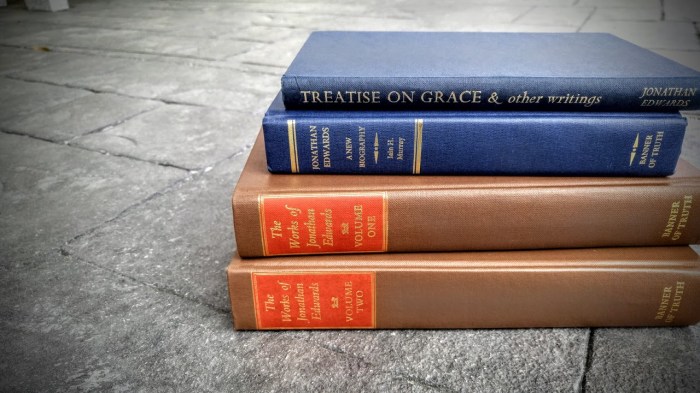
First, a little bit about this work: It is available to us in several different forms today, despite its late publication date of 1903. First, it comes in a nice, hardback 1971 volume edited by the aforementioned Paul Helm (pictured above, top). This edition comes to the reader alongside Edwards’s Treatise on Grace, and Observations on the Trinity (not to be confused with the Essay on the Trinity currently being discussed. Observations is primarily about the covenant of redemption, rather than God’s ontological being). Though I believe this monograph to be out of print, there are still several used copies to be found online or through used book sales. Fortuitously, my copy was signed by the editor (Helm) and dedicated to another theologian, John Frame! The second manner in which An Essay can be found is in various ebook formats like this one. Thankfully today, most ebooks grant us huge knowledge at our fingertips for mere pennies to the dollar.

Although Edwards likely intended its publication during his own lifetime, his sudden death prevented it from coming into popular view. (Edwards died in 1758). The work itself is but only thirty pages long, and can be read in one or two settings by the careful reader. In what follows, I will attempt to describe Edwards’s views of the Trinity as espoused in this short work.

First Edwards begins with the premise that God is infinitely happy in His own being. His opening salvo is filled with joy-language:

Tis common when speaking of the divine happiness to say that God is infinitely happy in the enjoyment of Himself, in perfectly beholding and infinitely loving, and rejoicing in, His own essence and perfections and accordingly it must be supposed that God perpetually and eternally has a most perfect idea of Himself, as it were an exact image and representation of Himself ever before Him and in actual view, and from hence arises a most pure and perfect act or energy in the Godhead, which is the Divine love, complacence and joy (1971, 99).

Here Edwards tips his hat to his main thrust and direction in this Essay. He is going to argue that when God thinks about Himself, He has a perfect self-understanding. He always thinks rightly and perfectly about Himself. This self-reflection brings Him great joy. Two aspects of this self-reflection are going to be emphasized over and over again in this essay: (1) God’s perfect knowledge of Himself and (2) God’s joy in this self-knowledge.

Now to the part that is controversial: Edwards believes that when God contemplates His own glory, this in part explains how the Son of God (the Second Person of the Trinity) can be eternally generated, without beginning or end. Note: Edwards does not use the word “create.” That would be to assert that one or more persons of the Trinity are creatures. Thus, this kind of argumentation is called the “psychological model.”

If God beholds himself so as thence to have delight and joy in Himself He must become His own object. There must be a duplicity. There is God and the idea of God, if it be proper to call a conception of that that is purely spiritual an idea (1971, 100).

Thus the Second Person of the Trinity, the Eternal Logos, is that perfect idea of Himself which God knows, perceives, and apprehends perfectly. As an infinite being, this results in a “duplicity” (his term), or another person being eternally generated in God’s self-understanding. Thus, this self-understanding is another “person” and is in some way distinct from the first. (Edwards is jealous NOT to lose the personality of the Three persons in his view on the Trinity!) He says in His own words,

Therefore as God with perfect clearness, fullness and strength, understands Himself, views His own essence…that idea which God hath of Himself is absolutely Himself…Hereby is another person begotten, there is another infinite eternal almighty and most holy and the same God, the very same divine nature (1971, 103, emphasis added).

He goes on to make the connection explicit between God’s self-knowledge and the Son of God,

And this person is the second person in the Trinity, the only begotten and dearly beloved Son of God; He is the eternal, necessary, perfect, substantial and personal idea which God hath of Himself; and it seems to me to be abundantly confirmed by the Word of God (1971, 103).

Whether or not this explains how God can eternally exist as Three Persons, I will let the reader decide. Obviously, Edwards includes much more nuance and thought than a brief synopsis like this one can contain in a simple blog post. But another question arises almost immediately. What about the Third Person of the Trinity? What about the Holy Spirit? To this point, Edwards has been emphasizing God’s self-knowledge. But in regard to the Holy Spirit, Edwards will now turn the attention to God’s joy in Himself. Listen:

The Godhead being thus begotten by God’s loving an idea of Himself and shewing forth in a distinct subsistence or person in that idea, there proceeds a most pure act, and an infinitely holy and sacred energy arises between the Father and Son in mutually loving and delighting in each other, for their love and joy is mutual…I think it is plainly intimated to us that the Holy Spirit is that love (1971, 108, emphasis added).

To summarize, it would be helpful to quote Edwards at length just one more time. This paragraph from page 108 of Helm’s 1971 edition I think is very clear:

The Father is the deity subsisting in the prime, unoriginated and most absolute manner, or the deity in its direct existence. The Son is the deity generated by god’s understanding, or having an idea of Himself and subsisting in that idea. The Holy Ghost is the deity subsisting in act, or the divine essence flowing out and breathed forth in God’s infinite love to and delight in Himself. And I believe the whole Divine essence does truly and distinctly subsist both in the Divine idea and Divine love, and that each of them are properly distinct persons.

Once again, whether this psychological model is convincing, I will let the reader decide. In layman’s terms what Edwards is saying here is simply this:

God is eternal. The Father is the “deity subsisting in the prime.” That is to say, the Father is who we think God is in standard theological definitions: eternal, omnipotent, holy, beautiful, and wise. In fact, God is so wise that when He thinks of Himself, His knowing and valuation is pure, holy, and precise. Unlike finite creatures, God’s self-knowledge lacks nothing. So glorious is His knowledge, that another “person” entirely is generated, the Son or the Logos. He is not created, but always was, is, and is to come. This must be, because God never began to think about Himself. Herein we have the Son. The Son is the Father’s pure, unmitigated, unfiltered self-knowledge.

But it does not end there.

Because God is a joyful God, truly rejoicing in His being (for His judgments and valuations are always morally perfect) He also takes great pleasure in the mutual recognition between Father and Son. This joy itself includes personality, and is the Holy Spirit, or we can say, God’s eternal joy and enjoyment between Father and Son. Thus, there is one God substantially, but because of the glorious infinity of God’s wisdom and joy, He eternally exists as Three Persons: God in the Prime (Father), God’s perfect self-knowledge (Son), and God’s joy in Himself (Holy Spirit).

See also my short video on Essay on the Trinity. 

Interview with Rob Boss, Ph.D on His New Book: God-Haunted World: The Elemental Theology of Jonathan Edwards


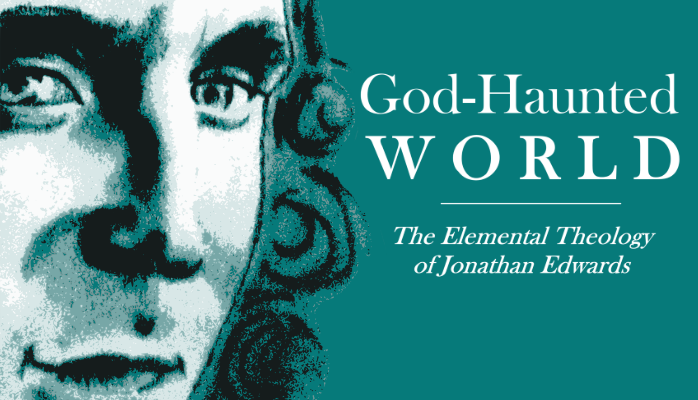
Today, EdwardsStudies.com has the privilege of talking with Rob Boss about his new book God-Haunted World: The Elemental Theology of Jonathan Edwards.
aaeaaqaaaaaaaaymaaaajgm3odu1zdjlltjmogutngq1ms1hnjzlltczzthiodiznmflzg

Tell us a little about yourself Rob, how long have you been studying Jonathan Edwards, and how did you get interested in his works?

Thank you for the invitation, Matthew. My first encounter with Edwards was in 1994 while reading Michael Crawford’s Seasons of Grace: Colonial New England’s Revival Tradition in Its British Context (OUP, 1991). Soon afterward I purchased the Banner of Truth edition of Edwards’ works and began reading Freedom of the Will. It was an experience akin to drowning, but I persevered until I finished the Hickman edition of Edwards’ works. I then started collecting the Yale edition.

My interest in Edwards has been driven primarily by my experience of God’s grace. I found in Jonathan Edwards a doctor of the soul who could diagnose spiritual ailments and prescribe treatments that heal. His ability to direct persons to repentance and faith in Jesus Christ resonated deeply with me.

After pastoring a church in Oklahoma I returned to Southwestern Baptist Theological Seminary for Ph.D. work in church history, where I wanted to continue my study of Edwards. It was at Southwestern that I met my dissertation supervisor, Robert Caldwell. Caldwell is a careful JE scholar who studied under Doug Sweeney and has written books on Edwards’ trinitarian theology and theology of awakening.

You scored a sweet review from Douglas Sweeney and have a recommendation from Kenneth Minkema as well. Those guys are pretty awesome in our quarters. How did you score those reviews? Have you worked with them before?

“Sweet” is an apt (and even Edwardsean) description. I am very thankful that they requested review copies of my book.

I first met Ken Minkema in October of 2007 at Northampton, MA. Under the direction of Richard Hall, a conference was convened at First Churches of Northampton on the theme of “Jonathan Edwards and the Environment.”

I presented papers at a series of Northampton conferences in 2007, 2008, and 2010. Participants included Ken Minkema, M.X. Lesser, Stephen Nichols, Rhys Bezzant, Gerald McDermott, Michael McClymond, Robert Caldwell, Oliver Crisp, and other Edwardsean scholars. It was a stimulating time to say the least.

Tell us about the title of the book God-Haunted World.

The title of the book is a story in itself. When I returned to seminary for doctoral work, I met Stephen Dempster, a noted OT scholar visiting from Canada. Though from a different field, he was full of encouragement and advice. We had a number of inspiring discussions on Edwards’ typology and natural theology. During one of our exchanges, he described Edwards’ worldview as “God-haunted” and encouraged me to write a book about it.

I registered the domain name godhauntedworld.com and began writing furiously. At the end of a couple of months, I showed my writing to Caldwell, who wisely suggested that I reduce it to 20 or so pages and submit it to a journal. Instead of submitting it for publication, I submitted it to the 2007 Northampton conference on “Jonathan Edwards and the Environment.” My paper was titled “God-Haunted World: An Edwardsean Rationale for Saving the Creation.” I soon received notice that my paper had been accepted. I was elated!

In the following years, I stuck with the “God-haunted world” theme and tried to bend my doctoral papers in that direction.

What do you mean by “The Elemental Theology of Jonathan Edwards.”

“Elemental” denotes the role of nature or the elements in Edwards’ emblematic theology.

Take us through the flow of the book. How do you progress through the content?

The book begins with a brief historical survey of the emblematic worldview of the Renaissance and its adoption by post-Reformation Protestants and emblem writers. I examine some emblematic works of select individuals such as Ralph Austen, John Bunyan, Benjamin Keach, Cotton Mather, and others. I then compare Edwards’ notebook “Images of Divine Things” with theirs, noting poetic quality, doctrinal content, and the primacy of Scripture over nature. I identify Edwards’ project as a reinscripturation of the world and I explore the main theological categories of his intertextual, devotional worldview.

Tell us about some of the main works of Edwards that you discuss in this book.

I focus mainly upon his typological notebook “Images of Divine Things,” with reference to his Miscellanies, Scientific Writings, and Sermons.

What do you want readers to capture about President Edwards, the man himself, by reading this work?

I hope that readers will better understand the meditative Edwards. I want to introduce them to Edwards’ intensely devotional, reinscripturated worldview which he summed up perfectly in “Image” no. 70,

If we look on these shadows of divine things as the voice of God, purposely, by them, teaching us these and those spiritual and divine things, to show of what excellent advantage it will be, how agreeably and clearly it will tend to convey instruction to our minds, and to impress things on the mind, and to affect the mind. By that we may as it were hear God speaking to us. Wherever we are and whatever we are about, we may see divine things excellently represented and held forth, and it will abundantly tend to confirm the Scriptures, for there is an excellent agreement between these things and the Holy Scriptures.

As I mention in the book, familiar objects such as spiders, arrows, death, sun, rain, plants, animals, and human events are transformed into powerful and affecting mental images in Edwards’ preaching and writing. The entire world is a vivid illustration of spiritual truth, truly a second book of revelation which provides powerfully affective images both comforting and frightful.

How did your research change your views about Edwards, if at all, during the process of writing?

A significant turning point in my understanding of Edwards came when I began to classify Edwards, Bunyan, and others like them as creative evangelical theologians. They believed that a poetic disposition is requisite to a proper understanding of Scripture and the world.

This is fascinating to me, especially since both E.O. Wilson and Richard Dawkins have given the poet-scientist an exalted role in properly interpreting the world. In Unweaving the Rainbow, Dawkins says that nature should inspire scientists to write poetry in order to transform worldviews. Jonathan Edwards says that creation is poetry. The difference is huge.

Reading Tibor Fabiny’s work helped me see Edwards in a wider context which included Luther, Shakespeare, emblem writers, and the English Baptist Benjamin Keach.

Writing about Edwards’ poetic worldview of similitudes and correspondences can be a frustrating exercise. One wants to see, touch, and manipulate his system of thought; at least I do. A recent breakthrough came when I started visualizing Edwards’ thought through complex network graphs. I was able to include some of these visualizations in the book, and am doing more on ElementalTheology.com.

The cover art is pretty cool. Who came up with that concept?

Full credit goes to my younger daughter, Sarah. While she was home on summer break from Wheaton College I took advantage of her artistic abilities and commissioned her to create a “new and cool” Edwards with a piercing and direct gaze. I think she nailed it. She also copy edited the book (though any remaining mistakes are entirely my own).

Have you read Oliver Crisp’s new work Edwards Among the Theologians?

I have read selections of it and am eager to finish it. His work is simply remarkable.

What are you reading right now?

In addition to the Bible, I am currently rereading Notes on Scripture, WJE, vol. 15, along with some Dostoevsky and Steinbeck.

Are you done with Edwards yet, or are you going to keep digging for future works?

There is much more to be explored … Edwards’ theology is an ocean of great breadth and immense depth.

Thanks for interviewing with us, Rob. Any parting thoughts or recommendations for readers of EdwardsStudies.com?

I leave you with a cool quote from Mark Noll’s America’s God: From Jonathan Edwards to Abraham Lincoln, 444.

Attentive readers of these pages will realize that if I had to recommend only one American theologian for the purposes of understanding God, the self, and the world as they really are, I would respond as the Separatist Congregational minister Israel Holly did in 1770 when he found himself engaged in theological battle: “Sir, if I was to engage with you in this controversy, I would say, Read Edwards! And if you wrote again, I would tell you to Read Edwards! And if you wrote again, I would still tell you to Read Edwards!

The Religious Affections (Synopsis)

The Religious Affections (Synopsis)

The Religious Affections is for very good reason considered one of the most important works of Jonathan Edwards in particular and one of the most excellent and helpful treatises on Christian spirituality in general. Caught in both the glory and the drama of the First Great Awakening (1740-1742), Jonathan Edwards was tasked with the responsibility to defend God’s mighty outpouring of grace from both its detractors and its extremists. Ever the supporter of the revivals, and when necessary the revival’s internal whistle-blower, Edwards took it upon himself to help foster and defend the outpourings of God’s grace wherever he saw them being challenged.

In this 1746 work, Edwards greatly expands and reprises the goals of his earlier The Distinguishing Marksby attempting to show the true identifiers that demarcate real religious revival as opposed to counterfeits and impostors. In his prior piece, Edwards reduced true Christianity to five essential marks. True believers, he conjectured in his simpler piece, were those who: (1) loved Christ, (2) loved His truth, (3) loved the Word of God, (4) loved other believers while (5) hating the sin they found in their own lives.

In both works, he sought to define and defend true Christian experience. This was necessary both to defend the Great Awakening, and to distinguish it from its excesses and worst representatives, who, in Edwards’s opinion flew to unwarranted extremes. Edwards knew that the revivals were under spiritual – even demonic – attack from both sides. Some saw the revivals as bizarre manifestations of misguided religious zealots, perverting the decent and orderly doctrines of the Puritan fathers. Contrarily, others took their behaviors to uncalled for levels, verging on the bizarre, and critiquing anyone who didn’t experience the zeal they themselves had. Some revivalists even went as far as to publically call out ministers by name and pulpit who were not considered to be sincerely “converted” at all, since they did not participate fully enough in the revivals.

Originally, Religious Affections was a sermon series preached on 1 Peter 1:8, which says, “Though you have not seen him, you believe in Him and rejoice with joy that is inexpressible and filled with glory, obtaining the outcome of your faith, the salvation of your souls” (ESV). Today, the full-length treatise, one of Edwards’s best, is available as a paperback and as Volume 2 of the Yale Edition of the Works of Edwards. 

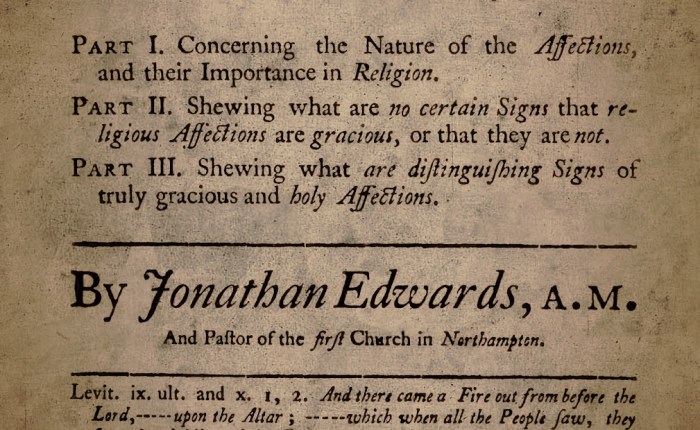
The growing fracture between “new” and “old lights” (pro and anti revivalism respectively) forced Edwards to expand and clarify his previous work. In Religious Affections, Edwards sets out to accomplish three major goals (1) he shows from Scripture that the religious affections (“the more vigorous and sensible exercises of the inclination and will of the soul”) are indeed true manifestations of real Christian spirituality and of the holy life (2) he warns of a number of “experiences” that cannot either verify or falsify the reality of one’s professed conversion and (3) he enumerates several factors that are indicative of true conversion and regeneration. Chief among these last factors (as the quote below demonstrates) is the fruit of holy living—or Christian practice—carried out in the believer’s life.

It is helpful to clarify what Edwards means by “religious affections.” While some have suggested that they are equivalent to “emotions,” Edwards means something more profound, and closer to the deepest inclinations of one’s soul, that is, what one’s spiritual condition causes his or her will to love or hate, to affirm or reject. The word “passions,” too, would not have suited Edwards, as the passions were thought of in his day to mean primarily the lusts of the flesh. By affections, Edwards is speaking about the will’s own inclinations and dispositions to either approve or disapprove – to either affirm or loathe – stimulus as it is presented to an individual. The most fundamental concern in Edwards’s mind is to show how the Christian’s converted soul inclines toward the things of God (His holiness, loveliness, righteousness, personal piety etc.) while the soul of the unbeliever is primarily inclined to the self. Of course, this idea of the will having inclinations is greatly expanded in Freedom of the Will (1954) in which Edwards seeks to show how human choices are bound to the inclinations that are cherished in the deepest recesses of the heart.

As mentioned above, Religious Affections unfolds in three major parts. Part one defends the centrality of religious affections in general in true religion (read: Biblical Christianity). Love, joy, hope, the fear of the Lord, longing for God’s presence – all are truly and really representative of bona fide religion and authentic spiritual experience. This assertion refutes those who saw the dramatic outpourings of the Great Awakening as unnecessary excesses and strange extremes. His major thrust here is to show that those who have experienced grace, cannot help but respond to God’s grace in significant inward, and even outward, ways.

Part two demonstrates that there are many such manifestations of signs or apparent affections, however, which may – or may not – validate true Christian experience. Among these, Edwards lists outward expressions of praise, the shaking of the body or voice, and moving personal testimonies. There mere fact that a person says they have experienced grace does not prove it. Even if a person would see images of the crucified Christ in their minds, or have verses of the Bible strikingly impressed upon them, this would not in itself prove genuine conversion beyond doubt. These, after all, can all be fabricated or falsified.

Part three, then, shows what are the distinguishing signs of “truly gracious and holy affections.” Among these Edwards sees love for God’s holiness and obedience from the heart as being central to Gospel realities. Over and over in the last section, Edwards underscores the importance of the saint’s love for God’s glory above all things, as evidenced by deep humility, a love of God’s mercies and grace, and obedience in the Christian life.

By taking this approach, Edwards walks the tight rope of evaluating the revivals with both precision and grace. Clearly he is not fooled by any and all religious fervor and frivolity just because it bears the name of Christ upon it. Not all that glimmers is gold. Some gold is fool’s gold, a mere imitation of that which is precious and real. Obviously, Edwards is very open to what God was doing in his own time by connecting some of the admittedly unusual works of God’s grace with biblical examples and precedents. Men and women of biblical history fell down in the presence of the holy, shook with fear, and leaped for joy – why shouldn’t that still happen today? In fact Edwards argues that those who never experience moving tears of joy, or a personal conviction for their sins, or experience love towards their brothers as deep and abiding affections should give pause and consider again the state of their soul. Real Christianity is affective. There is no Christianity without these deep inclinations because Christianity, when real, does affect the person’s personal disposition to the holy!

Yet at the same time, Edwards also argues (especially towards the end of the work) that the ultimate proof is in the pudding. No matter how loudly a man shouts or how profusely he weeps publicly, he cannot claim to have been truly changed by grace if this transformation is impermanent or does not result in real, lasting Christian fruit in the basic areas of obedience, humility, service, and concern for others. In this way, Edwards showed, quite ably I think, that time itself would prove the real results of the revival. False professors would eventually be exposed as frauds when they were found to be without lasting fruit in their lives or barren from the attendant holiness that naturally springs forth from what Christ called the “good tree.”

This great work has a number of applications and uses. First and foremost the Religious Affections helps to delineate what true conversion looks like, both in Edwards’s day and in our own! In Edwards’s day it was hard to prove to others that one was truly “converted.” The difficulty was exacerbated by the throngs of professed conversions in the wake of the Great Revival of the 1740’s.  Church elders were slow to receive new members or communicants to the Table if they could not give a properly documented testimony.  Often, the Puritans looked for a series of finely ordered “steps” in one’s testimony of professed faith. The burden of proof lay heavy upon the person seeking church membership and communion. In fact, Edwards’s own mother did not receive the Lord’s Supper until well into her adult life! Edwards showed that real conversion can happen quickly and dramatically, but must also be substantiated over the long haul.

In our day, it is much easier—we must simply give an “altar call” story, or a similar anecdote of “accepting Jesus into our heart.” Perhaps where the Puritans erred in their rigorous demand for steps, we fall into the equal and opposite error by not listening closely enough in people’s testimonies for evidence of real repentance. Change. True, many people will be taken for true Christians just because they speak of “coming forward” or “receiving Christ” even though their lives do not seem to give, real, substantial, credible, longitudinal evidence of a transformed character. But Edwards is right to point toward the person’s lasting fruit in their walk. This alone will reveal the truth over time no matter how dramatic of a story or experience they can recount.

Edwards speaks to both extremes (too easy vs. too hard) by evaluating one’s profession of conversion experience by a truly Biblical grid of analysis. Edwards shows that true conversion does indeed transform both the inward man, in his “affections” (love, joy, fear of the Lord, etc.) as well as the outward man in living out the will of God in his daily experience. Pastors who are prayerfully evaluating their flock, as well as those unsure of their own salvation, will find this work deeply helpful in this regard.

While this particular reviewer is mostly sympathetic to Edwards’ position about conversion, many of my charismatic and Pentecostal friends will likely find some fault with Edwards’ teaching on the inner-life of spiritual experience. Throughout, Edwards is particularly hard on those who claim to have received such things as visions of Christ or strong “impressions” of particular Scripture passages upon the heart as being too easy to manipulate and falsify. While he is surely right in showing that these things cannot prove that one is a Christian, some readers (but not all) will feel he has gone too far in assessing the supernatural revelations of the Holy Spirit to the human mind in a negative fashion. Personally, I found Edwards insights on these matters to be desperately needed in a world of hyper-subjective excesses (“The Lord told me…” etc.) and non-falsifiable claims of religious experience, often bordering on the narcissistic and the bizarre.

Moreover, I found this book to be one of the greatest works of Edwards, and one of the best introductions to his thinking and theology. Much of this book (especially his non-polemical sections) can be read as devotional material. His emphasis on Christianity’s burning-heart piety (love, joy, fear of God etc.) reads like the work of a man passionate about Jesus and His intrinsic glory. It is with great reason that the Religious Affections has taken its place among the all-time spiritual classics.

“From what has been said, it is manifest that Christian practice, or a holy life, is a great and distinguishing sign of true and saving grace. But I may go further and assert that it is the chief of all the signs of grace, both as an evidence of the sincerity of professors unto others, and also to their own consciences” (p. 326-32).

–Matthew Everhard is the Senior Pastor of Faith Evangelical Presbyterian Church in Brooksville, Florida

Book Reviews: Jonathan Edwards, “Sermons on the Matthean Parables” Volumes I, II, & III (Wipf and Stock Publishers)

I am here reviewing all three volumes of sermons in this new series on the Matthean Parables by Jonathan Edwards, published by Wipf and Stock, and edited by Kenneth P. Minkema, Adriaan C. Neele, and Bryan McCarthy.

     I say “new” because these sermons have been essentially hidden from modern audiences since they were originally preached in the early to mid 1700’s. Thankfully, as of 2012, they have finally been transposed to printed form from their original manuscripts in Edwards’ own puzzling handwriting.
     For decades and even centuries, these manuscripts have been stored away, deep in the vault of history, now currently resting in the caring hands of the Jonathan Edwards Center at Yale University.
     Today, these powerful sermons can again lift Edwards’ voice and be heard anew, in some cases more than 270 years after they originally thundered from the Northampton Church pulpit. Since then, almost no human eyes have viewed them since the Colonial Congregationalist penned them himself. For this reason, these three paperback volumes are a true treasure chest, replete with jewels and gems for advancing Jonathan Edwards studies.
     The whole series, I think, will significantly move forward our understanding of Edward’s theology of regeneration and conversion, not to mention his theology of, and first-hand participation in Great Awakening-era revivalism.
     Each of the three volumes is a compendium of multiple sermons on one particular parable. Often, Edwards’ sermons were preached over various occasions (called “preaching units”) and took on a life of their own, far beyond the typical hour-long sermonic format, so commonly known among the Puritans. Such is the case with these sermons: they are really each a greatly extended but cohesive literary whole, preached upon a particular pericope of Scripture.
     Each sermon series (in one case, 19 preaching units!) treats of multiple theological doctrines, and contains various of Edwards “uses,” or applications. Of course, they were originally preached over the time-frame of multiple weeks and even months, often containing both morning and afternoon/evening oratories.
     Volume One focuses on the “Parable of the Wise and Foolish Virgins” (Matthew 25:1-13). Here, Edwards intends to show the similarities and distinctions between those who virgins who have oil in their lamps and those who do not. In this way, Edwards draws some distinctions between the Church Visible, and the Church Invisible. His primary thrust is to show that there are many professing believers who would appear to be genuinely converted, and yet do not have the new principle of inner life, given only by the sovereign hand of God.
     Volume Two treats of the “Parable of the Soils” (Matthew 13:1-23). Predictably Edwards discourses at some length the four general responses that hearers have to the Gospel as originally given and explained by Jesus. Interestingly, this sermon series was preached immediately after George Whitefield had come through Northhampton. The sermon series itself more than hints at Whitefield’s revivalistic power and affect, and the people of Edwards’ congregation’s reaction to the same. This volume contains an additional text by Whitefield, a brief treatise on how to “hear” a sermon.
     Volume Three is in regard to the “Parable of the Net” (Matthew 13:47-50). Here Edwards powerfully describes the doctrines of grace as it relates to as-yet unregenerate men being forcibly pulled from their natural element (like fish from the sea) and prompted to die to self and live the new life of conversion in Christ. This third volume, although much more in outline form than the others, has the added distinction of being preached at the same time that Edwards was preparing The Religious Affections for publication. For this reason, the reader gets a unique look into what Edwards was stewing on during this great book’s final preparations.
     What ties these three volumes together and makes them interesting historical and exegetical material is their relationship to the events of the Great Awakening. Each volume was preached at a unique time in early colonial revivalism history. Additionally, the series taken together gives the modern reader a view of Jonathan Edwards’ theology of the Kingdom, since Minkema and Neele have wisely chosen a set of sermons  for publication that are moored to theological motifs held in common by each parable.
     Readers will find these sermons to be a very helpful companion as they read other works of Jonathan Edwards such as The Religious Affections which deal with very similar topics and themes, if only in a more didactic form. For many, the sermons will actually be easier to read than his treatises.
     One weakness should be mentioned. I am not sure why the editors chose to include the very same opening article on “Edwards the Preacher” by Wilson H. Kimnach in all three volumes, but alas, they did. Perhaps they thought that some readers would not buy the whole set and would need the same article printed separately in each volume. For my own part, I would have preferred that they included different prefatory materials in each book. Together they could have done more to prepare and educate the reader as to the historical context of the sermon series.
     Moreover, this set of three books will be an incomparable treasure to all Edwards scholars, as it was to me. The very idea that I am reading today what was hidden for centuries was enchanting. Scholars, pastors, and students of revivalism alike will all greatly benefit from these faithful, historic proclamations of Gospel truth!
–Matthew Everhard is the Senior Pastor of Faith Evangelical Presbyterian Church in Brooksville, Florida. 

Where Do I Begin Studying Edwards? His Sermons.

In this short video, Matthew Everhard of EdwardsStudies.com gives a brief recommendation as to where to begin reading Edwards. If his sermons is the place you would like to begin, there is probably no better one volume introduction to begin with than the 2005 compilation of messages published in hardback by Hendrickson.

Here is the book on Amazon.

Kyle Strobel Discusses His Book “Formed for the Glory of God”

Kyle Strobel, one of the number of excellent young Jonathan Edwards scholars discusses his book Formed for the Glory of God (Purchase here). In this accessible volume, Strobel discusses the spiritual practices of Jonathan Edwards including, prayer, meditation, fasting, and Scripture reading.

Where Should I Begin Studying Edwards?

In this video post, EdwardsStudies.com general editor Matthew Everhard gives a very brief introduction to an incredibly clear and easy book to begin studying Edwards! In fact, this book is so easy to read, it even has cartoons provided. That doesn’t necessarily make the thoughts of Edwards easier, but this is as good of an intro as you can get to the Northampton Puritan.

The book recommended here is James P. Byrd’s work Jonathan Edwards for Armchair Theologians. You can buy it here at Amazon.com. 


An Edwards-Inspired ESV Bible from Crossway

Hundreds of years ago, the Puritan Jonathan Edwards owned a one-of-a-kind Bible that has rarely, if ever, been replicated. Until today, that is.

Edwards (1703-1758) took possession of an unusual 1653 King James Bible, the pages of which were removed, and spliced back into a larger volume with entirely blank pages. The resulting amalgamation looked like a large notebook that had swallowed a small hand-sized Bible alive!

This enabled Edwards to own a Bible in which every other page was completely blank – perfectly suitable for a lifetime of note-taking. And that he did! Edwards filled the Bible with 5,506 notes and entries making it one of the great artifacts of Early Colonial history through which we can learn of his personal theology and exegetical insights. Today, this Bible has become known as the “Blank Bible” and is now in possession at the Beinecke Rare Book and Manuscript at Yale University.

[Note: I have written a much larger history of Edwards’s unusual Bible here.  Edwards’s Blank Bible can be read for free here at the Yale site, or obtained in print as Volume XXIV of Edwards Complete Yale Works (24 Volumes). ]

Today, I am excited to announce that Crossway has intentionally replicated this unusual Bible and made it available to the public for purchase. No, you don’t get Edwards’s own notes inside, but you do get to create your own notes everywhere throughout!

The result is Crossway’s Journaling Bible: Interleaved Edition. Let me describe it in this brief review.

Main

The first difference between Edwards’s Bible and the replica is translation. Edwards had the KJV and this Crossway edition of course comes in the English Standard Version. But for me, that is ideal. The ESV is one of the most literal and beautiful translations available today. Edwards would approve.

Now, you’ve seen journaling Bibles before, right? In fact, Crossway has several others to offer in their lineup. So what makes this one different? Well, the great design factor here is that the Edwards Bible comes with an entire blank page (both sides) between every page of Scripture making the usable writing space about ten times greater than even the most free-form journaling Bible. Far from being a mere wide margin Bible, this setup allows artists, preachers, diary scribes, and budding theologians to produce far more commentary, message notes, graphic designs, or exegetical observations in their Bibles.

In terms of size, it is surprisingly consistent with what Edwards had. His was 9.5 X 7.5, and the new Crossway edition is almost the same dimensions. That seems rather fitting to me. For those in the know, this is essentially the same size as an ESV Study Bible, the owners of which know is a rather large book indeed. This book probably won’t make a very good traveling companion for you, and it certainly won’t fit in your pocket, but it will make a faithful servant at your study, desk, or office.

Main

At the same time, there are some features that would make the Puritan Edwards downright jealous. Edwards was known to treasure paper (yes, paper!), often writing his sermon notes on unfolded fans, parcel packaging, bills from the market, or whatever else he could get his hands on. Let me say that the paper in this edition is fantastic. A cream color, it is pleasant to the eye, smooth to the touch, and thick enough for substantial writing. That’s what this baby is designed for, right?

Speaking of layout, the two-column format is printed without center column references, similar to what Crossway does in their longtime favorite Thinline setup, although the font is a half-step down at a mere 7.5. This makes the Journaling Bible: Interleaved Edition a bit difficult to see for those with troubled up-close sight. For me, it’s no problem at all. It looks to me roughly comparable to a Cambridge Pitt Minion, although the PM has the text lines printed much closer together giving the Edwards Replica a better, easier read in my own opinion.

In one sense, it is minimalistic. There are no study notes, charts, or maps. The reference suite featured is Crossway’s lightest touch, containing only references to those places in Scripture where other portions are directly quoted. For instance, Acts 2:17 has a reference note to Joel 2:28-32. But there is very rare page clutter here, such as translation notes and manuscript variants. Thus, the text is virtually free from obstruction. The job to fill the pages with notes and references belongs to the owner. You.

Blank Page

This edition comes in cloth over board, giving it a nice timeless look. It’s both quaint and modern. Rustic and durable. The hardback style means this larger Bible has plenty of structure to prevent it from being floppy, although draping it with a nice piece of natural brown leather would make a pleasing (but significantly costly) upgrade.

Here are some other pics:

Mark 2

Edwards

Isaiah

Top Ten Edwards Books

I am now closing in on the completion of my doctoral studies from Reformed Theological Seminary in Orlando, and have just received news that my dissertation is headed to the second reader, and soon thereafter, onward to the defense portion.

My topic has been narrowly focused on Jonathan Edwards’ theology of joy. For anyone who has ever attempted to read Edwards, they will find his writings just dripping with joy-related language: happiness, rejoicing in Christ, the joys of heaven, the mutual love within the persons of the Trinity. Joy is everywhere! Rich language of light, the sun, fountains, rivers, and streams all emit Edwards’ theology of Christian joy.

I’ve read deeply and broadly: books by Edwards and books about Edwards. I’ve read his treatises, sermons, and personal correspondences. I’ve read biographies about him and at least one biography from his own pen (David Brainerd). Everything is so good, it’s hard to pick. Nevertheless, I am going to attempt to recommend just one shelf-full of JE books. Here then, are my top ten recommended works from or about the Northampton Revivalist (in no particular order).

Sermons
1. Sermons of Jonathan Edwards. (Peabody, MA: Hendrickson. 2005). If you are looking to find some of Edward’s best sermons like “Sinners in the Hands of an Angry God,” “A Divine and Supernatural Light,” or “God Glorified in Man’s Dependence” this is the place to begin. [Reading Level: Moderate].

2. Sermons by Jonathan Edwards on the Matthean Parables: True and False Christians (On the Parable of the Wise and Foolish Virgins). (Kenneth P. Minkema, Adriaan C. Neele, and Bryan K. Kimnach, eds. Vol. I. Eugene, OR: Cascade Books. 2012). What’s neat about this volume, is that unlike the above, this one is filled with previously unpublished sermons that just came into the public eye in 2012. [Reading Level: Challenging].

3. Charity and Its Fruits. (Carlisle, PA: The Banner of Truth. 2005. Orig. pub. 1852.) Another of his major sermon series, converted into a treatise, this one focuses on the “love chapter” of 1 Corinthians 13 and features the glorious sermon “Heaven is a World of Love.” [Reading Level: Moderate].

Treatises

4. The Religious Affections. (Mineola, NY: Dover. 2013. Orig. pub. 1746.). Likely Edwards’ most well-known treatise, this book looks at the powerful inclinations of the heart (love, joy, fear etc.) and uses them to help determine which religious experiences are true and which are false. A major work tied to the Great Awakening revivals of the 1740’s. [Reading Level: Difficult].

5. God’s Passion for His Glory: Living the Vision of Jonathan Edwards. With the Complete Text of The End for Which God Created the World.(Jonathan Edwards and John Piper. Wheaton, IL: Crossway, 1998. Orig. pub. 1765.). In this book, beloved pastor John Piper walks readers through JE’s easier-than-you-might-think treatise on God’s motivation for creating the universe. Hint: joy! [Reading Level: Moderate].

Biographies

6. Jonathan Edwards: A Life. (George Marsden. New Haven, CT: Yale University Press. 2003). Here is a 500 plus page work that masterfully takes readers through JE’s life and times. I cannot imagine doing serious study on Edwards without this volume. Another honorable mention in this category is Iain Murray’s work of a similar structure. [Reading Level: Moderate].

Popular Introductions

7. A God Entranced Vision of All Things: The Legacy of Jonathan Edwards. (John Piper and Justin Taylor, eds. Wheaton: Crossway. 2004). Many crisply written essays on Edwards and his theology from men like John Piper, Sam Storms, Mark Dever, and more. [Reading Level: Moderate].

8. Jonathan Edwards for Armchair Theologians. (James P. Byrd. Louisville: Westminster John Knox Press. 2008). A great little introduction to Jonathan Edwards with cartoons sprinkled throughout to help readers “get it.” Really! There are cartoons! [Reading Level: Entry].

9. God’s Grand Design: The Theological Vision of Jonathan Edwards. (Sean Michael Lucas. Wheaton: Crossway. 2011). An excellent little introduction of about 200 pages to Edwards’ life and major thought categories. [Reading Level: Entry].

10. Edwards on the Christian Life: Alive to the Beauty of God. (Dane Ortlund. Stephen J. Nichols and Justin Taylor, eds. Wheaton, IL: Crossway. 2014). A very helpful book that focuses primarily on Edwards’ view of beauty but also considers: prayer, temptation, Scripture, gentleness and more. [Reading Level: Entry].