Interview with Michal Choinski: The Rhetoric of Revival

Edwardsstudies.com is talking today with Michal Choinski, the author of the new book The Rhetoric of the Revival: The Language of the Great Awakening Preachers published by V&R Academic. Michal teaches American literature at the Institute of English Studies of the Jagiellonian University in Krakow, Poland. 

Michal, before we launch into The Rhetoric of Revival, why don’t you take a moment to introduce yourself to our readers: where did you grow up, and how did you get interested in JE?
41serf2askl-_sx333_bo1204203200_

Well, I was born in Tarnów, in southern Poland – to attend the Jagiellonian University I moved to Kraków, where I did my MA in English literature in Shakespeare’s political drama. Then I decided to switch to American literature for my doctoral studies and for some time I was hesitating about which area of study to chose. A good friend of mine, Marta Gillner-Shaw, who now also teaches at the Jagiellonian, mentioned on some occasion Edwards’s Sinners at that time. Of course, I remembered the text vaguely from my introductory courses to American Literature. I reread the sermon, and was amazed by its rhetorical artistry. I guess when I had read it as a sophomore I just could not appreciate it fully. Then, the more of Edwards I read, the more interesting his language turned out to be. I also got interested in the phenomenon of the awakening itself, especially of its language-related aspects – from the perspective of Polish culture and religion, it seemed particularly fascinating, if not even exotic. So, this is what got me started with my research.

Tell us a little bit about what you are doing in the Jagiellonian University? What do you cover in your courses in American literature? Do you find Polish students interested in uniquely American writings? 

The classes I teach include mainly general literature survey courses. Apart from these, I run MA and BA seminars as well as “specialized courses” that are not compulsory but that students may select if they are interested. One such class concerns Southern writers, like Flannery O’Connor, Eudora Welty, or Harper Lee. My other courses include American Presidential Rhetoric and Shakespeare’s drama. What I think particularly strikes a chord with my students is contemporary American poetry and drama. We do not have time to read much of Edwards, though – Sinners, of course, fragments of Personal Narrative and I always try to make time to take a look at Edwards’s letters – for instance the one he sent to his daughter from Stockbridge in March 1753. My students are always puzzled about why he offers Esther to send her a rattlesnake, or about the recipe for jam he includes in the postscriptum. This helps in presenting Edwards as real person rather than just another blurry name of the American past.

Michal Choinski

Apart from teaching, I research Edwards’s writings using computer methods together with my colleague, Jan Rybicki. For instance, with the help of stylometric software used to determine the authorship of texts, we have been able to determine to what extent Thomas Foxcroft, Edwards’s literary agent and editor, amended and modified his writings.


You mentioned to me in an email that it took you over ten years to write The Rhetoric, tell us a bit about how it all developed.

Well, yes, almost ten years, if you include all the research time. I did my reading on rhetoric and American colonial culture during my doctoral studies for four years, and then after my defense in 2011, it took me almost five more years to transform the dissertation into a book. I was very lucky to receive two research fellowships at the JFK Institute at Freie Universität Berlin where I could access rich collections on American studies. Meanwhile, I was also preoccupied with translating the Yale Edwards Reader into Polish, which also consumed insane amount of time and diverted my attention elsewhere. But, of course, if it was not for my tendency to procrastinate, I would have done it earlier.

Give us the “big E on the eye chart” for this book – what’s it all about?

In the book, I tried to characterize the sermons of the Great Awakening preachers, and to understand why their language bore such an impact on the colonial audiences. The oratory the New Lights used, the “rhetoric of the revival” was very innovative, and met with massive reactions from the colonial audiences. The first chapters outline the basis of rhetorical theory, discuss the transition from rhetoric to preaching, and the rhetorical tradition of the earlier generation of colonists. “Rhetoric” is the big word for this book – I wanted to point out its importance as a great method of enquiry, as well as a means of continuity within American revival tradition. Then, in the analytical part, I introduce different Great Awakening preachers and study their sermons, paying close attention to the minutiae of figures and arguments they use.

You chose Edwards as well as some others (Whitefield, Tennent). How did you choose your subjects? 

I study the sermons of six preachers: Jonathan Edwards, George Whitefield, Gilbert Tennent, Jonathan Dickinson, Jonathan Parsons and Andrew Croswell. All of them were engaged in the Great Awakening and all of belonged to the “New Lights” group, the proponents of the revival. Through my choice, I have tried to include both the prominent ministers everyone knows about, as well as those pulpit orators whose discourses have not been in the main academic spotlight. My goal in the selection of sermons was to present the diversity and richness of the Great Awakening rhetoric and to illustrate different aspects of the colonial “rhetoric of the revival”, be it persuasiveness,  theatricality, or its experiential and confrontational character.

You look at three particular sermons of Jonathan Edwards. Why did you choose these three? 

Yes, with Edwards I look into three sermons: Sinners in the Hands of an Angry God, The Future Punishment of the Wicked Unavoidable and Intolerable and The Distinguishing Marks of a Work of the Spirit of God – I wanted each of them to demonstrate a different aspect of Edwards’s “rhetoric of the revival”. The choice for the first one was rather obvious. You can hardly attempt at discussing Edwards’s pulpit oratory without studying Sinners – although with this sermon, because it is such a famous (or infamous) text, you also have to take into account the bulk of critical literature. In my study of Sinners I stressed how the changes in perspective and the use of a “deictic shift” allowed Edwards to transport his hearers mentally into the figurative imagery. Then I look into how in Future Punishment the preacher employs a wide variety of rhetorical ploys to create rich sensory images designed to elicit an emotional reaction from the audience. Finally, The Distinguishing Marks helps me to demonstrate Edwards’s skill of argumentation in a theological debate.

Your book is Volume 1 in the exciting series “New Directions in Jonathan Edwards Studies” in cooperation with The Jonathan Edwards Center at Yale University. That’s got to be pretty thrilling.

Yes. I was very happy and honored when Professor Kenneth Minkema from Jonathan Edwards Center at Yale University proposed the publication of my dissertation in the series. He was also very patient with addressing all my doubts and problems concerning the whole process.

Any book, conference, or website recommendations? 

I mentioned digital humanities and Edwards studies earlier. Robert Boss’s book “God-Haunted World: The Elemental Theology of Jonathan Edwards” as well as the webpage with his beautiful visualizations is something any person interested in Edwards should definitely take a look at.

Thanks for joining us Michal!

Thank you so much for having me!


Interview with Dr. Rhys Bezzant

Today EdwardsStudies.com has the opportunity to talk with Dr. Rhys Bezzant, the Dean of Missional Leadership and Lecturer in Christian Thought at Ridley College in Melbourne, Australia. He is also the author of Jonathan Edwards and the Church published by Oxford University Press (2013).

Dr. Bezzant, thank you so much for taking the time to talk with us. That’s quite a title you have over there at Ridley: “Dean of Missional Leadership.” Tell us about what you are up to at the College these days. What courses are you teaching?

rhys

Don’t be too impressed! Outside of regular classes, I have pastoral responsibility for a cohort of students who want to serve in a variety of ministry settings within Australia, often on the front line of outreach: campus workers, Bible translators, youth pastors, children’s workers, church planters … I get the title to try to capture something of the breadth of the task! Apart from that, I teach Church History, Christian Worship, and some theology classes.

Any future Edwards scholars being reared under your tutelage there, I would imagine?

I talk a lot about Edwards in Australia, because not many other people do! Our teaching of church history has more often than not been oriented towards Britain, but new global impulses mean the church in Australia increasingly understands itself in relation to the US and Asia. I often say my goal is to make Edwards a household name, but only if the Lord Jesus is better known! It can be a tough gig getting students to think about further research in church history, because our churches need evangelists and pastors so desperately.

Give us a good lead as to what we might learn about JE in your book “Jonathan Edwards and the Church.” 

51a2bcew96nl-_sx329_bo1204203200_

What I tried to do in that book is work through all the stages of Edwards’s ministry, and show what he taught about the church at any moment. So it is a chronological analysis of his ecclesiology. Basically, he is a great Protestant, who sees the center of the church as the ministry of Word and sacraments, but adds to that definition the ways in which the church is central to the development of God’s purposes in the world. His ecclesiology is dynamic and responsive, not just institutional or clerical. God’s promises have to be held together with God’s presence and purposes. The church is like a tree, deeply rooted in theology but also responsive to its environment.

If I’m not mistaken, you have another book coming out about Edwards as a mentor. This sounds pretty cool. Are you working with the “log college” educational concept for ministers in this book, or do you mean something else by the term “mentoring”?

Yep, presently I am working on a book about Edwards’s ministry of mentoring. I think he was a better pastor than is sometimes imagined, and his mentoring was exceptionally effective. Mentoring is such a synthetic skill-set, drawing on Scriptural themes, historical examples, cultural norms and pastoral insights, so this topic gives me ample scope to understand features in Edwards’s pastoral labours often overlooked.

Any applications from your studies on mentoring that you think can be applied to educational leadership in our context today, in the modern world?

It takes much longer than it used to shape a future minister. There is so much to unlearn first. And the costs of serving in a church are much more significant than they once were. Mentoring helps in the process of growing in character, skills, and confidence. Seminary professors aren’t always the best people to do the mentoring, but at least we should start there. Intentional face to face experiences in education are more and more prized in a high-tech world.

Tell us a little bit about the Jonathan Edwards Center in Australia. What goes on over there?

Our job is to promote the texts and teachings of Edwards, and the history of evangelicalism more generally. We hold occasional conferences, public lectures, and Masters units for the professional development of clergy. Ridley holds the biggest collection of Edwardseana in Australia.

Are you in pretty frequent communication with the other JE Centers around the world? Let’s see there’s Yale, the one at TEDs, one in South Africa too…

Yep, the network based around the mother ship at the Yale Divinity School has been fantastic for me, when there are so few local Edwards scholars. Ridley hosted an Edwards Congress last year with representatives from every continent, built on the fellowship of the JE Centers worldwide.

Well, thank you so much for taking the time to stop by at EdwardsStudies.com. Before you go, are there any book or conference recommendations that you would like to pass along to our readers?

Why not take up the invitation this summer and do a one week reading course on Edwards at Yale?


George M. Marsden: A Short Life of Jonathan Edwards

A Short Life of Jonathan Edwards (Eerdmans, 2008) is, as the title suggests, a much briefer telling of the story of the life of Jonathan Edwards than the encyclopedic behemoth that George M. Marsden also published in 2004 for Yale University Press. The latter work, entitled Jonathan Edwards: A Life,  stands at over 640 pages, and enjoys the privileged status of being the definitive scholarly treatment of Jonathan Edwards biographies.

So, if you have read the much longer work, complete with its voluminous and copious footnotes and references, you are probably asking yourself these questions: First, is this simply a 150-page synopsis of what Marsden already wrote? Secondly, what else could Marsden say about Jonathan Edwards that he hasn’t already written elsewhere?

I asked myself those same questions.

As to the first question, I can say definitively, “No,” this is not a mere abridgment of the larger book. It is a complete rewriting and retelling of the life of the Puritan divine. As to the second question, I have to admit that the answer lies not so much in the fact that the books are radically different in content, as much as in the fact that the approach the author takes in the tiny volume is so fresh.

Let me explain.

I recently dove into the shorter work having already owned and mined the treasure in the larger work for several years. I liked the bigger book exceedingly and thought, “This is probably going to sound familiar – a deja vu.” I was skeptical at first. But as I began the very first chapter, I found myself enchanted by Jonathan Edwards and the story of his life all over again. The pages turned quickly. They were less filled with footnotes and marginalia. In fact, those entrappings, so appreciated by scholars and historians, do have a way of interrupting the flow of the story.

Clearly, the shorter work does not read like an academic treatise. Actually, that is its greatest strength. Instead, it reads much more swiftly, and almost sounds to the ear like a story being told in a classroom setting, or perhaps even around a coffee table discussion, or a campfire. One could probably even read this book aloud and keep a group of friends largely attuned for blocks at a time.

When describing this work, I want to keep using words like “charming” and “fascinating” to describe the tale as Marsden presents it here, even as I must make it clear that A Short Life does not lack the refined historical research which has become the hallmark of Marsden’s writing. It’s just not weighed down by it.

This work, much more so than it’s bigger brother, makes a good beach read or vacation paperback. It would also make an incomparable first introduction to the life of Edwards for laypersons. My guess is that people who read A Short Life will feel just as well baptized into the historical period in which Edwards lived as those who read other helpful introductions. At the same time, they will feel more as if they have heard a story well told. They will see Edwards as more than just a two-dimensional research interest, but as a three-dimensional man who struggled to be faithful to God in his own day and time.

I particularly liked the way that Marsden compared Edwards to Benjamin Franklin throughout the book. This foil between two strikingly different men works through the storytelling as the thread which binds the whole narrative together.

So should an Edwardsian read A Short Life even if he or she has already read the larger work? My answer is, “Yes.” Read it for pleasure. Read it for a refresher or first-time introduction. Read it on the back porch with a cup of sweet tea and prepare to be enchanted by Edwards’s story of fidelity, piety, and mission all over again.


Edwards on Revival in a Small Town Church

Edwards on Revival in a Small Town Church

What does revival look like in the midst of a small town? Here is Edwards’s description of Northampton’s experience of the joyful effects of revival from his A Faithful Narrative:

This work of God, as it was carried on, and the number of true saints multiplied, soon made a glorious alteration in the town; so that in the spring and summer following, anno 1735, the town seemed to be full of the presence of God: it never was so full of love, nor so full of joy; and yet so full of distress, as it was then. There were remarkable tokens of God’s presence in almost every house. It was a time of joy in families on the account of salvation’s being brought unto them; parents rejoicing over their children as newborn, and husbands over their wives, and wives over their husbands. The goings of God were then seen in his sanctuary [Psalms 68:24], God’s day was a delight, and his tabernacles were amiable [Psalms 84:1]. Our public assemblies were then beautiful; the congregation was alive in God’s service, everyone earnestly intent on the public worship, every hearer eager to drink in the words of the minister as they came from his mouth; the assembly in general were, from time to time, in tears while the Word was preached; some weeping with sorrow and distress, others with joy and love, others with pity and concern for the souls of their neighbors.

Our public praises were then greatly enlivened; God was then served in our psalmody, in some measure, in the beauty of holiness [Psalms 96:9]. It has been observable that there has been scarce any part of divine worship, wherein good men amongst us have had grace so drawn forth and their hearts so lifted up in the ways of God, as in singing his praises. Our congregation excelled all that ever I knew in the external part of the duty before, generally carrying regularly and well three parts of music, and the women a part by themselves. But now they were evidently wont to sing with unusual elevation of heart and voice, which made the duty pleasant indeed.

(Works of Edwards, Vol. 4. Yale Edition, p. 151).

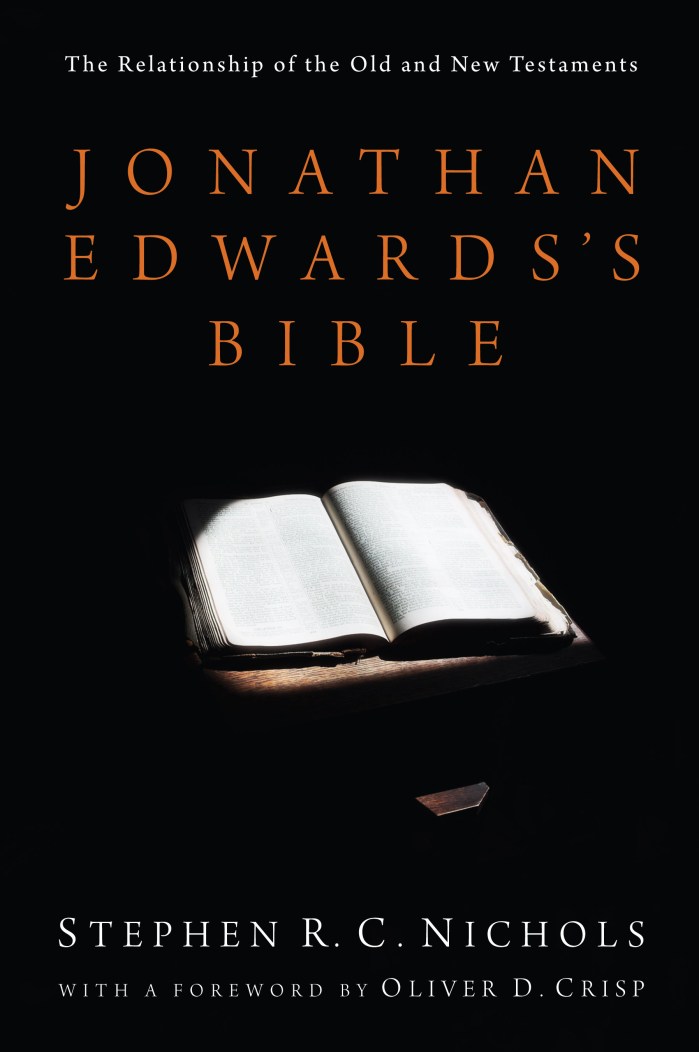
Review: “Jonathan Edwards’s Bible” by Stephen R.C. Nichols

When I first saw the title of the book Jonathan Edwards’s Bible, I assumed it could only be about the Blank Bible, which has been an interest of mine for some time. As you may know, JE had a completely unique KJV stitched together into a larger blank notebook.

Then, having read the subtitle a bit closer, “The Relationship of the Old and New Testaments,” I realized that this was a book about  Edwards’s hermeneutics (interpretive theory of the Bible) and my interest in the book changed directions on a dime, without being diminished in any way. Yes, the book is about Jonathan Edwards’s understanding of the interrelationship between the two testaments – a very necessary discussion to be held indeed among Edwards scholars.

Thankfully, Pickwick, an imprint of Wifp and Stock, was kind enough to provide a review copy to EdwardsStudies.com, so what follows is a brief review of Nichols’s very helpful book on Edwards’s view of Scripture.

PICKWICK_Template

Before going a step further into the contents of the book, I should make one more important clarification lest casual readers be confused. That clarification is that Stephen R.C. Nichols is to be distinguished from Stephen J. Nichols, another Jonathan Edwards scholar by the same name. Attentive readers will draw a connection between the latter writer and Ligonier Ministries and Reformation Bible College noting that he has several helpful introductory materials on Jonathan Edwards as well as other topics related to church history.

But that is not our Stephen Nichols here!

No, our author in this discussion is Stephen R.C. Nichols, an ordained minister in the Church of England, who studied under the highly reputed Oliver Crisp during his Ph.D. studies. Consequently, what we have here in Jonathan Edwards’s Bible is his dissertation, repackaged for public consumption. I wouldn’t necessarily say “popular” consumption, though, since this work is still very technical in some ways, and never fully sheds its obvious “dissertation” structure and feel.

Having said all that, this work is important for several reasons. First, Edwards studies has long lacked in substantive treatments of Edwards’s hermeneutical thought process. True enough, much work has been done on his philosophy, and Reformed theological bona fides, but not much has been done on the area of his understanding of how the two testaments relate to one another.

Overview

Let’s look at an overview of the book’s trajectory. Nichols (as with any dissertation) gives us a general overview of where this book will attempt to go. In the opening salvo, Nichols tells us that he will divide his study into four significant segments. First, Nichols will help us to understand how Jonathan Edwards views Old Testament messianic prophecy. Second, he will look at Edwards unique view of typology. Third, how Edwards sees consistency in doctrine between the testaments, and fourth Nichols gives an example of Edwardsian interpretation with the narrow focus of soteriology (especially how OT believers are saved). Of course, he concludes with summary and general observations.

Let’s break that down a bit more.

This first chapter will largely focus on what Edwards was hoping to accomplish in his “Harmony of the Old and New Testaments.” Unfortunately, this work was never finished before Edwards’s death, so Nichols will have to piece together Edwards’s unfinished work on the interrelationship of the testaments here, conjecturing at times what this work would have looked like if Edwards had lived to complete it. To do this, Nichols focuses in on Edwards’s understanding of how Messianic prophecy is fulfilled in the person of Jesus Christ. Although Edwards does not attack Anthony Collins specifically, clearly Collins’s challenge to traditional Christianity is on Edwards’s mind. Collins attempted to challenge Christianity’s assertion that Jesus is the Messiah by showing how it appears (to him) that fulfilled Messianic prophecy is arbitrary, and selectively applied by the church.

Nichols says,

In this chapter I argue that he is in fact guided by Scripture in his exploration to a degree hitherto unrecognized. While a conceptual impasse thus exists between Collins and Edwards, Edwards’s intention in the “Harmony” is not to offer proof from prophecy that Collins demanded, but to show the reasonableness and coherence of a Messianic reading of the ancient Hebrew prophecies (12).

Ultimately, Edwards would probably say (if I understand both him and Nichols correctly) that neither he nor anyone else would be able to offer incontrovertible proof of Jesus’s Messianic identity through prophecy alone, even when accurately interpreted, since these things are spiritually discerned and require the regeneration of the Holy Spirit to understand properly. Nevertheless, the voluminous amount of Scripture that Jesus – and only Jesus – fulfilled in Edwards’s view is insurmountably glorious and delightful to the believer.

Secondly, Nichols will tackle the wonderfully intriguing topic of Edwards’s view and usage of typology. Here, we are looking at the fact that Edwards saw a great many “types” or windows into the spiritual realm, not only in Scripture but in nature and history too. Of course, Nichols’s goal here is to consider how this informed Edwards’s overall understanding of Scripture. In short, it impacts his overall view considerably.

Understanding what Edwards is doing with types is critical to reading him correctly in many places, not the least of which is his Images of Divine Things and his History of the Work of Redemption. In fact, Edwards would likely argue that a person who does not see types almost everywhere in the OT (tabernacle, sacrifices, kings, priests, oil, blood) will miss the centrality of Christ in the Hebrew Scriptures. He will not see how all of the OT Scriptures point towards the absolute centrality of the coming Messiah in the person of Jesus Christ.

One of the idiosyncrasies related to Edwards’s view of types is that, because he finds them everywhere, he offers little consistent restraints in utilizing them. This has led to the charge that Edwards is somewhat wild and unrestrained in finding types in the Bible – and for that matter – everywhere else. For instance, as Nichols notes, Edwards ascribes at least three different typical meaning to stars (192). Edwards says that we should have a New Testament warrant to interpret types, but he does not pretend to abide by that rule himself at times. Ultimately, as Edwards himself probably would have us believe, the best restraint to interpreting types is Christian maturity (191).

Thirdly, Nichols attempts to look at what he calls, following Edwards, “doctrine and precept.” This refers to the vast agreement between the two testaments on doctrinal and theological matters. In this section, Nichols dials in most tightly on Edwards’s Reformed understanding of the covenants. Foundational to Edwards’s entire paradigm are the covenants by which most Reformed theologians view redemption history. First, the covenant of redemption. This is the concept that God, in an inter-Trinitarian way, entered into an agreement between Father and Son to redeem the world through the Gospel. Second, the covenant of works. This was the promise of life and the threat of death given to Adam in the Garden, which ultimately, Adam failed to uphold, bringing sin and death into the world. Third, is the covenant of grace which contains the promises of God to fulfill the covenant of works in and through Christ the redeemer. Nichols argues essentially that Edwards is faithful to his Reformed/Calvinistic heritage in seeing the great covenants as being the map that brings all of the acts of God in redemptive history into focus.

In this way, Edwards stresses continuity as over against discontinuity between the two testaments, although he grants that there are a multiplicity of administrative differences.Summarily, then, Nichols says,

So, he inevitably emphasizes the substantial similarity between Old and New Testament expressions of the covenant of grace. As with prophecies and types, Edwards is willing to find parallels in doctrine and precept that go beyond familiar categories employed by his tradition (14).

Finally, Nichols attempts to put all this together in a sort of “test case” in the last major section, focusing on soteriology, or how individuals are saved, especially in the Old Testament. This particular doctrine serves as a yardstick by which Nichols can measure his own assessments in the previous three sections. Nichols argues that “the soteriological harmony Edwards observes between the Old and New Testaments is ultimately expressed in a common object of saving faith, namely Christ, as was common to Edwards’s tradition” (190). After reading this section, Nichols will have done much to show the reader how similarly believers both before and after Christ were saved. Old Testament believers were saved, not by works, but by being born again into a living hope in the coming Messiah. Likewise, New Testament believers are saved by the Christ who was born, died, and raised again in redemptive history. Neither are saved through obedience to the Covenant of Works; both are saved through the Covenant of Grace.

Importance

This work by Nichols is incredibly important since understanding Edwards’s theology of Holy Scripture is critical to understanding his entire theological project. Nichols argues that Edwards’s view of the interrelationship between testaments is vast and cannot be easily dismissed. His system seems to be coherent, even if from time to time he seems to be a bit too “loose” with his discovery of types almost everywhere. Edwards does offer a defensible position regarding the messianic fulfillment of prophecies in the person of Jesus Christ (against Anthony Collins  who challenged this), although he admits that unbelieving minds will not be able to see these things adequately.

Significantly, “Edwards offers an example of a ‘grand unifying theory’ of the Bible, a comprehensive interpretation capable of embracing the minutea of Old and New Testaments” (195).  In his conclusion, Nichols provides compelling reason to believe that we must do more work in studying Edwards’s view of Scripture if we are to avoid misreading him in other areas such as his philosophy.

In the final analysis, Oliver Crisp is probably right to say of this book that “If we do not pay attention to this material (i.e. Edwards’s views on Scripture) we cannot hope to understand Jonathan Edwards…(Nichols) has shown how these things matter for some of the deep structures of the Sage of Northampton’s thought. In this respect, his study helps to flesh out one more of the parts that comprise Jonathan Edwards” (xi).


Don Whitney – Finding God in Solitude: The Personal Piety of Jonathan Edwards and Its Influence on His Pastoral Ministry

Editor’s Note: Recently, EdwardsStudies.com had the opportunity to speak to Don Whitney about his most academic work, Finding God in Solitude: The Personal Piety of Jonathan Edwards and Its Influence on His Pastoral Ministry (Peter Lang, 2014). While professor Whitney is known mostly for his interest in the spiritual disciplines and his successful popular level works, this book is a complete and thorough academic treatment on Jonathan Edwards.

donal-s-whitney

I caught up with Don Whitney, professor at Southern Baptist Theological Seminary, recently by phone call. Dr. Whitney happened to be house hunting at the time, so thankfully, he graciously took my call between padlocks and for sale signs. Our chat was warm and inviting, just like the tone of his many helpful books. Among other things, I learned that Dr. Whitney has an enthusiastic admiration for quality ink pens, and has even written birthday letters on nice stationary to most of his church’s congregants in an elegant handwriting which he relearned as an adult.

What I did not know about Professor Whitney until somewhat recently is that he is a second-to-none Jonathan Edwards scholar. My first introduction to his writing came through his extraordinarily helpful book, Spiritual Disciplines for the Christian Life. I am sure that others who know him also encountered his writings the same way. Indeed, Whitney spent the better part of a few years combing through Jonathan Edwards writings, especially his personal writings in Volume 16 of the Yale Works.

My first clue that that Whitney had a fascination with Jonathan Edwards was when I heard his talk on the Northampton Divine at the Desiring God conference several years back. But I did not know he had studied Edwards formally. As we chatted on the phone, I could hear the tenor in his voice change when he described the experience of holding Sinners in the Hand of an Angry God in his own hands when he studied at the Beinecke Rare Book Library at Yale.

Whitney’s interest in JE began in earnest several years earlier when he was teaching a course on the lives of three great Christians. In that course, Whitney asked his students to read a biography of Edwards, Spurgeon, and Lloyd-Jones as well as a taste of their own writings. And, as is the course for many of us, his fascination with the New England Puritan kicked into another gear.

He was hooked on Edwards.

Finding God in Solitude as you might guess, stays in Whitney’s primary traffic lane: that is to say, it does not depart far from his special interest in the spiritual disciplines. In this work, Whitney looks at the overall piety of Jonathan Edwards. By the way, when using the word “piety,” we should not think of religious show or artifice in any way. Sometimes the adjective “pious” has a bit of a negative overtone. On the contrary, we are talking about the very sincere desire of one’s heart to be given over in obedience and sanctification to the Lord. Truly, Edwards modeled this desire for personal holiness, as the book catalogs.

Edwards, of course, is well known for his devotional life: his prayers in the woods, his singing along to God by horseback, his Blank Bible, his Miscellanies, and voluminous notes on Scripture. All of that work was forged in the quiet of the study alone with God, largely uninterrupted by the distractions of the world (especially those we face in the modern world). But even among Colonial Puritans, Edwards’s desire for solitude alone with God was remarkable. Whitney sees in all of this a great example that modern believers can imitate in some limited ways, although we ought not to expect to have Edwards’s mental powers.

It is true that Jonathan Edwards’s desire for solitude got him into trouble, as all who have read a biography of the Puritan well know (the “Bad Book Case” and the Lord’s Supper controversy come to mind). Edwards’s preference for company with God alone probably prevented him from being a more sociable pastor in many ways. At the same time, as Whitney argues in his book, that same desire for the Lord’s presence also resulted in some of the most important and profound theological treatises, books, and personal jottings that Colonial America would ever produce.

The book itself is a doctoral dissertation made somewhat more readable. Since it is an academic publication, this is likely to be one of Whitney’s lesser read books. That’s probably a shame. Not only that, but the price-tag at nearly $80 will be a hindrance to some. But for others who want a full-length treatment of how Edwards’s personal spiritual life effected him as a pastor of the Northampton Church, the book may very well be worth the cost.

I also asked Whitney if any of his more academic study on Jonathan Edwards would seep through into his popular writings. He assured me that it would, if only to a less intense degree than is given in this academic treatise. As a matter of fact, his newest work, Family Worship, quotes Edwards and length, and provided a new venue for Whitney to allow Edwards to continue to speak through the written press. Although not technically about Jonathan Edwards, Family Worship will have a tinge of Edwards’s scent throughout.

When I asked Whitney what originally attracted him to Jonathan Edwards, the SBTS professor said it was his rare and attractive combination of “life and doctrine; heart and mind.” It would be hard to disagree with that sentiment. True enough, that same emphasis which can be found in Jonathan Edwards also comes through in Don Whitney’s works. Surely it is a great thing when passion for the Lord of Glory and deep and reflective theology come together.


Announcement: EdwardsStudies.com Joins the JESociety in Joint Publishing Venture for a Collection of Essays

EdwardsStudies.com is excited to announce a partnership with the JESociety to bring into publication, in print format, a collection of Jonathan Edwards-related essays. The essays selected for this first time collaborative venture should be of a high quality, on par with graduate-level standards of excellence, and of equal caliber to publications in other academic journals.

how-to-write-my-essay-2

What Topics?

Essays submitted for consideration may be focused around Jonathan Edwards’s biography, ministry, theology, writings, sermons, personal correspondences, philosophy, or historical significance.

Who Should Submit Essays?

Pastors, theologians, students, historians, professors, teachers, church leaders, or other qualified individuals may submit essays. Please do not submit essays that have already been submitted for consideration in other periodicals. However, graded and returned papers from institutions of higher learning may be submitted for consideration, provided that they are not submitted for publication elsewhere.

What Length?

Essays submitted may be of varying lengths. Short essays may contain as few as 2,000 words and long essays may contain as many as 10,000.

Deadline

The deadline to submit essays will be June 1, 2016.

How Do I Submit an Essay for Consideration? 

Essays may be submitted for consideration to the following address: jonathan edwards studies (all one word) at gmail dot com.

Author Interview: Dr. Toby Easley “Jonathan Edwards: Beyond the Manuscripts”

EdwardsStudies.com is pleased to be talking today with Dr. Toby Easley. Toby has a doctorate from Southwestern Baptist Theological Seminary, and has been researching Edwards for years, including time spent during his doctoral research in the Beinecke Library at Yale where he examined the manuscripts of the Northampton Puritan.

Dr. Easley, where did you get started studying Jonathan Edwards?

I was introduced to Edwards through preaching and teaching as a child and youth. I also read Edwards’s “Sinners” sermon in my high school American Literature class. My teacher actually ridiculed his Calvinistic viewpoints, and due to my theological background at church, I saw through his negative view of Edwards. Later, during my undergraduate studies, a friend gave me an eighteenth-century copy of Original Sin. My interest in Edwards was kindled again, but it was in 2005 at Southwestern Baptist Theological Seminary that I began to immerse myself in his sermons and notebooks. In 2007, I presented a paper at the ETS Regional meeting titled “Jonathan Edwards: Extemporaneous or Manuscript Preacher?”

Tell us what it is like sifting through Edwards’s works in the Beinecke Library?

The experience for me was extremely enlightening. Looking at pictures online or in books does not do justice to viewing the actual sermons in the Beinecke Library. One important element of my research of Edwards’s sermons focuses on uncovering stereotypes and on the developmental stages of his sermons throughout his life. Therefore, I needed to observe his sermons in the various manuscripts and outline forms throughout the eras of his life.

How did this research inform your writing of your new book?

Along with all of the vast secondary source materials I read throughout the writing process, the ability to view the primary source materials in their eighteenth-century handwritten form cannot be underestimated. I do not believe I could have come to solid conclusions on many of my assertions had hands-on observations not been possible. Unfortunately for Edwards’s enthusiasts today, Edwards did not have a secretary who wrote his sermons as he delivered them. However, with men such as Spurgeon in the nineteenth-century, we have his personal sermon notes along with written notes of his actual delivery. This variance makes our interpretation of Edwards’s communication practices and actual delivery much more complicated over the course of his life.

So tell us about “Jonathan Edwards: Beyond the Manuscripts.” Give us an overview of this project and what you hope readers will learn here.

My desire is to take readers through the life of an eighteenth-century scholar and explain that a journey exists in one’s own preparation and speaking style. I also endeavor to draw the reader into Edwards’s age of spiritual awakening and, at the same time, reveal important twenty-first-century applications of his communication and developmental stages.

I also address questions people often ask. Was Jonathan Edwards striving to maintain a precision, while becoming more extemporaneous? Furthermore, do the manuscripts prove that he was a monotone, stoic, lifeless preacher, with insufficient ability to adapt and transition to diverse audiences and settings? I invite the readers not only to see the development of the man that many historians regard as “America’s greatest theologian and philosopher,” but also to discover if he ever moved beyond the manuscripts in preparation and delivery?

Were there any “Aha” moments for you during the writing of this project?

Yes, when I began to realize that Edwards was not just a great composer of sermons, he was also to a great extent involved in examining others’ rhetorical methods and developing his own communication strategies. I was also astonished by the numerous communication settings that he participated in and his ability to adapt in an effective manner. We observe that late in his life, he simultaneously pastored both an English and Mohican congregation at Stockbridge, and was finally willing to take on the position as President at the College of New Jersey.

Is this going to be available in both paperback and ebook format?

The book will be available in hardback, paperback, and ebook.  

Do you have any other major projects in the works for the future?

Yes, I am presently working on my next book on the Transatlantic exchange between Jonathan Edwards and John Erskine and the American and Scottish awakenings.

Any other Edwards-related recommendations or shout-outs for our readers?

Yes, I recently read a book written by:

Yeager, Jonathan M. 2011. Enlightened Evangelicalism: The Life and Thought of John Erskine. New York, New York, Oxford University Press.

Articles:

Crawford, Michael J. Spring. 1991. “New England and the Scottish Religious Revivals of 1742.” American Presbyterians 69, no. 1: 23-32.