Sarah Boss: Second Generation Jonathan Edwards Scholar

Today, EdwardsStudies.com chats with Sarah Boss, a second generation Edwards Scholar whose essay “Edwards and Thoreau: Typologies of Lakes” appears in the new JESociety publication A Collection of Essays on Jonathan Edwards (2016).

Sarah, thank you so much for joining us today. Tell us a little bit about yourself.

Thanks for having me! I’m always happy to talk with other Edwards enthusiasts. In a nutshell, I’m a native Texan, a recent graduate of Wheaton College, where I studied English and history, and a current teacher in Fort Worth.

You teach ancient history at Covenant Classical School. What are some of your main foci in your curriculum and how is that going?sarah-boss

It’s going well, thanks! I attended Covenant myself, and it played a vital role in my development both spiritually and intellectually, so it has been a joy to be a part of giving what I received there. This year I’ve had the opportunity to teach a very bright, inquisitive class of seventh graders about Pre- and Early Dynasty Egypt and Sumer. A couple threads we’ve been following through these periods are rulers’ claims to divinity as a means of expressing or expanding their authority and how these claims and other technological or cultural developments enable empires to be born. (We also talk a lot about pyramids, of course!) A key emphasis of classical Christian education is training young minds to think critically and express themselves clearly, so our discussions are informed by the lens of biblical truth, beauty, and wisdom, especially as we think through age-old questions of humanity, divinity, and how they play out in society. So far I haven’t made any tangential references to Edwards in class, but the year isn’t over yet…

So, how did you become interested in a dead, wig-wearing Puritan (referring to Edwards of course!)?

Full credit goes to my dad, who introduced me to Edwards at a young age; this dead, wig-wearing Puritan was a household name for me growing up. I first read Edwards for myself as a ninth grader, beginning with “A Divine and Supernatural Light,” then dove in to his typological writings. I’ve read more broadly since then, but I still haven’t lost the fascination that I felt for Edwards’s “Images” as a fourteen year old. A year after discovering my interest in Edwards, I accompanied my dad to the Jonathan Edwards Society conference in Northampton, MA, where I got my first taste of the Edwards community in action. The summer before my senior year of high school I wrote a paper on Edwards that I was able to present at that year’s conference. I continued research afterwards and rewrote it as my high school senior thesis. The paper dealt with the connections between Edwards’s typological writings and the myth genre and sought to find an outlet for Edwards’s epic worldview in our contemporary society. I was out of my depth with such a colossal undertaking, and, as often happens, the more I read the less I felt I knew. But that first paper brought up questions I’m still wrestling with now and gave me a sense of how intricate and relevant Edwards’s thought remains today.

Tell us a little bit about your essay in the recent publication by JESociety and how it developed. It’s had a wider audience already, hasn’t it?

I originally wrote the essay for my college’s independent literary journal, The Wheaton Pub. The issue’s theme was “encounter,” and I knew I wanted to write about Edwards and his encounters with nature, but wasn’t sure what specifically. While reading Walden Pond for an American literature class, I was struck by how similar a certain passage was to an entry in Edwards’s “Images.” I decided to wrestle with these two passages in my essay, and teased out subtle differences that reveal opposing frameworks of thought. After being in The Pub, the essay appeared a few places online – including here on Edwards Studies – and I also had the opportunity to present a version of it at the Midwestern Conference on Literature, Language, and Media at Northern Illinois University this past spring. Now I am happy to have it included in JESociety’s latest publication.

You have the unique opportunity to work alongside your father in this publication. What’s that like?

My parents have always encouraged my interest in Edwards, and it has been special to present papers alongside my dad and now to be published with him. I feel very blessed to be part of a family that values education so much and to have a father who is intellectually creative and encourages me to be the same. With this publication in particular, as we wrote essays on related topics, I can see how much I have gained from his research and example and how that has influenced me as a thinker and writer. (Also, it’s pretty nice to have access to his library.)

What are your other research interests?

Most simply, I’m interested in nature. Nature as a universal symbol – how it manifests in literature, religion, and art and often serves as a muse or conduit for dialogues on life’s big questions. But also nature as a concrete, basic element of human life. Over the past couple years I’ve become more interested in the sciences, ecocriticism, and exploring how Christians do and should encounter nature and mediate a spiritual and scientific understanding of their environment. These questions have fed my interest in typology but also expanded it to engage issues of how to practically live out a biblical understanding of nature.

Any shout-outs or book recommendations for our readers?

A couple books that gave me a solid foundation when I first started researching Edwards are George Marsden’s Jonathan Edwards: A Life and Michael McClymond and Gerald McDermott’s The Theology of Jonathan Edwards (which I loved in part for the really cool cover art). A couple that helped contextualize my thoughts when writing my essay on Edwards and Thoreau are Mason Lowance’s The Language of Canaan: Metaphor and Symbol in New England from the Puritans to the Transcendentalists and Perry Miller’s classic Errand into the Wilderness. A couple books on typology I am currently reading (or am excited to read over Christmas break) are Jennifer Leader’s Knowing, Seeing, Being: Jonathan Edwards, Emily Dickinson, Marianne Moore, and the American Typological Tradition and Tibor Fabiny’s Figura and Fulfillment: Typology in the Bible, Art and Literature. Lastly, for an in-depth study of Edwards’s typology and the tradition he drew from, I recommend Rob Boss’s God-Haunted World: The Elemental Theology of Jonathan Edwards.

This is What Happens When Ten Edwards Geeks Get Together and Collaborate: Introducing “A Collection of Essays”

EdwardsStudies.com and the JESociety have recently joined forces and put together a group of ten young, fresh Jonathan Edwards Scholars with an agreement to work together on one project. Each writer was asked to contribute an original piece on the Northhampton Puritan. The result is the new book, A Collection of Essays. Contributors include pastors, theologians, students, and scholars.

Here’s the video introduction:

Author Interview: J.T. Holderman

In celebration of our new publication,  “A Collection of Essays on Jonathan Edwards” (JESociety Press, 2017) EdwardsStudies.com will be doing some short profile interviews with our article contributors.  Today, we chat with J.T. Holderman. 

Tell us a little bit about what you are doing right now? (career, ministry etc.)

Since you asked, life is all manner of exciting these days. For starters my wife Kim and I just welcomed our second baby girl to the family, Corinne Hope. I forgot how much I love sleep. This past July my Senior Pastor retired and I have been called into that position and am striving daily to be faithful in loving the people of Bellevue Presbyterian Church here in Gap, PA. The transition from Associate Pastor to Senior Pastor has been eye-opening and I’m realizing daily the weight of the calling to the pastorate. Life is all manner of exciting.

edwards-essaysHow did you get interested in JE?

I first became interested in Jonathan Edwards while studying at Princeton Theological Seminary. It was there that I picked up a book by John Piper titled God’s Passion for His Glory. Within this 250 page book is a biographical narrative of Edwards and a copy of his The End For Which God Created the World. As I read Piper’s detailed account of Edward’s and his indebtedness to the man, I found similar chords of interest in my own heart towards Edwards. After reading Edward’s The End For Which God Created the World I found myself shocked and stunned at first the intellect and brilliance of Edwards to pinpoint the reason for God’s creation, that He might be glorified, and second at the weight of the man’s logic to turn the human heart toward the Lord.

As I read the biography Piper supplied, I realized quickly that Edwards ended his earthly life in the same town in which I was studying, Princeton, NJ. More than that he was buried in a nearby cemetery. One afternoon, with coffee in hand from the local Small World Coffee, I made a pilgrimage to the grave, where there I worshiped the Lord in thankfulness for the man Jonathan Edwards.

What are some of your favorite works of JE?

Perhaps my favorite work of Edwards are his sermons. At least through the written medium his soul thirsty work for preaching the glory of God is a balm to me in every season of life. I would recommend as a starting place The Sermons of Jonathan Edwards: A Reader edited by Wilson H. Kimnach and co. Second to his sermons, I would be remiss if I did not highlight The Religious Affections, a marvel of human intellect and logic.

Give us a tidbit from your essay! What is your article about?

In my chapter in the collection of essays, I highlight in brief a biography of Edwards and certain implications we should glean from his life. Here’s an excerpt:

To many, the Christian faith looks like a joyless prison. It is a religion of prohibition: you can’t get drunk, you can’t sleep around, you can’t lie on your taxes. Many in the world see Christianity as a set of rules that restrict the individual and take all “fun” out of life. Edwards, however, would encourage us that it’s exactly the opposite for the Christian. He roots the fundamental core of Christianity in relation to an individual’s happiness, freedom, and joy, not in a prison of constraint and obedience. Christianity does not kill delight; it, instead, magnifies it and puts it in its proper place. Edwards says it this way:

“God is glorified not only by His glory’s being seen, but by its being rejoiced in. When those that see it delight in it, God is more glorified than if they only see it.”[1]

[1] Quoted in John Piper, God’s Passion for His Glory (Wheaton, Ill: Crossway, 1998), 79.

Author Interview: Obbie Tyler Todd

In celebration of our new publication,  “A Collection of Essays on Jonathan Edwards” (JESociety Press, 2017) EdwardsStudies.com will be doing some short profile interviews with our article contributors.  Today, we chat with Obbie Tyler Todd. 

Greetings Obbie, tell us about yourself! 

I serve as Associate Pastor of Students at Zoar Baptist Church in Baton Rouge, Louisiana. Previously I pastored a small rural church outside of Bardstown, Kentucky for over a year. As I was finishing up my Th.M. at Southern Seminary, Kelly and I felt the Lord calling us to Cajun country. Not long ago I also began my PhD work at New Orleans Baptist Theological Seminary. Currently I’m studying 18th century South Carolina Baptist Richard Furman and his influences (e.g. Jonathan Edwards). Tom Nettles at Southern greatly aided me in exploring the Edwardsean influence on Furman and other 18thedwards-essays-19th century Baptists. I had Dr. Nettles for both Th.M. and PhD-level courses in Edwards studies, and I owe much of my initial research of Edwards to him. It was after one of these courses that I was inspired to compose my blog “The Edwardsian” (https://edwardsianblog.wordpress.com). Just about every month I’m writing on Edwards, and I don’t see that habit ceasing any time soon.

How did you become interested in Edwards? 

I suppose my first step into the world of Jonathan Edwards was reading Iain Murray’s Banner of Truth biography the Summer between my M.Div. and Th.M. at Southern Seminary. It was a bit hagiographic, but its devotional and pastoral elements grabbed me instantly. From there I started reading primary sources and then Marsden and so on. Dr. Tom Nettles was of course very influential in my introduction to Edwards. For my Th.M. paper I wrote on Edwards’ psychology of conversion and it’s during this time that I discovered the Religious Affections. Dr. Michael Harkin was also influential for me. His Andrew Fuller course also spawned the essay that I submitted for this book. As years have gone by, my Edwards collection has grown exponentially and I find myself going back to him time after time. He’s an ocean.
Do you have any Edwards-related book recommendations? 
I have a few. My favorite treatise by Edwards is The Religious Affections. I believe many people mistake this book for an exclusively devotional work, but it’s so much more than that. “True religion,” as Edwards calls it, encompasses anthropology, theology, psychology, soteriology, etc. It’s the telos of Edwards’ entire ministry, and we see this theme manifest itself in his covenantalism, his ecclesiology, his sacramentalism, his revivalism, and his view of conversion itself. For me, The End for Which God Created the World is absolute brilliance. It’s like reading Piper before Piper, and I honestly don’t think John Piper would mind me saying that. When you read this in tandem with The Nature of True Virtue, it’s amazing to witness the dynamics between metaphysics, aesthetics, and ethics. Perhaps my favorite two sermons are God Glorified in Man’s Dependence, both for its ultimacy and for what it meant in the timeline of Edwards’ own ministerial career – his “coming out” party so to speak. The other is The Excellency of Christ. I’m not aware of a more Christocentric sermon that exists today. The paradoxes and the beauty of Christ that Edwards so masterfully brings out…it’s homiletic brilliance and one I seek to mimic when appealing to the Person of Christ from the pulpit.
Tell us a little bit about your essay in A Collection…
My Essay features the theological link between Jonathan Edwards and Andrew Fuller, specifically between David Brainerd and Samuel Pearce as presented by the two theologians. This work was spawned from research I did under Michael Haykin at Southern as I was finishing up my Th.M. He really encouraged me to look to Fuller’s missiology and the Edwardsean influence therein. Today, I believe many people think of Edwards strictly as a theologian or even as a philosopher. However, his revivalism and conversionism were equally acute. Fuller’s missiology was, in many ways, the fresh embodiment of Edwards’ revivalism and piety. What Brainerd did for Edwards in serving as a true exemplar of Christian practice, Pearce was for Fuller. I labor to show that and how Fuller intentionally adopted Edwards’ approach to biography. So many studies are being done right now involving Edwards’ influence upon 18th and 19th century Baptists, especially Fuller. I think it’s important to remember Edwards’ missiological legacy as well.

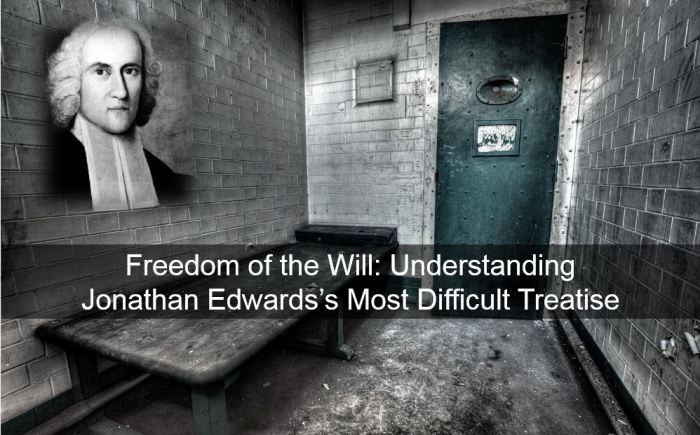
Freedom of the Will: Understanding Jonathan Edwards’s Most Difficult Treatise

R.C. Sproul one time said this of Jonathan Edwards’s 1754 book, the Freedom of the Will:

“I believe this is the most important theological work ever published in America.”

Whether or not you agree with Sproul’s assessment, there is no denying that Jonathan Edwards has produced a true title-contender for the best attempt at answering one of the most ancient questions: Do we truly have freedom to decide our destiny, or is it somehow determined for us by God?

Not only is this work one of the true classics of American Reformed theology, but it is also an intellectual tour de force, nearly impossible to refute by those holding competing positions. Here, Edwards engages in the longtime debate between Calvinism and Arminianism, right where the primary trenches have been dug – by examining how the human freewill engages with God’s sovereignty.

Personally, I would not recommend new readers of Jonathan Edwards to begin with The Freedom of the Will, even though understanding it is crucial to comprehending Edwards’s thought. Although I have personally combed through almost all of Edwards’s important works, I will be the first to admit that I enjoyed reading Freedom the least. It is not as though I find the subject matter uninteresting. I do. The intersection between God’s sovereignty and man’s responsibility is relentlessly fascinating. It is not as though the book is unimportant; on the contrary it is one of Edwards’s most well known writings, and surely among his most necessary to digest.
freedom-of-the-will-2

Yet because the treatise is among the most complicated of Edwards’s writings, requiring of the reader an understanding of both philosophy and theology (as well as some technical jargon belonging to both disciplines), it is difficult to easily navigate. More than that, Edwards writes in a somewhat repetitive style, attacking his interlocutors from every imaginable angle in his major points. For this reason, attempting to reduce Jonathan Edwards’s masterpiece The Freedom of the Will down to just a few pages of summation is a fool’s errand. But being a great fool myself, I thought I would give it the old “college try” anyways!

Forthwith, I make my attempt to summarize this important work.

***

To begin with, we need to have a basic understanding of the era in which Edwards wrote this work. The Enlightenment was in full steam. New ideas that challenged the long-held conceptions of how the universe “works” were being tested. Locke and Newton were all the rage. In the Enlightenment, man was at his most optimistic. Advances in science, medicine, and technology were taking place almost daily. And with these advances came the optimism that gave mankind fresh reasons to feel significant and meaningful in his existence.

In this way, humankind was beginning to push God out of the center of the universe, and off of His throne, so to speak. Theological convictions that had been long held in the Reformation era were crumbling. Puritan foundations were being challenged. Man began to see himself in a more central position of importance in the universe. If God created the universe at all, they conjectured, He surely created it for the benefit of man, His prized possession. If God could still be thought of as a sovereign Lord (and that too was up for debate), the notion that He actually “controls” all things would have to be modified significantly. Down came the scaffolding of the Biblical, Reformed, and Puritan worldview. Up went the new construction of man controlling his own destiny in history. Deism – the view that God was an original clock-maker who wound up the world and then stepped away – was gaining prominence in many corners.

At the center of the new conception was the idea that mankind is free to pursue his own agenda: to forge his own way and follow his own path. Each man, it was suggested, should recognize his own freedom to choose his path. The “will,” it became popular to believe, was like the objective, neutral control center of the human mind from which each man has the freedom to determine his own course. He can choose his own way without compulsion. For man to be truly free, he had to be in a position of complete neutrality as regards his personal decision making capacity. If a decision or choice was forced upon him by any external factor (such as the older, Puritan understanding of God’s divine decrees) that would render his choices meaningless.

It is into this milieu that Edwards wrote.  Freedom of the Will is a “shot across the bow” to challenge this newer, more enlightened, and independent way of thinking about one’s self-destiny. Above all else, Freedom was an attempt to defend (1) the traditional view that God is indeed absolutely sovereign and (2) that man’s own responsible will determines his course (with some significant qualifications and delimitations).  In this way, Edwards sought to defend the traditional Reformed position that God is actively, sovereignly, reigning over the universe, while mankind is truly responsible for his moral and ethical actions. Edwards argues that mankind has a will, no doubt. Whether or not it is truly “free” as the Enlightenment suggested, would have to be debated.

The book begins in the author’s preface with an acknowledgement by Edwards that using nicknames like “Calvinism” and “Arminianism” has its downfalls. On the same token, though, sometimes they are necessary to delineate – in the broadest strokes possible – what are the sides and terms of the debate. He admits that he is a Calvinist and will defend this position, even though he denies copy-and-pasting Calvin’s own thoughts into his own work. This project will be Edwards’s own unique attempt to defend Calvinistic convictions without borrowing them wholesale from others. As it turns out, Edwards does just that: defend the tradition, but in new and innovative ways.

The book then divides into four major parts. In part one, Edwards lays the groundwork for the rest of the book.  He defines philosophical concepts and terms like “necessity,” “contingency,” and “ability” that will be used incessantly throughout. Readers had better pay attention here or be lost for the rest of the work! This would be one of those places where Edwards is tapping into terms and concepts that are drawn from philosophy, but giving them his own distinctive definitions.

Of particular importance, Edwards makes a distinction between what he calls “moral ability” and “natural ability.” Natural ability (or inability, as the case may be) has to do with what a man is physically capable of doing. No matter what he desires to do, natural ability limits man in some ways. He cannot “will” to do the physically impossible. He can walk; but he cannot fly. On the other hand, moral ability (or conversely, inability) has to do with what a person can or cannot do of their own volition. He can or cannot perform the action, not because of some physical limitation, but because it violates his inward inclinations.

Edwards gives several examples that are quite helpful to understand this distinction. A drunkard is perfectly capable of putting down the bottle in his hand and never picking it up again. There is no physical limitation to stop him from doing so. Certainly, he “can.” And yet it is not his natural inability that prevents him from becoming a teetotaler. The reason why he is so dependent on alcohol comes from a desire resident in his being to do what he truly wants most: take another drink. In the same way, a beautiful woman may be perfectly able to commit adultery against her husband. There is no physical or natural limitation to her being able to “cheat.” But it is her conscience within her, her moral character and ethical fortitude, that prevents her from doing so. She is a dutiful and faithful woman and “cannot” commit adultery because of her heart’s inclination toward fidelity. So she is morally unable to cheat.

If we remember what Edwards wrote in the Religious Affections, he told us that each of us has strong “affections” or inclinations that draw us to certain things and repel us from others. The affections are a pretty important component to human existence, in Edwards’s view, because they are what cause us to love some things and hate others. Here too in Freedom of the Will, the inclinations of the soul are very important because they are for Edwards what drives us to or from the choices that we make. In this way, Edwards refuses to accept the more modern Enlightenment notion that the will is “neutral.”

It is not!

Edwards then says something that will become the foundation for his entire treatise. Human beings, as responsible moral agents, ALWAYS (without any exception) choose to do what they are most strongly inclined to do at that time. In fact, it is impossible for them NOT to do what they are most inclined or disposed to do. In this way, he will argue throughout, our “volition will be determined.” But lest we think that Edwards is a mere fatalist, he will also argue that because this choosing is according to our own strongest inclinations, it is also completely consistent with liberty. We freely choose what we want most. For this reason, Edwards has been called a “compatibilist” (i.e. that human liberty is logically compatible with divine sovereignty).

Part two, quite honestly, is pretty boring in some respects. Over and over Edwards will repeat the same argument from every possible angle. Here, he will show how it is impossible to make any choice whatsoever from a completely neutral perspective (as his opponents suggest). Every decision, he says, is made for a reason that springs from one’s already determined inclinations. His opponents (both named and theoretical) will suggest that to be truly free, one must be able to make a decision from a completely neutral, unbiased, blank-slate, position of “liberty.” Edwards says this cannot be so.

For example, suppose we are choosing between two paths home (my analogy, not Edwards’s). One is shorter and quicker, the other is longer and more beautiful. Whenever we choose a path, we do so for some reason. We are never neutral. Perhaps we want to get home sooner. Perhaps we want the scenic view. But there is always something that determines the choice. Even if we were to choose for no consciously known reason, there must be some reason we prefer the one path over the other.

Part two does heat up however, towards the later stages of the section, where Edwards begins to talk about God’s foreknowledge and employs a flurry of Scriptural citations. Biblicists will love this part! Here, he argues that all human choices in time are already known by God (which the Arminians also admit). But if they are known to God beforehand, they are also as sure to come to pass in the future as if God were seeing them from the perspective of the past. With God, there is no difference between seeing a future event and a past one. Both are certain in his all-knowing mind.

In part three, Edwards then attempts to answer an important question: if we are already predisposed to either good or evil (remember, we always choose according to our inclinations) what is the point of calling a choice morally “good” or “bad”? How can we place any blame if we are only doing what we are inclined to do? Besides, how can helping an old woman across the street be praiseworthy, if it has already been determined that I must do so? Should I get any credit for that? On the same token, how can we blame a thief for doing exactly what his constitution requires him to do? If he must steal, how is it his fault?

Edwards answers this by replying that one’s disposition is exactly what makes a person’s actions worthy of praise (or blame) in the first place. Suppose the Good Samaritan helped the poor mangled traveler in Luke 10 from a completely neutral heart. He felt nothing in his heart either way about the helpless man’s condition. He casts a lot and it comes up “help him” rather than “leave him.” Would this be more praiseworthy than if his disposition cared deeply? Of course not! His concerned disposition is exactly what prompts him to help, and the reason why his action is worthy of commendation. Besides, Edwards argues, God Himself is completely and absolutely disposed to holy action and cannot do otherwise, and He is the most praiseworthy being in the universe! Surely we do not find fault in Him for acting righteously from a determined, necessary inclination to do what is good, do we?

I think his argument comes across strongly in this line of reasoning. Remember, the Enlightened opponents that Edwards is confronting here are arguing the opposite. They held (contrary to Edwards) that the will is the most free when it is the most neutral. In fact, it is the lack of any disposition in the will – complete and utter neutrality – that they argue is exactly what makes it “free.” From their perspective, if the will has a preconceived inclination, it is not truly at a state of liberty.

But suppose the Enlightenment view is correct. Suppose that a particular woman is considering whether or not she should cheat on her husband. She has no predilection towards either faithfulness or adultery. She can go either way without any external compulsion. Arbitrarily, and without compulsion from any factor internal or external, she chooses fidelity — at least for today. Is this really praiseworthy? Does this seem like a laudable situation? Edwards would say absolutely not!

In the fourth and final section, Edwards makes one of his most famous analogies. He returns again to the idea of natural ability and moral ability. Suppose, he says, that there were two prisoners. Both were granted an opportunity to receive clemency by a King if only they would but kiss his ring, fall before him, and confess their sins. The first prisoner heartily desires to do just that. He is eager to confess his faults and make a full apology to the King. But there is a problem: the bars of his prison have not been opened! He cannot squeeze through the gates! He is locked in. Trapped by stone walls. He is naturally (physically) unable to get out of the prison and to kneel before the King. Edwards believes that this is how the Enlightenment thinkers conceive of Calvinism; that it is patently unfair for God to prevent men from coming to Him by making them unable to do so.

But then Edwards makes his best move of the treatise.

In describing the second prisoner, he pictures another felon who is likewise granted an opportunity to receive clemency. His cell however is unlocked, the gate swings wide open! But this prisoner does not budge. Why not? Isn’t he free? He is in one sense for sure. But this prisoner does not come out to repent because he hates the King. He would rather spit in his face. To repent and confess for this prisoner would be unthinkable. He is morally unable to repent. This man, says Edwards, and not the first released captive, is what Calvinism teaches about the will: it is bound, not by any limitation placed upon it by God, but rather by the hardened disposition of sinful man’s heart. He is his own prison guard.

Finally in part four, Edwards considers a host of objections against his position that are still made to this day. For instance: doesn’t moral necessity (that we must do what we are inclined to do) make human beings mere machines? Isn’t this another restatement of the Greek concept of fate? Doesn’t this make God the author of sin by creating us with sinful dispositions?`

Whether or not we view Edwards’s rallying answers to these questions as satisfying will in large part be determined (no pun intended!) by whether we’ve found his prior arguments about moral and natural necessity coherent and convincing.

Of particular help to many will be Edwards’s formal conclusion itself. In this last flurry, Edwards works through each of the primary doctrinal pieces of the famous Reformed acronym TULIP in turn. With a winsome defense of Calvinism, Edwards arrives at his argument’s denouement – God’s grace is absolutely necessary to overturn the sinful heart of the rebellious person and turn them to Jesus. But in doing so, God also graciously “rewires” our predispositions so that we freely and willingly choose to savor Christ and follow Him by faith.

***

Well there you have it. The Freedom of the Will in just a few pages. Now go get yourself a copy so you can work through it yourself. Happy reading!

Interview with Oliver Crisp: Saving Calvinism

EdwardsStudies.com is very pleased to have Dr. Oliver Crisp, author of a number of works on Jonathan Edwards, back in the interviewer’s hot seat today as we discuss his new book Saving Calvinism (IVP, 2016) which is fresh off the press. 

First of all, tell us a little bit about your amazing productivity. I’m assuming you must have a lot of interns.

I don’t really have a lot of interns, although I do now use Research Assistants to help me compile indexes when that is necessary. I’m sometimes asked about my productivity, which I find a bit embarrassing to be honest. I don’t really have a particularly interesting answer to this question. I just try to write regularly, and read widely, and drink a lot of tea. I do think that I have been fortunate to make friendships with other scholars, and form reading groups where ideas are exchanged and papers are read. That is a real boon, and it is something I think every scholar or writer can benefit from.saving-calvinism

Alright, so tell us why Calvinism needs “saving.” What’s wrong with it and how can it be saved?

This title was not the original one I had envisaged. The publisher decided it was better than “Reforming Salvation,” which is what I had titled the book. However, their title does capture something important: in many ways the book is trying to argue for a more popular audience things I’ve said in some more scholarly works, namely, that the Reformed tradition is broader and more variegated than is often reported today, and that we need to recapture something of this in order that we don’t end up unnecessarily narrow in our doctrine and in order to keep some perspective. Sometimes we can lose the wood for the trees. Some specific issues dealt with in the book: the scope of election (who is saved?); the nature of the atonement (do we have to hold to penal substitution if we’re Reformed?); the scope of the atonement (for whom did Christ die?); whether we have to hold to some sort of theological determinism (God ordains all that comes to pass). The book addresses each of these matters in detail and argues in each case that the Reformed tradition is broader and deeper than we might think at first glance—not that there are people on the margins of the tradition saying crazy things we should pay attention to, but rather that there are resources within the “mainstream” so to speak, which give us reason to think that the tradition is nowhere near as doctrinally narrow as the so-called “Five Points of Calvinism” might lead one to believe.

Do you consider yourself an heir of the Calvinistic tradition, broadly speaking? 

Absolutely. Yes, I do. It has fashioned and shaped my thinking since I was a teenager. That is a long time ago now! These days I’m often called a Deviant Calvinist, but I don’t really think my views do deviate from the Reformed tradition, though in some respects they may represent views that are not as popular now as they once were, or that may represent a minority report in the tradition. But that only goes to underline the point I’m trying to make about the need to broaden our account of the tradition!

Of course, the namesake of this website is Jonathan Edwards. How does Edwards fit into your trajectory in this book, if at all? Does JE show up, or have readers logged on to the wrong website? 

Edwards definitely shows up in the book. He appears as one of the interlocutors in the chapter on free will, the other being the Southern Presbyterian theologian John Girardeau. Edwards is one of my heroes. I’ve learned much from him over the years. To my mind he is an interesting figure because he is both a canonical Reformed thinker, and yet also someone that pushed the envelope in a number of key areas of theology. (How many people in the pews know that he is both a founder of evangelicalism and, say, an idealist who denied that the material world exists? Probably a lot more know the former than the latter, though both these things are true of him!) In the case of his views on free will, Edwards is the person who really made theological determinism a serious option for Reformed thinkers, and the influence his views had in nineteenth century Reformed thought, in the USA and the UK in particular, is enormous. We are still living with the consequences of that today in popular Reformed thinking from the likes of John Piper, R. C. Sproul, and Tim Keller. So he has to be engaged with on this issue if you’re writing about Calvinism as I am in this book.

If you would, give us a taste of one of your favorite chapters. 

In the chapter on the nature of the atonement I argue that it is a mistake to think that penal substitution is the only option on the doctrine of atonement. Now, don’t get me wrong: I’m not rubbishing penal substitution. But there are other options that have been advocated by Reformed thinkers of the past. For instance, the notion of non-penal substitution. This idea, found in the work of the nineteenth century Scottish Reformed theologian John McLeod Campbell and based upon his reading of the letter to the Hebrews in particular, is that Christ offers up his life and death as a penitential act on our behalf, rather than as a punishment in our stead. And here is the interesting twist: Campbell came to his views through reading Jonathan Edwards who suggested at one point in his ruminations on the atonement that Christ could have offered up a perfect act of penitence instead of punishment, and that this would have been an acceptable offering suitable to remit our sinfulness.

Then there is the view I call penal non-substitution, or the penal example view. (It is also called the Governmental View in textbooks of theology.) This is often associated with Arminian theology stemming from the great Dutch jurist Hugo Grotius. However, the view was taken up by Edwards’s disciples in New England, who developed a Calvinistic strand of the doctrine. On this view Christ is not punished in our place. Rather, he is a kind of penal example. God shows us in Christ what he would have to do if he were to punish us for our sins. Christ’s work is a kind of deterrent to us, and a way of upholding the justice of God’s divine government of the world. So the atonement chapter shows how there are real riches in Reformed theology that most Christians today have no idea about.

The subtitle of your work is “expanding the Reformed tradition.”  I remember taking silly putty and pulling the image off of the full-color funny pages as a kid, and then stretching the image until it was distorted beyond recognition. How far do you think it can be expanded and still be recognizable?

The expansion I have in mind isn’t the same as distortion. Of course, there are those who say their views represent Reformed thought, but what they end up with is a caricature of what Reformed thinking is really about. I hope I am not one of those people, but readers will have to make up their own minds on that score!

There are constraints on what counts as “Reformed.” It’s more than a name or a label. It’s about belonging to a particular theological stream or tradition, which is shaped in important respects by particular thinkers and their work, particular arguments and ideas, a particular community (especially, particular church communities, denominations, and so on), particular liturgies or ways of worshipping and living out the Christian life, and particular confessions that inform the practices of these communities. But the confessions don’t speak with one voice. They are more like a cluster of closely-related but distinct voices—a kind of choir, if you like. Reformed theology belongs to this confessional tradition, and Reformed theologians and churches continue to write confessions even today. What I am trying to argue here and in other works before this one is that the Reformed tradition as I have characterized it is much broader and richer than many of us today imagine. It is not just about “Five Points,” and it was never just about Calvin’s thought. For instance, there are many mainstream Reformed theologians that deny the doctrine of “limited” atonement (the “L” in TULIP, the acrostic for the Five Points of Calvinism). These are not thinkers on the margins or troublemakers. They are leaders at the center of Reformed thinking like Bishop John Davenant, who is mentioned in the chapter on the scope of atonement. By a similar token, although Calvin is revered as a thinker of immense importance in Reformed thought, Jonathan Edwards could say in his preface to his treatise on Freedom of the Will that he had derived none of his views from the work of Calvin, though he was willing to be called a “Calvinist” for the sake of convention.

Okay, I’m tracking with you. But suppose someone objects and says, “Right, but the Reformed tradition is stationary by definition. We are creed professors and confession writers. Our tradition is one with strong fences and firm borders. Expanding the parameters is not part of our ethos.” What would you say? 

I would say two things. First, there is no such thing as a stationary tradition. Traditions are always developing, living things. We may think that our tradition is exactly the same as it has always been, but that is an illusion. For instance, in the twentieth century the Reformed tradition was developed in several ways including additional confessions (Barmen, the Belhar Confession, the 1967 Confession of the PC(USA), and so on). It was also significantly augmented by the work of important thinkers like Karl Barth, T. F. Torrance, Jürgen Moltmann, Emil Brunner, Kathryn Tanner, and so on. The Reformed tradition at the beginning of the twenty-first century is different as a consequence of this—and different in nontrivial ways. Some may scoff at this, saying that such “developments” don’t represent Reformed thought. But by what standard? Perhaps by the Westminster Confession. But this is only one Reformed confession, and it was only ever a subordinate standard. No confession is inerrant; Reformed Christians are supposed to be those who seek to be constantly reformed according to the Word of God—and that includes our confessions as well.

But secondly, the book itself is not recommending that we move the borders, so to speak. It is recommending that we look at what lies within the confessional bounds of Reformed thought. When we do, we find some surprising things. For instance, it is often reported that the Five Points of Calvinism are the conceptual hard-core of Reformed thought. That is very misleading. The Five Points supposedly originate with the Synod of Dort in the early seventeenth century. Yet we find important Reformed leaders who were signatories to that documentation who don’t think that limited atonement is the right way to think about the scope of Christ’s saving work. How can this be? The answer that recent historical theology has thrown up is that the canons of the Synod don’t require adherence to the doctrine of limited atonement. The alternative of hypothetical universalism, according to which Christ’s work is sufficient for all but efficient only for the elect, was alive and well in early Reformed thought. Moreover—and importantly for our purposes—this view was not regarded as an aberration but as a legitimate position that could be taken within the confessional bounds of Reformed thought. But that means that the Five Points aren’t the non-negotiable conceptual core of Calvinism after all. This is discussed in the book and is a good example of just the sort of broadening I think popular Calvinism (especially popular American Calvinism) needs to take more seriously.

What are some of the most valuable contributions that you think Calvin and his heirs gave to believers today? 

Reading Calvin is a breath of fresh air. For those who have only ever read about Calvin, reading the man himself is an invigorating experience. He writes clearly, directly, without artifice, and gets straight to the practical heart of the matter. His Humanist training makes him an excellent writer. What is more, he is as relevant today as he was 500 years ago. I think everyone who has an interest in Reformed theology, or just in Christian theology more generally, should read his Institutes. As to the contributions, they are many and varied. One of the things we in the Reformed tradition are very good at is writing doctrinal theology! Calvin is often identified with his account of predestination. Yet that appears in the third book of his Institutes, not the first. His treatment of the person and work of Christ, of the Holy Spirit in the life of the believer, of prayer and liturgy, of the sacraments, and of the way in which we have an in-built sense of the divine that we suppress to our great sorrow—these are all immense contributions to Christian thought. The same could be said of his commentaries, which are still regularly consulted by biblical critics today. Calvin’s Institutes is often called a summary of Christian piety. You can’t say that about many modern works of theology. You can say it of Calvin. The best Reformed theology isn’t just about careful arguments for theologically sophisticated conclusions. It is about how to live the Christian life. That is the great contribution of Reformed thinking to the Christian church: theology for a life well-lived.

Thanks for chiming in again today Oliver! Before you go, any other book recommendations for our readers? 

Yes indeed. For the Edwardians among you, I recommend Doug Sweeney’s recent book Edwards the Exegete (Oxford University Press, 2015), which is a terrific treatment of the way in which Edwards was steeped in the Bible, so that it shaped the whole of his thinking. For those interested in Reformed thought more broadly, I’d recommend Peter Leithart’s recent book on Reformed Catholicism entitled, The End of Protestantism: Pursuing Unity in a Fragmented Church (Brazos Press, 2016), as a thought-provoking and stimulating read that should get us all thinking about the future shape of the Church, wherever we come from.

A First Glimpse at the Proofs for JESociety’s Publishing Venture “A Collection of Essays”

Several months ago, right here on EdwardsStudies.com, we put out a call for papers to participate in a collaborative publishing project alongside our friends at the JESociety. We asked our fellow readers and Edwards devotees to send us their best unpublished works focusing on the life, thought and ministry of Jonathan Edwards. It has been our shared desire to put together a publishing effort that utilizes the writing skills of various Edwards scholars around the world, with an open opportunity for rising talent in our field. Today, we would like to update our readers on the progress of this work.

Contributors

First of all, we were able to secure the contributions of a rather stunning array of writers. Our contributors include pastors, theologians, and students – including both men and women. Here is a brief rundown of our contributors for this project:

Robert Boss (Publisher, Contributor, Layout and Design) 

Rob has his PhD from Southwestern Baptist Theological Seminary, and has served as a pastor in Oklahoma and taught at the seminary and college level at Southwestern Baptist Theological Seminary. He has presented papers at Jonathan Edwards conferences in Northampton, MA and is the author of the monograph God-Haunted World: The Elemental Theology of Jonathan Edwards. His long-term project is a visual theology which explores the doctrinal intersections between general and special revelation recognized by Jonathan Edwards and other early Evangelicals. He makes his home in Fort Worth, TX with his wife Stephanie. They have two wonderful daughters—one a student at The Southern Baptist Theological Seminary and the other a recent graduate of Wheaton College. His personal website is http://robboss.com.

Sarah Boss (Contributor, Design)

Sarah Boss graduated from Wheaton College in May 2016 with an English major and history minor. Her interest in Jonathan Edwards dates back to early high school, when she first read Edwards’s Images notebook. She presented a paper at the 2010 Jonathan Edwards conference in Northampton, MA. She also presented a version of the essay printed here at the Midwest Conference on Literature, Language, and Media hosted by the graduate English department at Northern Illinois University in April 2016. Sarah currently teaches part time in Fort Worth, TX, and plans to pursue grad school in Fall 2017, where she hopes to explore her interests in typology and natural theology.

Toby Easley (Contributor) 

Toby K. Easley (D.Min., Southwestern Baptist Theological Seminary) was born and raised in Tulsa, Oklahoma. After completing his education, he has taught and preached through every New Testament book at least once and others multiple times in the last twenty-five years. He has a love for New Testament Greek and enjoys analyzing gifted exegetes both past and present. During his doctoral studies, he had the opportunity to research at Yale University’s Beinecke Library, where he examined the original manuscripts and sermon outlines of Jonathan Edwards. He has authored numerous research presentations delivered at the Evangelical Theological Society, Evangelical Homiletics Society, and Church meetings relative to the life and works of Edwards. Easley also enjoys road and trail cycling, kayaking, golfing, fishing, and watching sports. In the study and library, he has a passion for research, writing, and publishing. His future goals include authoring additional books, podcasting, and expanding his Feder Ink publishing company. Furthermore, he is praying that during his lifetime the Spirit of God will move in another Transatlantic “Great Awakening,” like the one He orchestrated in the eighteenth- century! Toby Easley and his wife Kimberly live in Fort Worth, Texas, and love spending time with their four grown children and four grandchildren, who are all a blessing from the Lord (Psalm 127:1-5)!

Matthew Everhard (Contributor, Editor)

Matthew is the Senior Pastor of Faith Evangelical Presbyterian Church in Brooksville, Florida. He has been married to his beautiful wife, Kelly, for sixteen years and has three children, Soriah (14), Elijah (12), and Simone (7). Matthew received his undergraduate degree in Bible and Theology from Malone University in Canton Ohio; his Master of Arts in Practical Theology from Ashland Theological Seminary in Ashland, Ohio; and his Doctorate in Ministry from Reformed Theological Seminary in Orlando, Florida. While at RTS, Matthew wrote his dissertation on Jonathan Edwards entitled, A Theology of Joy: Jonathan Edwards and Joy in the Holy Trinity. He is an ordained pastor in the Evangelical Presbyterian Church (EPC), and the General Editor of EdwardsStudies.com. Matthew is also the author of several books including Hold Fast the Faith: A Devotional Commentary on the Westminster Confession of 1647 (Reformation Press, 2012).

J.T. Holderman (Contributor)

 J.T. Holderman serves as Senior Pastor of Bellevue Presbyterian Church in Gap, PA. He received a Th.M. in Homiletics from Gordon-Conwell Theological Seminary (2013), a M.Div. from Princeton Theological Seminary (2012), and a BA in Theology from Whitworth University (2007). His passions in ministry are preaching and seriously heeding the call to shepherd the flock of God. J.T. became interested in Jonathan Edwards while studying in Princeton, NJ, a one-time home for Edwards and place of his death. His favorite works of Edwards are his written sermons, particularly his sermon “The Excellency of Christ.” JT is married to his camp sweetheart Kimberly and they both have one daughter Sophia who is a delight and gift from God. They reside in Lancaster, PA.

David Luke (Contributor) 

David is Director of Postgraduate Studies at the Irish Baptist College (Moira, Co. Down, Northern Ireland) where he teaches Historical Theology and Church History. He previously served as Pastor of Gilnahirk Baptist Church, on the outskirts of Belfast, for almost sixteen years. He is married to Elizabeth and has three children Jill, Emma and Calum.

Zachary A. Hopkins (Contributor)

Zachary has been Pastor/Teaching Elder of the historic Edgington Evangelical Presbyterian Church since June 2012. Zach was born in Milford, Delaware, and raised in St. Louis, MO. He attended Illinois College (BA Religion & Sociology – Jacksonville, IL) where he was converted as a freshman, and later pursued a call to prepare for ministry at Gordon-Conwell Theological Seminary (M.Div – South Hamilton, MA). His reading and research emphases include the historical theology and ecclesiastical traditions of the English and American Puritans, particularly in the stream of the 17th century Westminster Assembly. His lovely wife, Mackenzie, is the crowing jewel of God’s earthly grace to him. Together they enjoy: working out, gardening, and woodworking/DIY projects.

Jonathan S. Marko (Contributor) 

Jonathan S. Marko holds a Ph.D. from Calvin Theological Seminary, and is assistant professor of philosophical and systematic theology at Cornerstone University, Grand Rapids, MI, where he instructs undergraduate and seminary students. His recent research is focused upon Enlightenment philosophers and has resulted in various articles and a forthcoming book comparing the religious epistemologies of John Locke and John Toland. Jonathan is also an elder at his church.

Obbie Tyler Todd (Contributor) 

Obbie is the Associate Pastor of Students at Zoar Baptist Church in Baton Rouge, Louisiana. He holds a Bachelor of Arts in Economics from the University of Kentucky. He also holds a Master of Divinity and Master of Theology from the Southern Baptist Theological Seminary in Louisville, KY. As a doctoral candidate in Theology at New Orleans Baptist Theological Seminary, Obbie is exploring the influence of Jonathan Edwards on the thinking of Baptist Richard Furman. Obbie and his wife Kelly are the parents of twins, Roman Tyler and Ruby June. Obbie is the author of two self-published works:Mountain Man (2014) and Wilderness (2015).

Christopher Woznicki (Contributor) 

Chris is a PhD student in Systematic Theology at Fuller Theological Seminary. He received a MA in Theology from Fuller and a BA in Philosophy from UCLA. He recently received a four-year scholarship made possible by the John Templeton Foundation to study the metaphysics of human nature as a part of Fuller’s Analytic Theology project. Christopher has published essays on Jonathan Edwards’s Trinitarian theology and has several entries in the forthcoming A Jonathan Edwards Encyclopedia (Eerdmans, 2016). In addition to his research on theological anthropology he teaches undergraduate courses in Biblical studies, trains pastors in Latin America, and is the college ministry director at a church in Los Angeles. He and his wife just had their first child, a beautiful baby girl.

Design and Layout

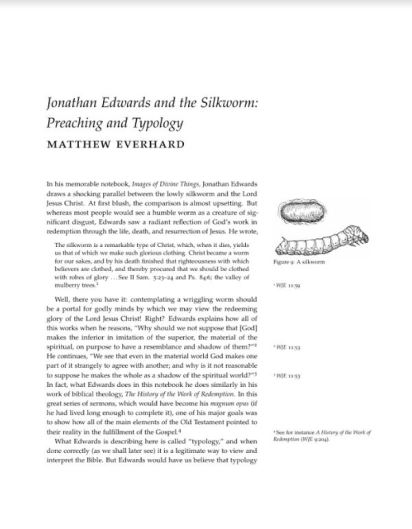
Secondly, we have just recently received some of the proofs of the project, and they look amazing! Our layout includes a wide, single column format which has been embellished by broad marginalia rather than the standard-formatted bottom notes. This includes beautiful space for note-taking as well as the inclusion of graphics and images. Overall we are extremely pleased with the look of the results.

Take a look:

edwards-collection_sample-1

Here is another:

edwards-collection_sample-2


Four Reasons Not to Study Jonathan Edwards

This is a website devoted to the writings and philosophy of Jonathan Edwards (1703-1758), the Puritan/pastor/philosopher. Here, we commonly examine his extant works, tease out the implications of the same, and discuss the richness of his voluminous writings in conversation with competent and able scholars who have devoted years to pouring over Edwards’s thoughts.

As studying Jonathan Edwards has been a major intellectual challenge for me over the past ten years – not to mention an outstanding source of devotional piety –  I thought it might be appropriate to also give some cautions to beginning scholars. Henceforth, in this brief article, I present

Four Reasons NOT to Study Jonathan Edwards

32

1. Edwards is Trendy. There is no doubt that Jonathan Edwards has experienced a stunning upsurge in popularity in the  previous century. Despite Ezra Stiles’s woebegone prediction that Edwards’s writings would soon be relegated to the dustbin of history, the opposite has happened. The Wigged Puritan has mounted an incomparable comeback in the last one hundred years. Ever since Perry Miller’s work in the 1950’s, Edwards has been on a virtual tear. The lauding of Reformed stalwarts Martyn Lloyd-Jones and R.C. Sproul have been a boon to Edwards’s reputation. Popularizers such as John Piper and Sam Storms have brought Edwards to unseen heights. Scores of doctoral dissertations have been written on the Northampton Pulpiteer. Major publishers such as Crossway cannot seem to crank out enough books to satisfy the trending popular thirst for more of Edwards. I have compiled a list of outstanding books, most of which have been written in the last ten to twenty years, that comb through Edwards’s major thoughts and ideas extensively. They sell like hotcakes.

And yet popularity alone is not sufficient. If you ask me, trends and fascinations alone are not compelling enough reason to begin a lifetime of study on any particular historical person. Since what can be read in one lifetime is so minuscule compared to what we need to know, we ought to choose better reasons to study any particular saint in history than that they are currently popular. Edwards’s biography is not nearly as adventuresome as Livingstone or Carey. His works are not nearly as quotable as Spurgeon’s. His life story not as significant as Luther’s. His theology not as paradigmatic as Calvin’s. Yes, reading Edwards will be richly rewarding to those who try, but his mere popularity alone is not a good enough reason. If you are undeterred still, read on and consider that

2. Edwards is Difficult. If you are expecting to immediately dive into Edwards and reap dividends, perhaps I can caution you and save you some time. He is a very hard read at times. Please do not begin with the Freedom of the Will. Yes, Sproul says that “this is the most important work ever published in America,” but please do not interpret that as in any way suggesting that it is one of the most approachable works. It is relentlessly logical. It is dense in its progression. It circles around and around again. It assumes the reader has technical awareness of the issues at hand. Its language is dated. It engages interlocutors that have long been dead. It argues at a philosophical level that transcends 98% of the books you will find in the average Christian bookstore!

Now this is not to suggest that Edwards is impossible to understand however. Far from it. Begin with his sermons if you like. His sermons at times can be rather easy to understand (if very difficult to live up to!). And there are more readable works such as the The Religious Affections, which I believe, most Christians can read to great devotional benefit, even if being lost in his vocabulary or argumentation at points. But if you are still so eager to dive into even Edwards’s more difficult works and treatises, be warned that

3. Edwards is Voluminous. Very few people will ever make it through the entire corpus of Edwards’s own writings. In fact, this is impossible since many of his works are still being transcribed from his nearly indiscernible handwriting. What does exist in print fills 26 volumes of the Yale Editions. The Edwards.Yale.edu websight (a wonder of the modern world in its own right) contains somewhere around 70 volumes of digitized works. And yet more keep being added. This is because Edwards thought and wrote with his pen in hand almost every day of his life.

Please understand: Edwards is not an author or subject of study that one can “master.” His works are too many. The hill is too high. The mountain nearly impossible to scale. Without trying to frustrate the scholar, our hopes of reading all that Edwards has to say about biblical interpretation, theology, sermonizing, philosophy, typology, and history (to name a few) cannot be mastered by any one person. This is why relentless dialogue between scholars of various fields is so important. He is not like other writers who have just a handful of works which one can easily digest in the course of a few months or years. Edwards is the Mount Everest of Puritan theology. But if you still persist, consider

4. Edwards is (Mostly) Orthodox. His Calvinism will offend your modern sensibilities. He will drive you back to your Bible over and over. He will preach the damnable sinfulness of man until your conscience aches. He will insist on divine predestination and the sovereignty of God. He will tell you that you cannot convert yourself. He will close all possible doors on universalism. He is the exemplar of Puritan High Orthodoxy. If this offends you, it would be better to turn elsewhere. Jonathan Edwards believed in the doctrines of grace and the essential tenets of Reformed (or Calvinistic) orthodoxy. Evangelicals with wimpier theological bona fides will find themselves pressed between the rock of Edwards’s relentless logic and the hard place of his King James Bible. In short, Edwards will insist that “salvation is of the Lord” (Jonah 2:9) and that there is “there is none other name under heaven given among men, whereby we must be saved” (Acts 4:12).

And yet just when you have Edwards all “figured out,” he will go ahead and thwart you with his innovative doctrine of continuous creation, or his flirtation with panentheism (in places), or by refusing to use the inherited traditional language of justification agreed upon in the Reformed tradition.

Conclusion. Perhaps it would be better NOT to study Jonathan Edwards. There are easier men to read. There are others out there who will not stun your conscience as often or insist so much on holy living as Edwards. There are those who will leave you with a warm feeling instead of a knot in your stomach and a cramp in your brain. There are others whose writings can be digested in a few light readings.

But not Edwards.

On the other hand, if you are looking for a life-time companion who will challenge you, demand rigorous intellectual engagement from you, and stir your soul to reconsider the greatness and the beauty of God – Jonathan Edwards is just the friend you are looking for.


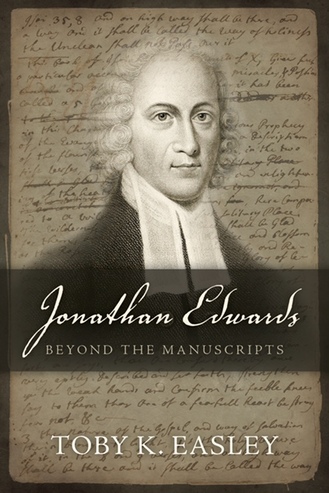
Book Review – “Jonathan Edwards: Beyond the Manuscripts,” by Toby K. Easley

You have probably already heard something of Jonathan Edwards’s reputation as a preacher. It has been said that Edwards was a drab manuscript reader who held his notes just a few inches from his face. It has been said that when he did look up occasionally from his ink-quill notes, the famed Puritan held his gaze unflinchingly, fixed upon the bell rope, dangling helplessly near the back of the plain-style church.

You may have even gone on to actually read many of Edwards’s long-form sermon manuscripts, and wondered whether you wouldn’t have been bored nearly to death yourself listening in the Northampton Church for hours upon end! And yet somehow this man was used as a spark in one of the greatest revivals in the history of our young nation, in the Great Awakening (1740-1742).

So, how do we reconcile the fact that Edwards has a reputation as a mere dissertation reciter (apparently bringing no more panache and flare into the pulpit than a court-stenographer), with the fact that Edwards is also the famed fire-and-brimstone herald of Sinners in the Hands of an Angry God, which shook its hearers to the ground in Enfield Connecticut?

This is the challenge that Dr. Toby K. Easley (D.Min, Southwestern Baptist Theological Seminary) tackles in his new book Jonathan Edwards: Beyond the Manuscripts.  Simply stated, Dr. Easley  seeks to discover whether Jonathan Edwards ever progressed as a preacher. Did he get better as he aged? Could he ever put away the notes? Did he ever go “off script”? Could he ever set aside his well-prepared treatises and simply let fly from the sacred desk?

In other words, did Edwards ever go “beyond the manuscripts?”

438583

In this exceptionally well-written work, Easley argues that, yes, Edwards did progress as a preacher. He did learn new ways to articulate his well-formulated and richly ornate sermons. Throughout this work, Easley traces the personal development of Jonathan Edwards as a preacher and homiletician. To do so, Easley monitors closely three factors: (1) First Edwards’s personal biography. Dr. Easley guides us through the chronological events which shaped Edwards as a preachers. (2) Second, Easley interacts with some of the sermons themselves as pieces of oratory and rhetoric, examining and comparing their content. (3) Third – and this is what makes the book relentlessly fascinating – Easley personally combed through many of the sermon manuscript notebooks themselves, looking for clues as to how Edwards progressed (or stagnated?) as a preacher and orator. To do so, Easley ventured to Yale’s Beinecke Library to study them firsthand. In fact, as readers will see, Easley identifies five stages through which Edwards progressed as a pulpiteer.

The following are the handful of stages (in this reviewer’s own words) which Dr. Easley identifies in Jonathan Edwards as a developing preacher. Many readers will find that they too have tread some of the same ground ourselves over the years.

1. The Listener. Edwards began his preaching career far before he ever wrote a sermon or entered a pulpit. Most preachers do. He began as a sermon hearer. As the son of another Puritan divine of note, Timothy Edwards, and the grandson of the famed preacher Solomon Stoddard (who by the way, eschewed notes and advocated for impassioned and informed extemporaneous sermons), young Jonathan learned what a sermon ought to sound like far before he ever preached one. His own father’s methodology probably influenced his work from an early age, and Edwards’s penchant for accuracy, depth, and clarity likely bound him to well-structured written forms from early on.

2. The Manuscript Addict. In his earliest stages of sermon manuscripting, Edwards wrote his thoughts out in the fullest possible way. This would prove to become a difficult, but not impossible, habit for Edwards to break. He clearly preferred thinking his thoughts out in long form before entering the pulpit to address God’s people in the church. His other writings such as his Miscellanies bear this truth out. He thought pen in hand, and couldn’t help it. His early stages of preaching in New York, Bolton, and Northampton show sermons that most closely resemble written treatises: full, precise, and well-ordered. Early on, Edwards began with the standard Puritan sermon order of Text, Doctrine, and Application (Use), and would hardly deviate from this for the rest of his life. This stage of full manuscripting would continue, for the most part, throughout the 1720’s and 1730’s.

3. The Experimenter.  As Edwards further progressed in his career, he began using some modifications to the full-manuscript form. This may have been motivated by his desire to excel in the areas that his grandfather Stoddard had excelled, namely in delivery, and it may also have been encouraged by the shortage of paper, which Edwards consumed ravenously for all of his writing projects. He began using some abbreviations, and even symbols to convey words and even fuller thoughts. For instance, he uses a circle with a dot in the middle to represent “the world.” Or an X for Christ, or a concept related to Christology.

We should be very clear here: Edwards never did fully throw away the full-manuscript format, even as he sought to make his manuscripts more “user friendly” for delivery. Arched, horizontal lines across the duodecimal sized handmade notebooks, often served as visual cues, marking major sections. Some words were printed in all capitals to stand out and help summarize entire paragraphs while preaching. These flourishes were helpful for those moments when the preacher utilizes extempore expressions, and then returns to his notes to recover his bearing. Sermons for funerals or public occasions (preaching for the Boston clergy, for instance) continued to be written out in full hand however.

4. The Whitefield Admirer: A major leap seems to have happened in Edwards’s thinking about homiletics when George Whitefield came to town. In Whitefield, Edwards saw firsthand just how powerful oratory can be, when the preacher does not use prepared notes, but instead delivers the sermon from memory. Eye contact, easy of expression, natural speech – all seemed more powerful from Whitefield’s noteless exhortations. From this point on, Edwards appears to have been convicted to some degree about the deficiencies of his own preaching, perhaps hearing the now-gone voice of his Grandfather Stoddard echoing in his mind as well. Though he could not quite fully ditch the manuscripts, this period after 1740 begins to show evidence that Edwards tried harder and harder to make his notes briefer and more portable for pulpit delivery. Sinners in the Hands of an Angry God, for instance exists in two extant forms: one which is written in full, and another which exists in a bare minimal outline form.

5. The Mature Orator: The final stage of development took place, according to Dr. Easley, after Edwards left Northampton and began preaching to the Indians at Stockbridge. Here, he had to balance two different congregations; one English speaking and the other a Native American congregation through an interpreter. In this stage, Edwards re-preached prior sermons, and simplified many others as he worked on his major works such as Freedom of the Will. Commonly, he dropped technical terms and adopted illustrations from nature, hunting, and the broader human experience. The very nature of these congregations almost forced Edwards to learn new ways to communicate besides his well-tailored manuscript recitations.

If I might interject my own thoughts at this point – I wonder what would have happened if Edwards had gone to Stockbridge before Northampton? If he had learned to preach the simpler before the more complex? Would his time with the Mahicans have enabled him to speak more comfortably to his Colonial audience as he developed greater confidence in a more natural or free-speaking manner? We can only guess. God’s sovereignty ordered Edwards’s life as it has unfolded in our history books, and Stockbridge would be the conclusion to his career rather than the beginning.

Interestingly, Easley tells us the story of the time that Edwards – close to the time of his death – lectured for the students at Princeton holding them spellbound for nearly two hours. According to eyewitnesses, the time passed as if it was but a few moments. Edwards was riveting. As the eager young students consumed Edwards’s rich teaching, we can only wonder what it would have been like to see and hear Jonathan Edwards in his “prime,” confident, mature, and completely competent; having learned to preach in various settings with masterly control. Sadly, there are no recordings of Edwards, and we have only the eyewitness accounts and the manuscripts to help us. History tells us that Edwards died only a few weeks into his tenure as college president.

Overall, Jonathan Edwards: Beyond the Manuscripts is excellent.

Throughout, it contains applications for modern preachers learning our sacred art of exhortation. Dr. Easley gives many and varied suggestions for his pulpiteering readers, and one just may find some notable similarities between Edwards’s preaching journey and his own. To find one fault in this work, I could wonder why more pictures where not included of the manuscripts themselves. Easley describes them capably enough, but I often found myself asking, “I wonder what that manuscript looked like!” Only two pictures of the manuscripts themselves are included in the back, and I would have liked to see firsthand what some of Edwards’s sermons looked like, particularly in his outlining periods. But this is only a minor critique, and the book certainly excels this one flaw.

Perhaps many of us too, would do well to consider Jonathan Edwards’s journey as we press on to go “beyond the manuscripts.”

Interview with Dr. Jeffrey Waddington

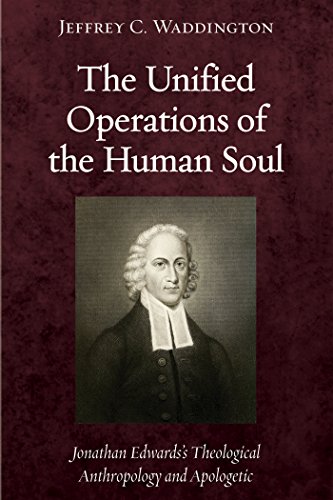
Edwards Studies is pleased to be talking today with Dr. Jeffrey Waddington, a voice that you may find familiar from his excellent work on the Reformed Forum. Besides being a frequent contributor on the podcast East of Eden, Dr. Waddington is an ordained minister in the OPC and an occasional contributor to Reformation 21. He is also the author of The Unified Operations of the Human Soul: Jonathan Edwards’s Theological Anthropology and Apologetic. 

Pleased to have you Jeff!

Brother, I am thrilled to be able to spend time with you today. I was looking around your EdwardsStudies.com site and am quite impressed with the architecture and interior design of the place. Excuse me while I take a swig of my piping hot blondie coffee! You have outdone yourself in bringing together a multimedia extravaganza of Edwards articles, videos, and reviews. I am overwhelmed. It warms the cockles of my heart!

jeff-recording-ctc-photo

We will talk about your book in just a few moments, but tell us what is going on with the Reformed Forum lately? Are there big plans for the East of Eden show? There have only been a couple in 2015 and just one in 2016. What gives?

The Reformed Forum board recently met over the net (and though I was absent) and the big topic of discussion is our upcoming third annual theology conference at Greyslake, IL in October. We have thoroughly enjoyed the first two conferences and look forward the teaching and the interaction with the folks who come from all over the US and Canada. As for East of Eden the slackened pace of getting this podcast out is simply a matter of logistics for the three of us involved: Nick Batzig from the Savannah area, David Filson from Nashville, and myself from the greater Philadelphia area. We love doing the podcast and hope to get back into a regular routine. Please pray that the Lord would grant us schedules that mesh and the energy to tend to our pastoral charges and do the podcast and all the other writing we do. Thanks for asking about the forum and the Edwards podcast.

How did you get into Jonathan Edwards? Was it through John Piper like the majority of us, or through your English Literature class like a few others of us around here?

Years ago as a Salvation Army officer (Wesleyan-Arminian pastor) I picked up a copy of Iain Murray’s bio on Edwards but did not read it until I came into the Reformed community through a PCA congregation in Ithaca, NY. I actually had read a fair bit of John Piper and loved him. But I did not act on his hints sprinkled throughout his various books and articles. And I did read Edwards in my tenth grade English class back in 1980 but I was not a believer at the time. I remember reading “Sinners in the Hands of an Angry God” and not being bothered by it at all. It was the plain gospel truth. Of course, as you know, Matthew, Edwards could rhapsodize just as lyrically on the joys of heaven as a world of love. Anyway, where was I? Oh yeah. I came into the Reformed community and purchased the two volume Banner of Truth edition of The Works of Edwards and began reading a little at a time. When I came to the Philly area to study at Westminster Seminary I purchased Piper’s delightful annotated edition of Edwards’s The End of Creation and fell in love with the aesthetic on display in the very way Edwards wrote The End. After that I took an independent study with Sam Logan, then president of Westminster and thoroughly enjoyed myself. That course was based on the taped lectures of John Gerstner on Edwards. Gerstner was just brilliant. Now as you know I have my differences with Gerstner, which are not inconsiderable, but in this series (which I would love to see on CD or MP3) he just shines. While I entered the PhD program at Westminster intent on doing something with Abraham Kuyper’s common grace doctrine, Sam Logan convinced me to work on something to do with Edwards. So I eventually took the PhD seminar on Edwards that Sang Lee offered at Princeton Theological Seminary. I took that course in 2003, just after his volume in the Yale edition of Edwards’s Works had been published. It was delight to learn from Lee, with whom I differ as well. He was gracious and an enjoyable professor. I had the privilege and pleasure of helping him edit the Princeton Companion on Jonathan Edwards. It took me a very long time to complete my PhD but I finally did under the supervision of William Edgar at Westminster. Edgar is a brilliant apologist interested in all things cultural. He was knowledgeable and encouraging.

Your 2015 book is entitled The Unified Operations of the Human Soul: Jonathan Edwards’s Theological Anthropology and Apologetic. Break that down for us – first the title, then the subtitle. What are you doing here?

51tfzgnar8l

The book is slightly revised version of my Westminster dissertation (very slightly revised!) for which I was awarded a PhD in 2013. I am challenging John Gerstner’s contention that Edwards was an exemplar of the classical method of apologetics. The heart of my argument is that Edwards rejected the hierarchical faculty psychology of the day (for instance as advocated by “Old Brick” Charles Chauncey, Edwards’s Boston nemesis). Faculty psychology at its worst thinks of the human soul as made up of three little agents called will, intellect, and emotions (or in Edwards’s case, just intellect and will). Edwards, I would argue, advocates the standard Reformed and Puritan notion of the convergence of the distinct yet inseparable powers or capacities or capabilities of the human soul. It is one person who wills, thinks, or feels. So the expression “unified operations of the human soul” simply tries to capture that facet of Edwards’s thinking that is capsulized in his notion of the new sense. The new sense or spiritual understanding involves the whole person or whole soul. Someone can understand to a certain extent the truth of the Christian faith without embracing it or being wowed by it. I was that way for many years. I am a preacher’s brat and a preacher myself. But I did not come to faith in Christ until I was 18 years old. Again this is somewhat standard Reformed anthropology (er…, doctrine of man). The new sense is at the heart of Edwards’s apologetic. He knew his intellectual endeavors defending the Christian faith against Enlightenment thinking would not bring a person to Christ without the Holy Spirit working a new heart in him or her. We might say with good reason that the true religious affections were the heart of Edwards’s apologetic. Affections are not to be equated with the emotions. I would argue, as others have as well, that affections are thoughtful volitions or we might say clear-headed thoughts that stir the will and emotions. Affections therefore have a volitional, emotive, and intellectual component. The subtitle is all about how Edwards’s understanding of man interacted with his view of the apologetic task. The heart of the book is the chapter on the relation of the intellect and will and how they must work together in regeneration to bring about true saving faith. The defense of the faith (the apologetic task) involves, to use the language of the Westminster assembly divines, the enlightenment of the mind and the renewal of the will. In that chapter I challenge Gerstner’s notion of the indirect effects of sin on the human mind. I interact with Alvin Plantinga’s use of Edwards on this topic in his justly famous Warranted Christian Belief to get at the problem. So in the end I argue that Edwards was an eclectic apologist who reflects his educational background and era and so draws from various philosophical streams that can assist him in making a biblical case for whatever doctrine Edwards is seeking to defend. The esteemed church historian Doug Sweeney kindly reviewed the book on the Jonathan Edwards Center at TEDS website. Where I might challenge Dr. Sweeney, who is gracious as the day is long, is his suggesting I was trying to make Edwards look like a presuppositional apologist. I am a presuppositionalist myself, or better, a covenantal apologetics guy. And I did argue that Edwards resembles Cornelius Van Til at times. I would still argue that. But Edwards insofar as Edwards was Reformed and his defense of the Christian faith reflected that, that far he looks like Van Til. Don’t worry if you don’t know who Van Til is. That may be a conversation for another time. I would be happy to fill your readers in on that score.

If you would, talk briefly about how Edwards saw humanity under this classic fourfold rubric: how man was created, fallen, redeemed, and consumated? Help us understand how these “states” work together. 

Edwards read his Bible but he also read the Scottish Presbyterian Thomas Boston’s Human Nature in its Fourfold State in which Boston unpacks the movement of man as created good and holy, the fall of man into sin and misery, his restoration plus in redemption, and the summing up of redemption in the consummate state when all the saints and angels gather together to live with the Triune God in the new heavens and new earth. Man’s thinking capacities reflect his spiritual condition in each state. The only way to transition from the fallen state to a redeemed state is if the Father draws the unbeliever, with the Holy Spirit working in the heart of the unbeliever so that they freely embrace Jesus Christ by faith, repenting of his or her sin and pursuing holiness. Edwards followed this basic Reformed understanding of how a sinner becomes a saint.

How does this fit together with the Imago Dei (the image of God) in man? Did Edwards see this as a key component in man’s identity? 

The image of God is a big deal for Edwards and figures prominently in his defense of the doctrine of original sin. Adam and Eve were created in righteousness, holiness, and knowledge. In other words, they were not created neutral. Edwards follows the standard view that the image has a broader and narrower reference. The broad reference is to our ability to think, communicate, relate. I would call these the preconditions for exercising the image in the narrower reference. The narrow reference refers to our holiness, righteousness, and knowledge. Adam and Eve possessed the image in both senses at creation and for some time thereafter. In the fall, we lost the image in its narrow sense but retained, in a twisted and defaced manner, the broad image. Redemption restores the lost narrow image and in fact goes beyond mere restoration. Yes, this was a key component of Edwards’s understanding of who and what man is.

You have used the word “analog” in your writings. Is that an Edwardsian phrase? How does he view man as an analog of God, and what does that say about God’s nature and attributes? 

The question closely follows on the last and overlaps with it a bit. When I say that man is an analog (or analogue for you dictionary geeks out there) of God, I am talking about how we were created to reflect God in our very being and beliefs and behavior. This is not Edwards’s language although I do think it reflects his theology. I guess I could say that the word analog images the reality Edwards is getting at when he talks about the way that man resembles God his maker. Edwards understood that God is Creator and man is creature but he also saw that we are called to hunger and thirst after righteousness. We are to be holy. And with the coming of the Son in the flesh, we are to be conformed to the image of the Son (an image of the Image, we might say) Jesus Christ. God, Edwards tells us, has an intellect and will (this enters into Edwards’s discussion of the Trinity, but that is a discussion for another day too) and so do we. Our intellect and will worked harmoniously in the garden but the fall brought a disruption to that harmony. Redemption restores it. And we spend the whole of our Christian life growing into greater and greater conformity to God so that we once again image forth in our own lives the Son of God Jesus Christ (as argued, for instance, in Eph. 4:24 and Col. 3:10). Edwards talks about this throughout his sermons and in the treatise on The End of Creation and the Religious Affections, etc.

Let’s tie in the “apologetics” aspect here. Give us a brief rundown of how Edwards goes about defending these constructions against the pressing threats he perceived in his own day.

Edwards did not pen an apologetics handbook or manual. If he had it would have made my life easier. Maybe! We have to glean his understanding of how to defend the Christian faith from his actual defense. Edwards attacks his opponents head on. But I would argue he does it graciously but with surgical precision. In Original Sin Edwards goes after the notion that Adam and Eve were created neutral and that we sin merely by imitation of bad examples. he deconstructs the idea that death is a blessing and affirms a Reformed notion of the imputation of Adam’s sin to us (albeit with his own creative touches). In Freedom of the Will Edwards defends the compatabilist notion that God’s sovereignty and human responsibility coexist when properly understood. Edwards’s target is libertarian free will. Edwards’s rejection of faculty psychology is on full display here. Edwards reduces the idea of libertarian free will (that we have the ability to choose A or B from a state of complete equilibrium under no influence of prior motives). Take a look at Edwards’s sermons and semi-private notebooks and you will see how he reacts to deism and other challenges to the Christian faith. Edwards affirms common grace (that the Holy Spirit is active in the world mitigating the worst effects of sin and allowing for human flourishing to occur and for the gospel to be spread and for sinners to become saints and come into the church) and he affirms natural or general revelation. This is God’s revelation of himself in creation (including us human creatures). Edwards also affirmed something called the “prisca theologica” or primitive theology. This is the idea that the human race has passed along accounts of revelation from Adam to Noah to Abraham to whoever and that this accounts for some similarities between different religions and is a form of special revelation and general revelation. This primitive theology cannot save since it is twisted and perverted as it gets past down from generation to generation. But it means, among other things, that no one is free from exposure to God’s revelation in nature, primitive theology, and Scripture (special revelation). Edwards was an acute and effective apologist. I do not happen to think he was perfect. I think we have made progress since his day and would not want to go back to his day. But he is not afraid to use sanctified reason and Scripture in his defense of the faith and that is a good thing.

Do you have more research to do in this area or do you have any plans for future projects along these lines?

I am interested in everything (well, almost) theological (and philosophical, political, military, and historical, etc) and so my work extends well beyond Edwards. In that regard I suppose I am like Edwards himself. However, I try to keep abreast of the latest developments in Edwards scholarship and always am reading something by or about Edwards. As Piper would say, Edwards is one of my constant companions and conversation partners. I am looking on doing something where I compare Edwards on the unified operations and the work of the 19th and 20th century Dutch Reformed biblical theologian Geerhardus Vos on the soul. I once noted on Facebook that Vos wrote in four pages in his newly translated Reformed Dogmatics on the soul what i tried to say about Edwards in my dissertation in more than 200 pages. Ugh!! I would also like to do work on Edwards the exegete. Perhaps I may revisit the question of how much influence John Locke had on Edwards. I am one who does not think it was as radical as others have thought. Feel free to make recommendations brother!

How about some shout outs and recommendations for our readers. 

Marsden’s  Life is the best biography on Edwards. It is well written and makes Edwards understandable in terms of his own age. Murray’s bio is still worth reading. I think Stephen Nichols’s Jonathan Edwards: A Guided Tour of His Life and Thought is a wonderful intro to the life and thought of Edwards. McDermott and McClymond’s Theology of Jonathan Edwards is encyclopedic, but I have many major reservations about the book (and not just because they critique me in a few footnotes!). Craig Biehl’s Infinite Merit is a magisterial treatment of Edwards’s understanding of justification within the broader spread of God’s purposes in Christ and his unchanging rule of righteousness. This website has to be must read as well. Check out reformedforum.org for articles and podcasts related to Edwards and Reformed theology in general. Various websites connected with the Alliance of Confessing Evangelicals (reformation21 and Place for Truth, for instance) are worth checking out. I also frequent the Desiring God site and love various Piper books. I also recommend checking out the Gospel Coalition site as well. This is not to say I agree with everything these sites or authors say. But they are worthwhile. There are many others.

Thank you so much for chiming in Jeff! Hope you will write an article or so for us here at Edwards Studies, can we count on that from you sometime brother? 

Absolutely. Let me have some recommendations and I will run with them.